Category Archives: mechanics

Seeing the invisible

Track of the Brownian motion of a 50 nanometre diameter particle

Track of the Brownian motion of a 50 nanometre diameter particle in a fluid.

Nanoparticles are being used in a myriad of applications including sunscreen creams, sports equipment and even to study the stickiness of snot!  By definition, nanoparticles should have one dimension less than 100 nanometres, which is one thousandth of the thickness of a human hair.  Some nanoparticles are toxic to humans and so scientists are studying the interaction of nanoparticles with human cells.  However, a spherical nanoparticle is smaller than the wavelength length of visible light and so is invisible in a conventional optical microscope used by biologists.  We can view nanoparticles using a scanning electron microscope but the electron beam damages living cells so this is not a good solution.  An alternative is to adjust an optical microscope so that the nanoparticles produce caustics [see post entitled ‘Caustics’ on October 15th, 2014] many times the size of the particle.  These ‘adjustments’ involve closing an aperture to produce a pin-hole source of illumination and introducing a filter that only allows through a narrow band of light wavelengths.  An optical microscope adjusted in this way is called a ‘nanoscope’ and with the addition of a small oscillator on the microscope objective lens can be used to track nanoparticles using the technique described in last week’s post entitled ‘Holes in liquid‘.

The smallest particles that we have managed to observe using this technique were gold particles of diameter 3 nanometres , or about 1o atoms in diameter dispersed in a liquid.
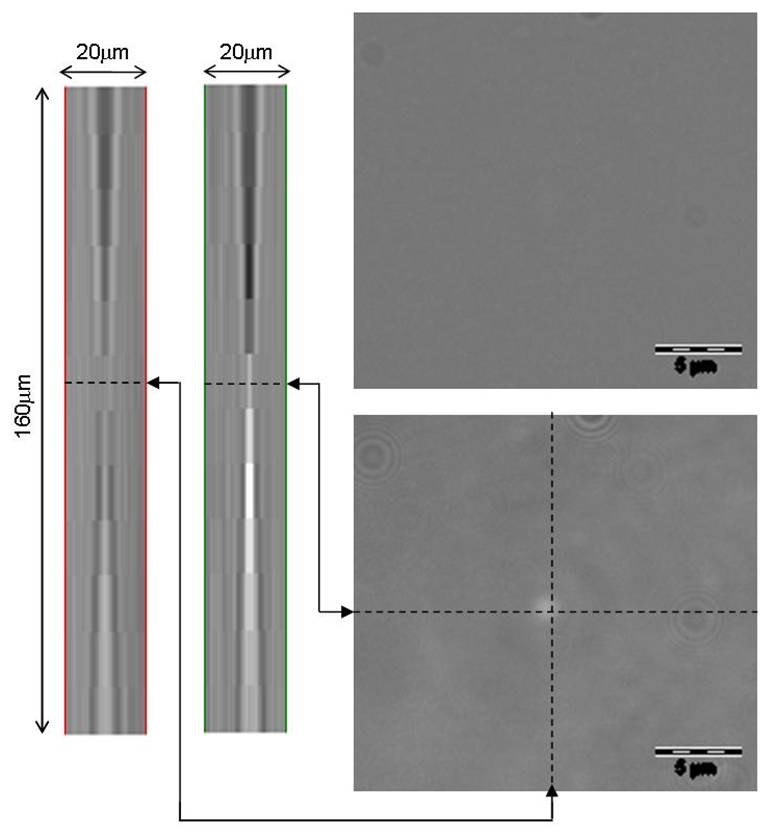
 

Image of 3nm diameter gold particle in a conventional optical microscope (top right), in a nanoscope (bottom right) and composite images in the z-direction of the caustic formed in the nanoscope (left).

Image of 3nm diameter gold particle in a conventional optical microscope (top right), in a nanoscope (bottom right) and composite images in the z-direction of the caustic formed in the nanoscope (left).

Sources:

http://ihcp.jrc.ec.europa.eu/our_activities/nanotechnology/jrc-scientists-develop-a-technique-for-automated-three-dimensional-nanoparticle-tracking-using-a-conventional-microscope

‘Scientists use gold nanoparticles to study the stickiness of snot’ by Rachel Feldman in the Washington Post on October 9th, 2014.

J.-M. Gineste, P. Macko, E.A. Patterson, & M.P. Whelan, Three-dimensional automated nanoparticle tracking using Mie scattering in an optical microscope, Journal of Microscopy, Vol. 243, Pt 2 2011, pp. 172–178

Patterson, E.A., & Whelan, M.P., Optical signatures of small nanoparticles in a conventional microscope, Small, 4(10): 1703-1706, 2008.

Caustics

caustic_hole

White light caustic of 4mm diameter hole in 6mm (PMMA) plate subject to 3kN tension

As children many of us have burnt a hole (yes, tenuous link to last week’s post on ‘Holes’) in a piece of paper by focussing the sun’s rays with a magnifying glass. If you move the glass up or down and tilt it slightly then the sun’s rays will not be focussed on a spot and instead you see a complex spiralling pattern of light. This pattern is caused by the rays being bent by their passage through different sections of the curved glass. The same type of pattern, known as a caustic, appears on the bottom of your bath when you let (clean) water run out down the plug-hole if you have spotlights above the bath. This caustic is produced by the light rays from the spotlight being bent by varying degrees depending on where they pass through the vortex formed by the water spinning down the hole.  Caustics can also be produced when light passes through a glass of water or on the bottom of an outdoor swimming pool in bright sunlight.

The top picture shows the caustic formed by light passing through a transparent plate with a hole when the plate is stretched in the vertical direction. The load in the plate has to flow around the hole where it ‘bunches up’ or concentrates (see last week’s post entitled ‘Holes’) which causes high levels of local deformation with the plate thinning non-linearly at the intersection of the hole circumference and horizontal diameter. When the light passes through the deformed region it is deviated by amount dependent on the local thinning and forms the pattern shown.

This is not a totally abstract phenomenon because the same mechanism of thinning occurs at the tip of cracks as a result of the very high stress concentration at the sharp crack tip, as shown schematically in the diagram below. So we can evaluate the stress concentration by measuring the caustic it generates; it is even possible to predict in which direction the crack will grow next.

Schematic diagram of transparent plate with a crack loaded vertically in tension (left), light ray tracings through the cracked region (centre) and caustic formed on a screen (right).

Schematic diagram of transparent plate with a crack loaded vertically in tension (left), light ray tracings through the cracked region (centre) and caustic formed on a screen (right).

For information:

Carazo-Alvarez, J.D., Patterson, E.A., 1999, ‘A general method for automated analysis of caustics’, Optics & Lasers in Engng., 32: 95-110.

http://lgg.epfl.ch/caustics/

Holes

Holes, little circular ones. There are billions of them in engineering machines and structures. There are more than a million in a jumbo jet alone. Some of them are filled with fasteners, such as bolts and rivets, others are empty to allow fluids to flow through a surface. Load passing through a structure has to flow around holes, especially when they are empty, and the contours of stress bunch up around a hole to form a stress concentration. For a small hole in a very large plate, the stress on the circumference of the hole is three times the level found in the absence of the hole. This concentration increases for bigger holes or smaller plates, so that holes are a potential source of failure – that’s why sheets of stamps are perforated with lines of holes.

A hole can also stop a failure. For instance a crack extending under repeated loading will often stop when it grows into a hole because the ‘sharpness’ of the crack tip is blunted by the roundness of the hole. Engineers sometimes deliberately drill a hole at a crack tip to arrest its progress. So, holes can be both an engineer’s friend and foe.

Engineering archaeology

Last week I spent a relaxing day painting the old railings in front of our house. Since I am not a painter and decorator by trade the end result is not perfect but they look much better in shiny black than two-tone rust and matt black.   One of the fleurs de lis on our railings had been knocked off when either we moved in or the previous occupiers moved out.  It’s a way of life being an engineer, so the shape of the failure surface on the broken railing was bugging me while I was painting the rest.  You would expect wrought iron railings to be ductile, i.e. to deform significantly prior to fracture, and to have a high tensile strength.  Wrought iron’s properties are derived from its very low carbon content (less than 0.25%) and the presence of fibrous slag impurities (typically about 2%), which almost make it a composite material.  It was historically used for railings and gates.  However, my broken railing had exhibited almost no deformation prior to fracture, i.e. it was a brittle failure, and the fleur de lis had broken in half on impact with the stone flags.  So on one of the rainy days last week, when I couldn’t paint outside, I did a little bit of historical research and discovered that in the late 1790s and early 1800s, which is when our house was built, cast iron started to be used for railings.  Cast iron has a high carbon content, typically 2 to 4%, and also contains silicon at between 1 and 3% by weight.  Cast iron is brittle, i.e. it shows almost no deformation prior to fracture, so the failure surface tends be to flat and smooth just like in my fleur de lis.

This seems like a nice interdisciplinary, if not everyday, engineering example.  It would be vandalism to go around breaking iron railings in front of old buildings.  So, if you want Everyday Engineering Examples of ductile and brittle behaviour, then visit a junk shop and buy an old china dinner plate and a set of cutlery.  The ceramic of the china plate is brittle and will fracture without deformation – have some fun and break one!  The stainless steel of the fork and spoon is ductile and can be easily bent, i.e. it is easy to introduce large deformation, in this case permanent or plastic deformation, prior to failure.  In fact you will probably have to bend the fork back and forth repeatedly before it will snap with each bending action introducing additional damage.

The more curious will be wondering why some materials are ductile and others brittle.  The answer is associated with their microstructures, which in turn is dependent on their constituents, as hinted above.  However, I am not going to venture into material science to explain the details.  I have probably already given materials scientists enough to complain about because my Everyday Engineering Examples are not directly analogous at the microstructural level to wrought iron and cast iron but they are more fun.

Sources: http://www3.westminster.gov.uk/spgs/publications/Railings.pdf