Tag Archives: writing

Reflecting on the future of RealizeEngineering

Decorative image of a flowerMy recent summer vacation [see ‘Entropy and junkies‘ on August 2nd, 2023] was a period of relaxation, recuperation and reflection.  One of my reflections was on the future of this blog.  It has become more of a commentary from an engineer than the ‘engineering commentary’ referred to in the tagline in its masthead.  Perhaps this was inevitable when I have been writing a weekly post for more than a decade, starting in January 2013 [see ‘500th post‘ on February 2nd, 2022]. There is an archive of almost six hundred posts available for you to browse, including about twenty written before I started weekly posting.  I have decided that I will aim to complete twelve years of weekly postings and then probably return to random postings in early 2025.  About five years ago, I wrote ‘Sometimes it is a joy to order my thoughts and commit some of them to writing; other times it is a chore and a challenge to dream up something vaguely interesting to tell you’ [see ‘Thinking more clearly by writing weekly‘ on May 2nd, 2018]. Recently, it has become more often a chore and less often a joy so I hope to temporarily redress the balance by creating an end-point without taking a precipitious decision to stop weekly posts now.

When less is more from describing digital twins to protoplasm

Word cluster diagramI spent several days last week reading drafts of PhD theses from two of my students.  I have three PhD students who are scheduled to finish their studies before Easter when they plan to start jobs that they have already been offered.  So, there is some urgency to their writing besides the usual desire to finish after three years or more of work on the same topic and the end of their funding.  Their relatively undiluted study of their topic can make it difficult for PhD students to see the big picture and write accessible descriptions of their research.  I have also encountered this challenge in describing our recent work on integrating digital twins to form an engineering metaverse.  There are dozens of published definitions of digital twins whereas the reverse holds for metaverses – no one really knows what they are.  Mary Midgley wrote, in her book ‘Beast and Man’, that descriptions should not be an account of everything about an entity or event but just enough to bring to our minds the appropriate conceptual scheme or construct that will tell us everything we need to know.  Our challenge as communicators is identifying the conceptual scheme that is needed, in other words selecting what matters and nothing else.  I like her example of an inappropriate description: “a section of protoplasm, measuring 1.76 meters vertically, emerged at 2:06 P.M. from hole in building at point x on plan and moved northward, its extremities landing alternately on concrete substratum, finally entering hole in further building, at point y on plan, at 2:09 P.M.”  If you need a conceptual scheme to understand this sentence, then try ‘a person walked across the road’.

Source: Mary Midgley, Beast and Man – the roots of human nature. Abingdon, Oxon. Routledge Classics, 2002.

Image: Cluster #1: simulation along product life cycle from Semeraro C, Lezoche M, Panetto H & Dassisti M, Digital twin paradigm: a systematic literature review, Computers in Industry, 130: 103469, 2021 who found thirty definitions of digital twins and created five such clusters of definitions.

In touch with another spirit

I have written before about the process of writing, both in general and in this blog in particular. While I do not claim to write literature; nevertheless I felt some empathy with a couple of statements in Michel Houllebecq‘s novel ‘Submission‘. The first was ‘…only literature can put you in touch with another human spirit, as a whole, with all its weaknesses and grandeurs, its limitations, its pettinesses, its obsessions, its beliefs; with whatever it finds moving, exciting or repugnant.’ And the second was ‘Even in our deepest most lasting friendships, we never speak as openly as when we face a blank page and address a reader we do not know.’ I know a few people who read this blog but they are a tiny minority of the readers so essentially I am addressing a reader I do not know when I write a post. However, my posts sometimes lead to a conversation that is more open than would have happened without the post. Inevitably, these conversations occur with the small number of readers with whom I am in direct contact. However, I suspect that I reveal my limitations and obsessions to all of my readers, I hope I avoid my pettinesses while enthusing you with what I find moving or exciting, such as Michel Houellebecq’s novel this week or Olga Tokarczuk’s last week.

Source: Michel Houellebecq, Submission, Vintage, 2016.

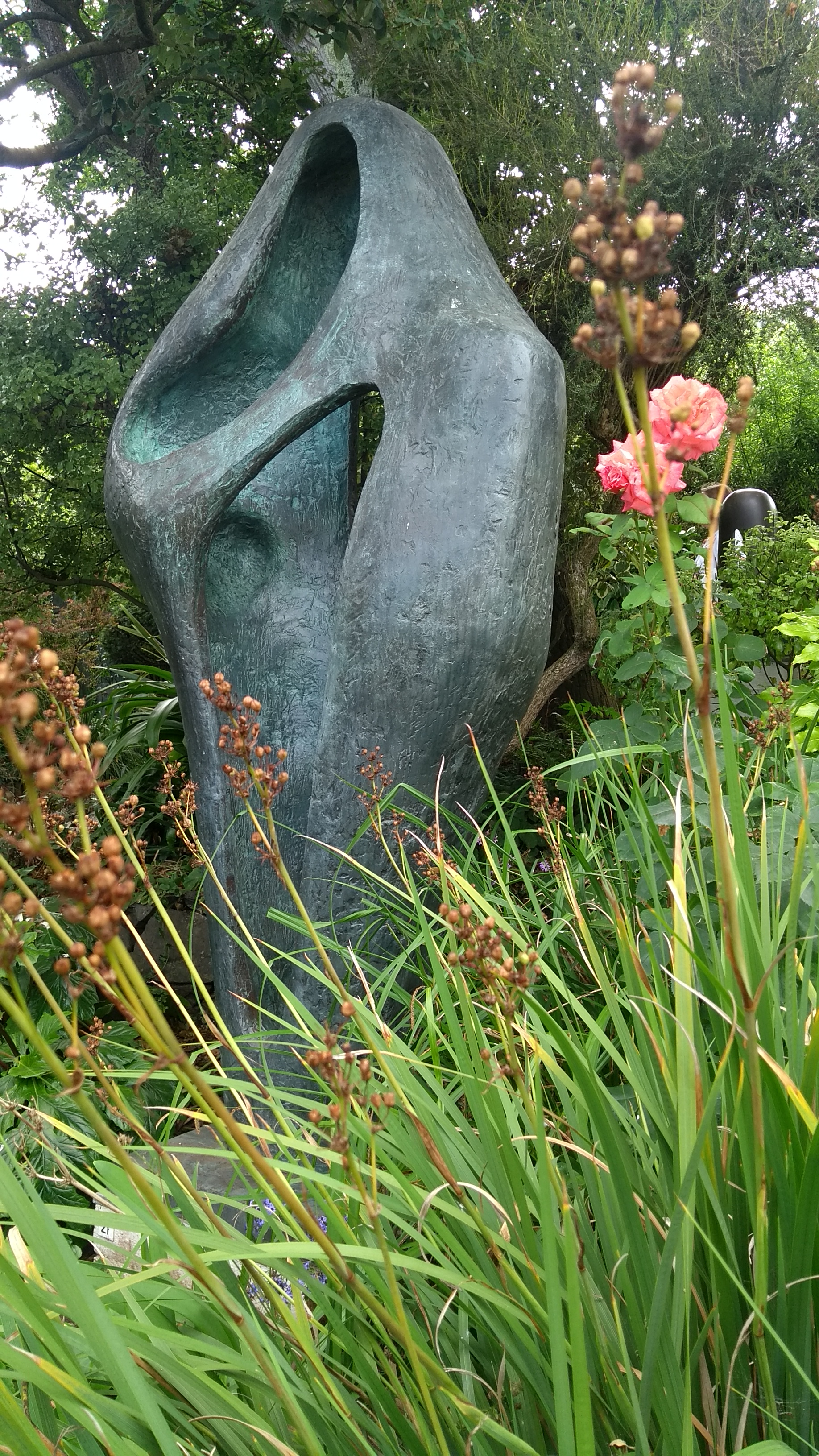
Image: Barbara Hepworth sculpture in the garden of Hepworth Museum, St Ives

You can only go there in your head

“Inner space and outer space are similar, aren’t they really?  You’re never going to get to the edge of the universe in a spaceship.  You might as well try going on a bus.  You can only go there in your head.”  This is a quote from David Hockney in ‘Spring Cannot Be Cancelled‘  by David Hockney and Martin Gayford.  It’s a beautiful book.  Full of thought-provoking insights and recent artwork by Hockney painted in Normandy mainly during the pandemic.  I read it last month while in the Yorkshire Dales [see ‘Walking the hills‘ on April 13th 2022].  Hockney writes about his need to paint.  He finds it utterly absorbing and endlessly sustaining.  Gayford compares this need and experience to the work of American psychologist, Mihaly Csiksczentmihalyi [see ‘Slow-motion multi-tasking leads to productive research‘ on September 19, 2018] who wrote about concentration so intense that there is no spare capacity to think about anything else, your self-consciousness disappears and you lose your sense of time leading to a deep sense of happiness and well-being.  I cannot paint but I can achieve something approaching a similiar state when I am writing.

Source:

Martin Gayford and David Hockney, Spring cannot be cancelled – David Hockney in Normandy, London: Thames & Hudson, 2021.