
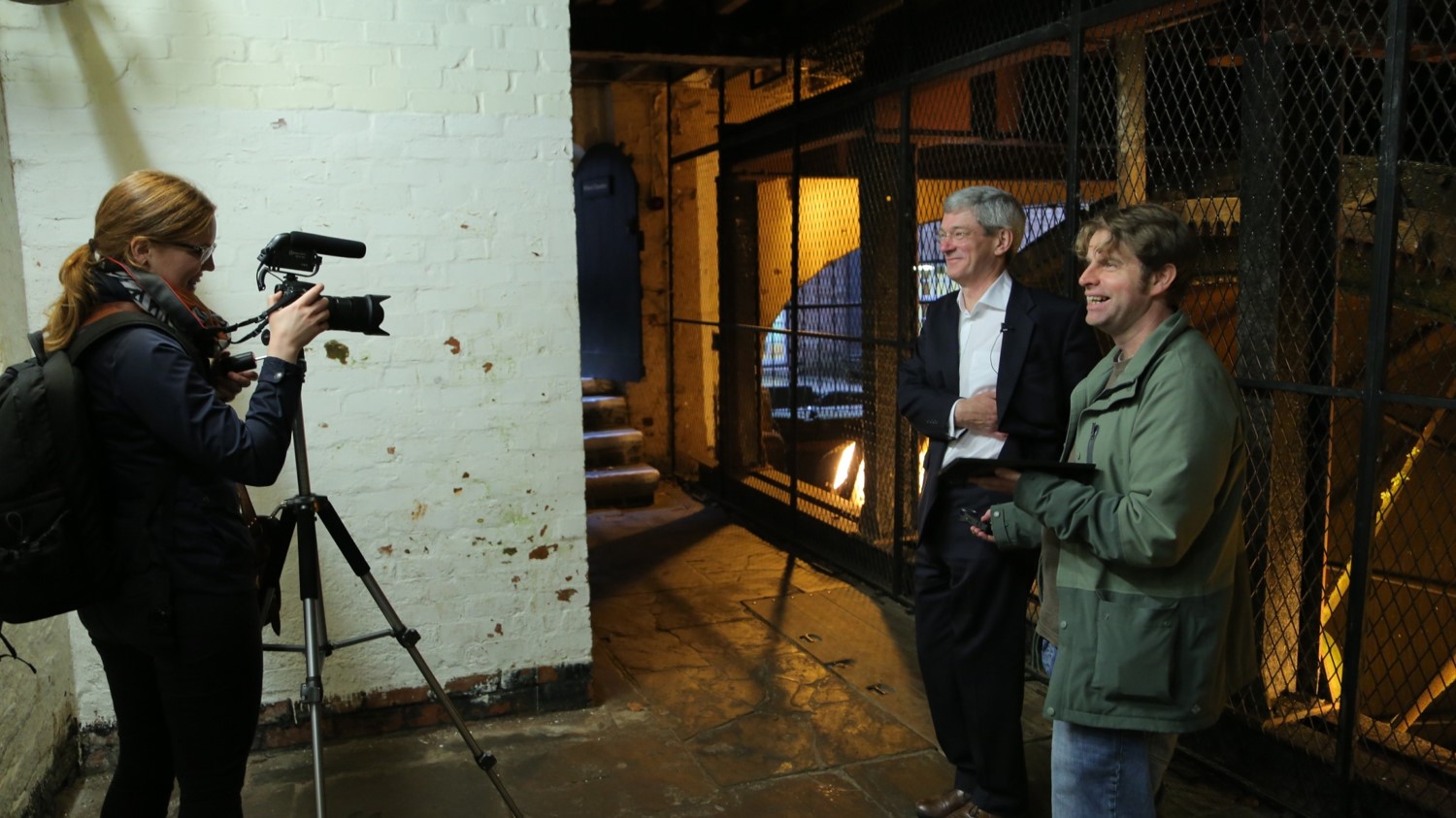
Filming for the MOOC Energy: Thermodynamics in Everyday Life
Last week’s post was stimulated by my realisation that I had made a mistake in a lecture [see ‘Amply sufficiency of solar energy?‘ on October 25th, 2017]. During the lecture, something triggered a doubt about a piece of information that I used in talking about the world as a thermodynamic system. It caused me to do some more research on the topic afterwards which led to the blog post. The students know this already, because I sent an email to them as the post was published. It was not an error that impacted on the fundamental understanding of the thermodynamic principles, which is fortunate because we are at a point in the course where students are struggling to understand and apply the principles to problems. This is a normal process from my perspective but rather challenging and uncomfortable for many students. They are developing creative problem-solving skills – becoming comfortable with the slow and uncertain process of creating representations and exploring the space of possible solutions [Martin & Schwartz, 2009 & 2014]. This takes extensive practice and most students want a quick fix: usually looking at a worked solution, which might induce the feeling that some thermodynamics has been understood but does nothing for problem-solving skills [see my post on ‘Meta-representational competence‘ on May 13th, 2015].
Engineers don’t like to be wrong [see my post on ‘Engineers are slow, error-prone‘ on April 29th, 2014]. The reliability of our solutions and designs is a critical ingredient in the social trust of engineering [Madhaven, 2016]. So, not getting it wrong is deeply embedded in the psyche of most engineers. It is difficult to persuade most engineers to appear in front of a camera because we worry, not just about not getting it wrong, but about telling the whole truth. The whole truth is often inconvenient for those that want to sensationalize issues for their own purposes, such as to sell news or gain votes, and this approach is anathema to many engineers. The truth is also often complicated and nuanced, which can render an engineer’s explanation cognitively less attractive than a simple myth, or in other words less interesting and boring. Unfortunately, people mainly pass on information that will cause an emotional response in the recipient, which is perhaps why engineering blogs are not as widely read as many others! [Lewandowsky et al 2012].
This week’s lecture was about energy flows, and heat transfer in particular; so, the following posts from the archive might be interest: ‘On the beach‘ on July 24th, 2013, ‘Noise transfer‘ on April 3rd, 2013, and ‘Stimulating students with caffeine‘ on December 17th, 2014
Sources:
Martin L & Schwartz DL, Prospective adaptation in the use of external representations, Cognition and Instruction, 27(4):370-400, 2009.
Martin L & Schwartz DL, A pragmatic perspective on visual representation and creative thinking, Visual Studies, 29(1):80-93, 2014.
Madhaven G, Think like an engineer, London: One World Publications, 2016.
Lewandowsky S, Ecker UKH, Seifert CM, Schwarz N & Cook J, Misinformation and its correction: continued influence and successful debiasing, Psychological Science in the Public Interest, 13(3):106-131, 2012.
 One impact of publishing a monthly post instead of the weekly one I used to produce [see ‘600th post and time for a change‘, on January 3rd 2024], is that I often starting writing without any memory of the recent posts. So, I have only just noticed that, ignoring the posts on technical topics, all my posts this year have been on the theme of what it means to be an individual [see ‘Is the autonomous individual ceasing to exist?’ on January 1st, ‘Its all in the mind’ on March 5th, and ‘Are we individuals?’ on April 2nd]. You might be led to believe that I am having a crisis of identity but you would be wrong. I think that this common theme arose subconsciously as result of the technological and political events that are reshaping society at the moment. We appear to be losing the capacity to recognise others as beings like ourselves, which is the basis of freedom and democracy. Without it we treat others as objects rather than individuals leading towards tyranny and the dissolution of trust and truth.
 Realize Engineering