Tag Archives: renewable energy

Fracking

The British Prime Minister, David Cameron has argued in an article in the Sunday Telegraph (on August 11th, 2013) that if we don’t back fracking technology then the country will miss an opportunity to help families with their bills and make the country more competitive.  In his article the Prime Minister only makes the economic case in favour of using fracking to extract shale gas.  He completely ignores the environmental costs of these economic gains, which will always be present as in any industrial process – the second law of thermodynamics tells us to expect these costs – a form of increased entropy.  The environmental costs of fracking are still disputed.  Companies and politicians with something to gain from its successful implementation argue that the costs are very low or insignificant.  However, recent research has concluded that more than 100 earthquakes were triggered in a single year in Ohio due to fracking-related activities (J. Geophysical Research: Solid Earth, doi.org/nh5).  The largest of these quakes was of magnitude 3.9 and was caused by pumping pressurised waste water into a deep well.  There are also concerns that waste water from fracking might contaminate groundwater.

A joint report of the Royal Society and the Royal Academy of Engineering has concluded that the fracking process can be successfully managed without significant risks to the environment or society.  However, in France fracking has been banned.  So, the arguments flow in both directions.  As a society we are addicted to energy, and fossil fuels in particular, and hence we need sources of oil and gas.  The risks involved in extracting shale gas by fracking are probably no greater than those associated with oil or natural gas; its just that they tend to occur closer to people’s backyard, which makes people more sensitive to them.  Actually, the technology has been around and used for a long time; see John Kemp’s column at Reuters for an explanation of the process and its history.  However, if we intend to use it on a larger scale then we need to guard against unexpected consequences and be ready to deal with the mess when things go wrong.  When engineers succeed in these two goals then no one will notice but when they fail the public and many politicians will be quick to attribute blame to them, whereas it likely will be our addiction to fossil fuel that is to blame.
Wind power

Winds are generated by uneven heating of the earth’s atmosphere by the sun, which causes hotter, less dense air to rise and more dense, colder air to be pulled into replace it.  Of course, land masses, water evaporation over oceans, and the rotation of the earth amongst other things added to the complexity of weather systems.  However, essentially weather systems are driven by natural convection, a form of heat or energy transfer, as I hinted in my recent post entitled ‘On the beach’ [24th July, 2013].

If you are thinking of building a wind turbine to extract some of the energy present in the wind, then you would be well-advised to conduct some surveys of the site to assess the potential power output.  The power output of a wind turbine [P] can be defined as a half of the product of the air density [d] multiplied by the area swept by the blades [A] multiplied by the cube of the velocity [v].  So the wind velocity dominates this relationship [P = ½dAv3] and it is important that a site survey assesses the wind velocity.  But the wind velocity is constantly changing so how can this be done meaningfully?

Engineers might tackle this problem by measuring the wind speed for ten minute intervals, or some other relatively short time period, and calculating the average speed for the period.  This process would be repeated over a long period of time, perhaps weeks or months and the results plotted as frequency distribution, i.e. the results would be assigned to ‘bins’ labelled for instance 0.0 to 1.9 m/s, 2.0 to 3.9 m/s, 4.0 to 5.9 m/s etc and then the number of results in each bin plotted to create a bar chart.  The number of results in a bin divided by the total number of results provides the probability that a measurement taken at any random moment would yield a wind speed that would be assigned to that bin.  Consequently, the mathematical function used to describe such a bar chart is called a probability density function.  Now returning to the original relationship, P = ½dAv3 and using the probability density function instead of the wind velocity yields a power density function that can be used to predict the annual output of the turbine taking account of the constantly changing wind velocity.

If you struggled with my very short explanation of probability density functions, then you might try the Khan Academy video on the topic found on Youtube at http://www.youtube.com/watch?v=Fvi9A_tEmXQ

Engineers use probability density functions to process information about lots of random or stochastic events such as forces ocean waves interacting with ships and oil-rigs, flutter in aircraft wings, the forces experienced by a car as its wheels bounce along a road or the motion of an artificial heart valve.  These are all activities for which the underlying mechanics are understood but there is an element of randomness in their behaviour, with respect to time, that means we cannot predict precisely what will be happening at an instant in time; and yet engineers are expected to achieve reliable performance in designs which will encounter stochastic events.  Frequency distributions and probability density functions are one popular approach used by engineers.  Traditionally engineers have studied applied mathematics that was equated to mechanics in high school but increasing they need to understand statistics.

Impossible perfection

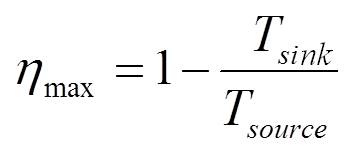
Carnot's equation for ideal efficiency of a cyclic device converting heat to work and operating between two temperatures specified on the Kelvin scale

Carnot’s equation for ideal efficiency of a cyclic device converting heat to work and operating between two temperatures specified on the Kelvin scale

In my last post [National efficiency on 29th May, 2013] I calculated the efficiency of the nationwide process of electricity generation in the UK [35.8%] and made no comment on the relatively low value.  It will be similarly in all industrialised countries as a consequence of the second law of thermodynamics and the requirement for all real processes to increase entropy.  A French engineer / scientist, Sadi Carnot [1796-1832] demonstrated from the second law, that the maximum efficiency achievable in ideal conditions by a process operating in a cycle to convert heat into work is a ratio of the temperatures of the heat source and cold sink to which excess heat is dumped.  In a power station the heat source might be a fossil-fuelled furnace, a nuclear reactor or a solar concentrator.  The cold sink is usually the environment, perhaps in the form of river or sea water.  So both source and sink temperatures are limited.  The sink by the local climate and the source by the temperatures that modern materials can withstand.

The very best efficiency based on Carnot’s expression for a maximum material temperature of 350 degrees Centigrade [=623 Kelvin] and environment temperature of 5 degrees Centigrade [278 Kelvin] is 55%.  Of course a real power station will never operate at this level because ideal conditions are not achievable – perfection is impossible.

The ideal efficiency improves as the operating temperatures of the heat source and sink are moved further apart and this quest to raise this temperature difference drives a substantial proportion of materials research.  However, even operating with a heat source at 800 degrees Centigrade, using expensive, high temperature alloys, such as Hastelloy N  [a nickel-chromium alloy], on a winter day in the Canadian capital, Ottawa where the average January daytime temperature is -7 degrees Centigrade, the Carnot efficiency of a power station would be only 75%  [=1-(266/1073)].

National efficiency

Thermodynamics, especially the first and second laws, are usually perceived as boring and perhaps mysterious by most people, including many engineers, as well as irrelevant by many non-engineers.  However, thermodynamics is fundamental to how engineers deliver products and services to society.  The name ‘thermodynamics’ does not help much, perhaps it would be better to call it ‘energy science’, since it is about energy transfers, conversions and flows.

The national energy flow charts mentioned in my post about ‘Energy Blending’ on 22 May 2013 illustrate nicely the first and second laws of thermodynamics (or energy science).  The underlying basis of the flowcharts is to treat the nation as a system and to account for the energy flows in and out across the system boundaries.  The first law, which is about conservation of energy, demands that the inflow and outflow balance one another, so for the UK and USA the annual inflows were 12.5 and 92 quintrillion joules respectively.  A quadtillion is a million million million or 1 with 18 zeros.

The second law demands that any real process involves an increase in entropy, which is a measure of energy dispersion, essentially lost or wasted energy, and this is also present in the flow charts.  In the centre of the UK chart is electricity generation or conversion with an input totally 82.4 Mtoe [millions tons oil equivalent], an output of 29.5 Mtoe and losses of 48.2 Mtoe, which are demanded by the second law of thermodynamics.  So the overall efficiency of electricity generation in the UK is 35.8% [=desired output/required input].

Footnote: the raw data for the UK and USA energy inflows were 299.2 Mtoe [millions tons oil equivalent] and 97 quadrillion Btu [British Thermal units] respectively which I converted into the SI unit for energy, the joule.  The links for the energy flow charts are:

UK Energy flow chart: http://www.gov.uk/government/uploads/system/uploads/attachment_data/file/65897/5939-energy-flow-chart-2011.pdf

USA Energy flow chart: http://www.eia.gov/totalenergy/data/annual/pdf/aer.pdf