Tag Archives: particles

Seeing the invisible

Track of the Brownian motion of a 50 nanometre diameter particle

Track of the Brownian motion of a 50 nanometre diameter particle in a fluid.

Nanoparticles are being used in a myriad of applications including sunscreen creams, sports equipment and even to study the stickiness of snot!  By definition, nanoparticles should have one dimension less than 100 nanometres, which is one thousandth of the thickness of a human hair.  Some nanoparticles are toxic to humans and so scientists are studying the interaction of nanoparticles with human cells.  However, a spherical nanoparticle is smaller than the wavelength length of visible light and so is invisible in a conventional optical microscope used by biologists.  We can view nanoparticles using a scanning electron microscope but the electron beam damages living cells so this is not a good solution.  An alternative is to adjust an optical microscope so that the nanoparticles produce caustics [see post entitled ‘Caustics’ on October 15th, 2014] many times the size of the particle.  These ‘adjustments’ involve closing an aperture to produce a pin-hole source of illumination and introducing a filter that only allows through a narrow band of light wavelengths.  An optical microscope adjusted in this way is called a ‘nanoscope’ and with the addition of a small oscillator on the microscope objective lens can be used to track nanoparticles using the technique described in last week’s post entitled ‘Holes in liquid‘.

The smallest particles that we have managed to observe using this technique were gold particles of diameter 3 nanometres , or about 1o atoms in diameter dispersed in a liquid.
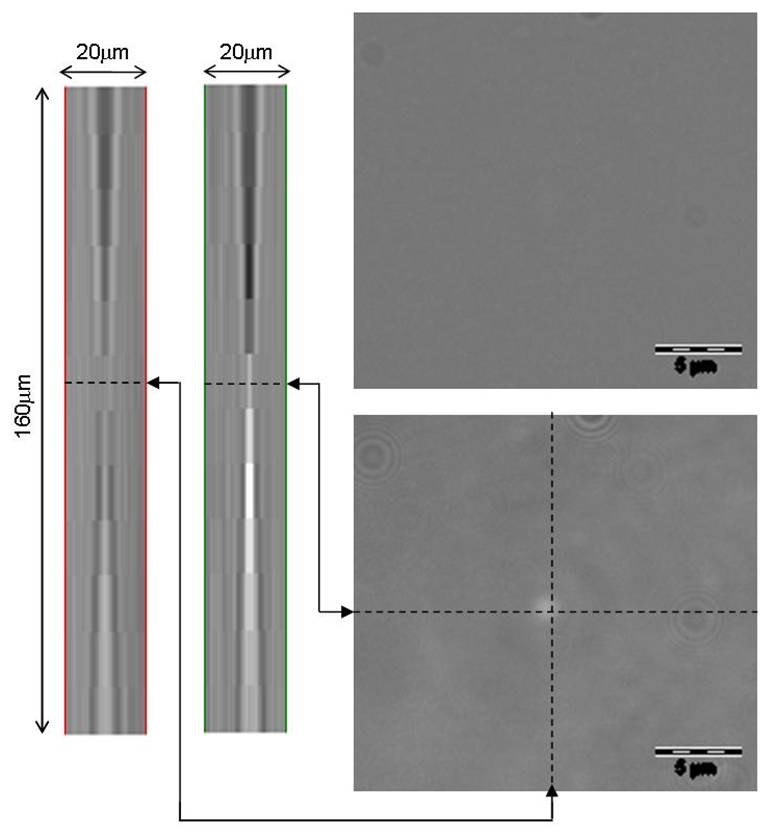
 

Image of 3nm diameter gold particle in a conventional optical microscope (top right), in a nanoscope (bottom right) and composite images in the z-direction of the caustic formed in the nanoscope (left).

Image of 3nm diameter gold particle in a conventional optical microscope (top right), in a nanoscope (bottom right) and composite images in the z-direction of the caustic formed in the nanoscope (left).

Sources:

http://ihcp.jrc.ec.europa.eu/our_activities/nanotechnology/jrc-scientists-develop-a-technique-for-automated-three-dimensional-nanoparticle-tracking-using-a-conventional-microscope

‘Scientists use gold nanoparticles to study the stickiness of snot’ by Rachel Feldman in the Washington Post on October 9th, 2014.

J.-M. Gineste, P. Macko, E.A. Patterson, & M.P. Whelan, Three-dimensional automated nanoparticle tracking using Mie scattering in an optical microscope, Journal of Microscopy, Vol. 243, Pt 2 2011, pp. 172–178

Patterson, E.A., & Whelan, M.P., Optical signatures of small nanoparticles in a conventional microscope, Small, 4(10): 1703-1706, 2008.

Holes in fluids

Out-of-focus image from optical microscope of 10 micron diameter polystrene spheres in water

Out-of-focus image from optical microscope of 10 micron diameter polystyrene spheres in water

The holes that I wrote about last week and the week before (post entitled ‘Holes‘ on October 8th)were essentially air-filled holes in a solid plate.  When an in-plane load is applied to the plate it deforms and its surface around the hole becomes curved due to the concentration of stress and light passing through the curved surfaces is deviated to form the caustic.  If you didn’t follow that quick recap on last week then you might want flip back to last week’s post before pressing on!

The reverse situation is a solid in a fluid.  It is difficult to induce stress in a fluid so instead we can use a three-dimensional hole, i.e. a sphere, to generate the curve surface for light to pass through and be deviated.  This is quite an easy experiment to do in an optical microscope with some polystyrene spheres floating in distilled water with the microscope slightly out of focus you get bright caustics.  And if you take a series of photographs (the x-y plane) with the microscope objective lens at different heights (z-value) it is possible to reconstruct the three-dimensional shape of the caustic by taking the intensity or greyscale values along the centre line of each image and using them all to create new image of the x-z and, or y-z plane, as shown in the picture.

Well done if you have got this far and are still with me!  I hope you can at least enjoy the pictures.  By the way the particle in the images is about the same diameter as a human hair.

Image in optical microscope of polystrene particle in water (left), series of images at different positions of microscope objective (centre) and artificial image created from greyscale data along centre-lines of image series (right).

Image in optical microscope of polystyrene particle in water (left), series of images at different positions of microscope objective (centre) and artificial image created from greyscale data along centre-lines of image series (right).

Source:

Patterson, E.A., & Whelan, M.P., Tracking nanoparticles in an optical microscope using caustics, Nanotechnology, 19(10): 105502, 2008.

Hot particles

diffraction pattern from nanoparticlesHave you ever wondered why people visiting the site of the Fukushima nuclear accident are only dressed up in coveralls and masks?  In my post on December 18th entitled ‘Hiding in the Basement’, I explained that gamma radiation requires a sheet of lead to stop it so the coveralls are clearly not protecting Fukushima visitors against radiation.

Our bodies cope with low levels of radiation everyday because we absorb about 0.024 Sieverts per year from the natural environment and the same amount is absorbed during a full-body scan in hospital.  One Sievert is equivalent to 1 Joule absorbed per kilogram of body mass. If you hold a tennis ball as high above your head as you can reach and let it fall to the ground, then the ball hits the ground with about 1 Joule of kinetic energy.  Your heart uses about 1 Joule of energy per beat.

The estimated maximum dose received by residents living close to Fukushima was 0.068 Sieverts or about three annual doses.  The visitors’ coveralls and mask are protecting them from ‘hot’ particles that are often produced during a nuclear accident. ‘Hot’ particles can be inhaled or ingested and continue to emit radiation when inside the body thus delivering a large concentrated dose to a relatively small number of surrounding cells, which are disrupted and destroyed by the high-levels of energy.  ‘Hot’ particles are small pieces of radioactive material and vary in size from tens of nanometres to a few millimetres, so that they don’t have high penetrating power and can be detected using a Geiger counter.

Hiding in the basement

us highwayWhen we lived in the USA, I remember seeing billboards along the Interstate with messages from FEMA telling us ‘Be Ready’, to prepare, to plan, and to stay informed.  I was never quite sure what we were meant to be ready for since we lived in rural Michigan where we were fortunate not to experience violent weather and to be far from industrial plants that might explode and shower us with chemicals or radiation.  The billboard advertised the FEMA website [www.ready.gov] which contains very little factual information about radiation but does imply you should seek shelter in the basement of tall buildings in the event of a nuclear accident. Some commentators have suggested that the psychological effects arising from fear of nuclear radiation can cause more health issues than the dosage received especially for those not in the immediate vicinity of an incident.  So, knowing more about radiation in advance of an incident would be helpful and might also dispel many of the fears that cause opposition to nuclear energy.

So, does sheltering in a basement offer reasonable protection?  Well, radiation is produced when radioactive materials decay and their atoms release protons and neutrons from their nucleus plus some of the electrons that orbit the nucleus.  The protons and neutrons cluster together to form alpha particles (actually Helium nucleii) that are relatively massive and can stopped by a sheet of paper.  The electrons, known as beta radiation, whizz out at high-speed but can be stopped by a thin sheet of Aluminium.  High-energy photons are also released with the electrons and are known as Gamma radiation, which requires a sheet of lead or a considerable thickness of concrete to stop them.

So sheltering in the basement is a good idea especially if the building above contains a substantial amount of concrete.

Sources:

http://www.ready.gov/nuclear-power-plants

David Ropeik, Fear vs. radiation: The mismatch, in the International New York Times, Tuesday October 22, 2013. http://www.nytimes.com/2013/10/22/opinion/fear-vs-radiation-the-mismatch.html?_r=0