Tag Archives: MOOC

Engaging learners on-line

Filming at Quarry Bank Mill

Filming at Quarry Bank Mill

The Everyday Engineering Examples page of this blog continue to be very popular.  More than 70 engineering schools in the USA have signed up to use this approach to teaching engineering science as part of the ENGAGE project.  The lesson plans on that page assist instructors to deliver traditional lectures that are engaging and effective.  Now, we have transferred the approach to online delivery in a MOOC that was designed to support undergraduate learning as well as to increase public engagement and understanding of engineering science.

The MOOC entitled ‘Energy: Thermodynamics in Everyday Life‘ was completed by more than 960 learners from about 35 countries who ranged in age from 13 to 78 years old with a correspondingly wide range of qualifications in terms of both subject and level.  I believe that this is the first MOOC to use Everyday Engineering Examples within a framework of the 5E lesson plans and it seems to have been effective because the completion rate was 50% higher than the average for FutureLearn MOOCs.

We also included some experiments for MOOC learners to do at home in their kitchen.  Disappointingly only a quarter of learners performed the experiments but surprisingly almost half of all learners(46%) reported that the experiments contributed to their understanding of the topics.  This might be because results and photos from the experiments were posted on a media wall by learners.  There was also a vibrant discussion throughout the five-week course with a comment posted every 8 minutes (or more than 6,500 comments in total).

More than half the undergraduates (53%) who followed the MOOC did not continue to attend the traditional lectures and roughly the same percentage agreed or agreed strongly that the MOOC could replace the traditional lecture course with only 11% disagreeing.  So maybe the answer to my question about death knell for lectures [see my post ‘Death Knell for the lecture?‘ on October 7th, 2015] is that I can hear the bell tolling.

I gave a Pecha Kucha 20×20 on these developments at an International Symposium on Inclusive Engineering Education in London last month, which is available as a short video.

No beginning or end

milkywayNASAIn the quantum theory of gravity, time becomes the fourth dimension to add to the three dimensions of space (x, y, z or length, width and height), and Stephen Hawking has suggested that we consider it analogous to a sphere. Developing this analogy, we imagine time to be like a flea running around on the surface of a ping-pong ball. A continuous journey, without a beginning or an end. The ‘big bang’, frequently discussed as the beginning of everything, and the ‘big crunch’, proposed by physicists as how things will end, would be the north and south poles of the sphere. The Universe would simply exist. The radius of circles of constant distance from the poles (what we might call lines of latitude) would represent the size of the Universe. Quantum theory also requires the existence of many possible time histories of which we inhabit one. Different lines of longitude can represent these histories.

If you are not already lost (the analogy does not include a useful compass) then physicists would give you a final spin by dropping in the concept of imaginary time! Maybe it is time for the flea to jump off the ping-pong ball, but before it does, we can appreciate that it might move in one direction and then retrace its steps (or its hops if you wish to be pedantic). The flea can travel backwards because in this concept of the Universe, time has the same properties as the other dimensions of length, height and width and so it has backwards as well as forwards directions.”

This is an extract from a book called ‘The Entropy Vector: Connecting Science and Business‘ that I wrote sometime ago with Bob Handscombe.  I have reproduced it here in response to questions from a number of learners in my current MOOC.  The questions were initially about whether the first law of thermodynamics has implications for the universe as a closed system (i.e. one that can exchange energy but not matter with its surroundings) or as an isolated system (i.e. one that can exchange neither energy not matter with its surroundings).  These questions revolve around our understanding of the universe, which I have taken to be everything in the time and space domain, and the first law implies that the energy content of the universe is constant.  The expansion of the universe implies that the average energy density of the universe is getting lower, though it is not uniformly otherwise we would have reached the ‘cosmic heat death’ that I have discussed before.  However, this discussion in the MOOC led to questions about what happened to the first law of thermodynamics prior to the Big Bang, which I deflected as being beyond the scope of a MOOC on Energy! Thermodynamics in Everyday Life.  However, I think it deserves an answer, which is why reproduced the extract above.

Running away from tigers

rsph graphicToday, the probability that you will have to run away from a tiger is very small, no matter where you live.  Tigers have lost 93% of their historical range that used to stretch from Turkey across Asia to Eastern China and southwards to Indonesia.  Tigers have no problem with the first law of thermodynamics – they instinctively know that if they take in more energy than they expend then the excess energy will be stored as fat and when they become overweight they won’t be able to catch you or whatever else they decided to chase for their next meal.

As a species we seem to have lost that understanding of energy balances.   Obesity is increasing in many parts of the world.  The situation is so serious in the UK, where more than two-thirds of the adult population are overweight or obese, that the Royal Society for Public Health has proposed that food should be labelled with the amount of exercise required to burn-off the calories it contains and they have suggested using the infographic in the thumbnail.  Of course, the Royal Society’s position paper does not mention explicitly thermodynamics (or tigers!) though it does effectively cite the first law by stating ‘the cause of obesity is excess energy consumption relative to energy expenditure‘.  By coincidence, this week I interviewed Professor Graham Kemp, in the Institute of Ageing and Chronic Disease in Liverpool, about energy flows through our bodies for a MOOC on Energy: Thermodynamics in Everyday Life.

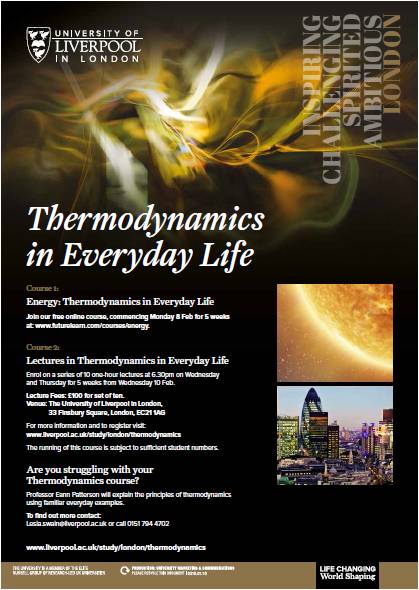
If you wathermolectures posternt to listen to that interview or learn more about the thermodynamics underpinning the energy balances controlling our weight, climate change and your electricity charges, then you need to join the more than 4,500 people who have already enrolled on the MOOC that will run for five weeks from February 8th, 2016.  I will also be giving an accompanying series of lectures in London.

I was astonished to discover that there are fewer tigers in the world than people signed up for our MOOC.  Less than 3,200 tigers exist in the wild mainly because our growing population and prolifigate use of the world’s resources has destroyed their habitat and those of the other species with which we share this planet.