Tag Archives: mechanics

Toxic nanoparticles?

My obsession with kinematics and kinetics over the past few posts is connected to my recent trip to Italy [see my post last week] as part of a research project on the mechanics of nanoparticles.  We are interested in the toxicological effect of nanoparticles on biological cells.  Nanoparticles are finding lots of applications but we don’t completely understand their interaction with cells and organs in the body.  We are interested in particles with diameters around 10 nanometres.  The diameter of a human hair is 10,000 times bigger.  The small size of these particles has potential implications for their kinematics and kinetics as they move through the body.  We know that protein molecules can attach themselves to nanoparticles forming a corona and as part of our research we are looking at how that influences the motion of the particle.  For instance, it might be appropriate to use kinematics for a spherical metallic nanoparticle but kinetics for one with a corona.

Some of you might be thinking, why go to Italy?  Well, other than for the coffee, I have been working with a colleague there for some time on methods of tracking nanoparticles that are below the resolution of optical microscopes.  We have named the technique ‘nanoscopy’ and it allows us to look at live cells and nanoparticles simultaneously without damaging the cell.  So our current research is an extension of the earlier work (see the two papers referenced below).  Of course the more basic answer is that we get on and are very productive together.

BTW – we can’t ‘see’ our nanoparticles because visible light has wavelengths about fifty times larger than the particles, so light waves pass single particles without being reflected into our eyes or camera.  However, a particle does disturb the light wave and produce a weak optical signature, which we utilise in nanoscopy.

Research papers available on-line at:

http://onlinelibrary.wiley.com/doi/10.1002/smll.200800703/abstract

http://onlinelibrary.wiley.com/doi/10.1111/j.1365-2818.2011.03491.x/abstract
Sweeping Kinetics

Last week I left the rubbish on the streets and encouraged you to make a mess in the classroom.  Partly because kinematics does not help us to analyse the forces involved in sweeping rubbish or, more glamorously, an ice hockey puck.  This is the realm of kinetics in which we need to consider the forces acting on objects to cause or impede their motion, such as the push from a broom and the friction against the pavement.  See the 5E lesson plan attached for more details on how Newton’s laws of motion can be applied in these situations.

You might be thinking ‘why should engineers be interested in forces involved in sweeping rubbish?’  Well, it might not be as glamorous as designing sports equipment but someone has to design street sweeping machines that keep our towns and cities clean and it is arguably more beneficial to society and the environment.  Of course, it would be better for the environment if we didn’t drop rubbish that needed sweeping but that’s another post…

5EplanNoD2_force&acceleration

For more on 5E lesson plans see: my post entitled ‘Disease of the modern age’ on June 26th, 2013 and ‘Sizzling Sausages’ on July 3rd, 2013.

For a set of videos on kinetics try: http://www.khanacademy.org/science/physics/forces-newtons-laws

Kinematics leaves rubbish

On the street outside my house leaves are being swirled into piles against the railings that guard the light-well for our basement.  In other streets, not graced by trees, discarded packaging from take-away meals eaten in the street is being blown around eluding the best efforts of the city’s refuse collectors.  This phenomenon is an ‘everyday experience’ for the vast majority of people although the content of the wind-blown detritus may vary depending on where you live.  It is not difficult to reproduce similar conditions in the classroom using the contents of the recycling bin and to use the motion of sheets of paper, screwed up balls of paper and paper airplanes to discuss the kinematics of motion and the limitations of its assumptions, i.e. that the geometry of an object has no influence on its motion, which restricts the cases we can consider using kinematics.  Think particles with mass but negligible size and shape plus objects that can be approximated in this way.  The 5E lesson plan attached below expands on this theme for instructors interested in using this Everyday Example.

5EplanNoD1_rectilinear&curvilinear_motion

For more on 5E lesson plans see: my post entitled ‘Disease of the modern age’ on June 26th, 2013 and ‘Sizzling Sausages’ on July 3rd, 2013.

If you want more on kinematics try: http://www.khanacademy.org/science/physics/one-dimensional-motion

Flexible credit

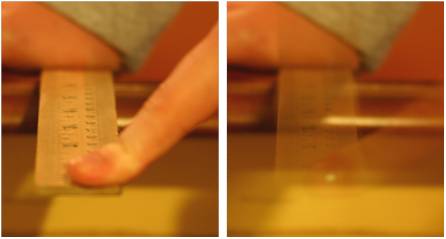
vibrating rulerOne of the major credit card companies used to advertise their card as ‘your flexible friend’.  If you clamp your card over the edge of the table and flip it with your finger then it will vibrate at a resonant frequency which decreases with length of the overhang, or cantilever as engineers might call it.  You could say that your flexible friend can sing too.

I used to use a twelve-inch ruler as everyday example of free and forced vibrations until someone pointed out to me that most engineering students don’t carry them around any longer.  So the credit card is a nice alternative that everyone carries with them, although the embossed text of your name and account number makes them a little too stiff and you might find that your plastic driving licence works better.  Neither will produce middle C as well as a plastic twelve-inch ruler – you can calculate the resonant or natural frequency by equating the kinetic energy and strain energy of the cantilever, as illustrated in the attached 5E lesson plan.  For more on 5E lesson plans see: my post entitled ‘Disease of the modern age’ on June 26th, 2013 and ‘Sizzling Sausages’ on July 3rd, 2013.  By the way, kinetic energy is the energy possessed by an object due to its motion and strain energy is the energy stored in an object as result of elastic (reversible) deformation and is equal to the work done in producing the deformation.

5EplanNoD12_free&forcedvibrations