Tag Archives: global warming

Is it time to change priorities on climate change?

It seems unlikely that global warming will be limited to only 1.5 degrees Centigrade above pre-industrial levels in the light of recent trends in temperature data [see ‘It was hot in June and its getting hotter’ on July 12th, 2023 ]. It is probable global warming will lead to average surface temperatures on the planet rising by 4 or 5 degrees, perhaps within a matter of decades.  A global average temperature rise of only 2 degrees would make the Earth as warm as it was 3 million years ago when sea levels were 25 to 35 m (80 to 130 ft) high (Blockstein & Wiegman, 2010).  While it is still important to aim for zero carbon emissions in order to limit global warming and avoid global temperatures reaching a tipping point, it seems improbable that politicians worldwide will be able to agree and implement effective actions to achieve the goal in part because of the massive, vested interests in industrialised economies based on fossil fuels [see ‘Are we all free-riders?’ On April 6th, 2016].  Hence, we need to start planning for potentially existential changes in the climate and environment that will force us to adapt the way we live and work.  In addition to rises in sea levels, a world that is 4 degrees hotter is likely to have an equatorial belt with high humidity causing heat stress across tropical regions that make them uninhabitable for most of the year. To the north and south of this equatorial belt will be mid-latitude belts of inhospitable deserts extending as far north as a line through Liverpool, Manchester, Hamburg, the straits north of Sapporo in Japan, Prince Rupert in British Columbia and Waskaganish on the Hudson Bay.  The habitable zones for humans are likely to be north of this line and in the south in Antarctica, Patagonia, Tasmania and the south island of New Zealand.  Agriculture will probably be viable in these polar regions but will compete with a very dense population [see ‘Belts of habitability in a 4° world’ in Nomad Century by Gaia Vince].  In other words, there will likely be mass migrations that will force a re-organisation of society and a restructuring of our economies.  Some estimates suggest that there could be as many as 1.2 billion environmental migrants by 2050 (Bellizzi et al, 2023).  We need to start adapting now, the world around us is already adapting [see ‘Collaboration and competition’ on June 8th, 2022].

It was hot in June and its getting hotter

Decorative image of a summer flowerLast month was the first June on record when the daily average global 2-metre surface temperature exceeded 1.5 °C above pre-industrial levels [1] and last week, on July 6th, the daily global air temperature hit a record high of 17.23 °C [2]  In 2020 it was estimated that the world’s remaining carbon budget was about 500 gigatonnes CO2 if there was to be a 50% chance of limiting global warming to 1.5 °C. It is now estimated that the remaining budget is about 250 gigatonnes CO2, i.e., it has halved in three years, as a result of continued pollution and temperatures rising faster than expected [3].  At the current rate of emissions, this budget will be exhausted in about six years.  Hence, it seems very likely that global temperatures will rise by more than 1.5 °C and perhaps by as much as 4 °C this century.  The last time the Earth was that hot was about 15 million years ago during the Miocene when sea levels were 40 m higher [4].  It is time to get much more serious about reducing carbon emissions instead of just talking about it.  Current targets for reducing emissions are so far in the future that they are beyond the horizon – effectively out of sight and out of mind.  We need to be costing everything in terms of carbon emissions and making decisions that reduce emissions now.

[1] Climate graphic of the week: first days of June bring record heat, FT June 17, 2023.

[2] Global temperature hits record high, FT Weekend 8th July 2023 based on data from NOAA.

[3] Forster PM, Smith CJ, Walsh T, Lamb WF, Lamboll R, Hauser M, Ribes A, Rosen D, Gillett N, Palmer MD, Rogelj J. Indicators of Global Climate Change 2022: annual update of large-scale indicators of the state of the climate system and human influence. Earth System Science Data. 15(6):2295-327, 2023.

[4] Foster GL, Rohling EJ. Relationship between sea level and climate forcing by CO2 on geological timescales. Proceedings of the National Academy of Sciences. 110(4):1209-14, 2013.

Ice caps losing water and gravitational attraction

Map of the world showing population density is greater in the regions furthest from the polesI have written previously about sea level rises [see ‘Merseyside Totemy‘ on August 17th, 2022 and ‘Climate change and tides in Liverpool‘ on May 11th, 2016] and the fact that a 1 metre rise in sea level would displace 145 million people [see ‘New Year resolution‘ on December 31st, 2014].  Sea levels globally have risen 102.5 mm since 1993 primarily due to the water added as a result of the melting of glaciers and icecaps and due to the expansion of the seawater as its temperature rises – both of these causes are a result of global warming resulting from human activity.  I think that this is probably well-known to most readers of this blog. However, I had not appreciated that the polar ice caps are sufficiently massive that their gravitational attraction pulls the water in the oceans towards them, so that as they melt the oceans move towards a more even distribution of water raising sea levels further away from the icecaps.  This is problematic because the population density is higher in the regions further away from the polar ice caps, as shown in the image.  Worldwide about 1 billion people, or about an eighth of the global population, live less than 10 metres above current high tide lines.  If we fail to limit global warming to 1.5 degrees Centigrade and it peaks at 5 degrees Centigrade then the average sea level rise is predicted to be as high as 7 m according to the IPCC.

Image: Population Density, v4.11, 2020 by SEDACMaps CC-BY-2.0 Creative Commons Attribution 2.0 Generic license.

Source: Thomas Halliday, Otherlands: A World in the Making, London: Allen Lane, 2022

Planetary Emergency

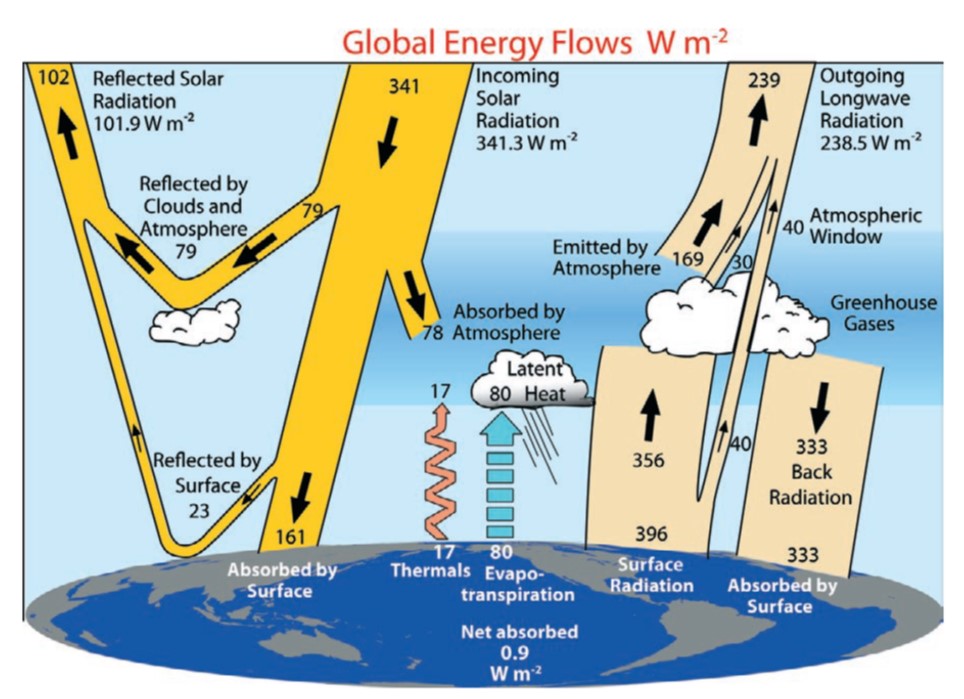
Global energy budget from Trenberth et al 2009

This week’s lecture in my thermodynamics course for first-year undergraduate students was about thermodynamic systems and the energy flows in and out of them. I concluded the lecture by talking about our planet as a thermodynamic system using the classic schematic in the thumbnail [see ‘Ample sufficiency of solar energy‘ on October 25th, 2017 for more discussion on this schematic].  This is usually a popular lecture but this year it had particular resonance because of the widely publicised strikes by students for action on climate change.  I have called before for individuals to take responsibility given the intransigence of governments [see ‘Are we all free riders‘ on June 6th, 2016 or ‘New Year Resolution‘ on December 31st, 2014]; so, it is good to see young people making their views and feelings known.

Weather-related events, such as widespread flooding and fires, are reported so frequently in the media that perhaps we have started to ignore them as portents of climate change.  For me, three headlines events have reinforced the gravity of the situation:

  1. The publication earlier this month of a joint report by UNICEF and the Royal College of Paediatrics and Child Health that air pollution in the UK so high that it is infringing the fundamental rights of children to grow up in a clean and safe environment; and, under the Government’s current plans, air pollution in the UK is expected to remain at dangerous levels for at least another 10 years.
  2. The warning earlier this month from the Meteorological Office in London that global warming could exceed 1.5C above pre-industrial levels within five years.  In my lecture, I highlighted that a 2C rise would be equal to the temperature 3 million years ago when sea levels were 25 to 35m high; and, a 1m rise in sea level would displace 145 million people globally [according to Blockstein & Weigmann, 2010].
  3. The suspension of construction of the new nuclear power station on Anglesey by Hitachi, which leaves the UK Government’s energy strategy in disarray with only one of the six planned new power stations under construction.  This leaves the UK unable to switch from fossil-fuelled to electric vehicles and dependent on fossil fuel to meet current electricity demand.

I apologise for my UK focus this week but whereever you are reading this blog you could probably find similar headlines in your region.  For instance, the 2016 UNICEF report states that one in seven children worldwide live in toxic air and air pollution is a major contributing factor in the deaths of around 600,000 children under five every year.  These three headlines illustrate that there is a planetary emergency because climate change is rapidly and radically altering the ecosystem with likely dire consequences for all living things; that despite a near-existential threat to the next generation as a consequence of air pollution most governments are effectively doing nothing; and that in the UK we are locked into a fossil-fuel dependency for the foreseeable future due to a lack of competent planning and commitment from the government which will compound the air pollution and climate change problems.

Our politicians need to stop arguing about borders and starting worrying about the whole planet.  We are all in this together and no man-made border will protect us from the impact of making the planet a hostile environment for life.