Tag Archives: Engineering

Cold power

Last week I wrote about heat transfer into fridges in the context of operation in vacation mode.  It is tempting to think that if energy is moving into the fridge as a result of heat transfer from the warm room to the cold food compartment in the fridge, then why can’t we use the energy to power the fridge.  A fridge that operated on this basis would be categorised as a perpetual motion machine of the second type because it would contravene the second law of thermodynamics and so it can’t exist.  One of the great pioneers of thermodynamics, Rudolf Clausius expressed the second law as ‘heat does not pass from a body at a low temperature to one at high temperature without an accompanying change elsewhere’.  In other words, something has to be done, generally in the form of work, to move energy from a cold to hot place, e.g. from the food compartment of the fridge to the warmer room.

refrigeration cycle


In a domestic fridge, the work is supplied in the form of electricity to drive a compressor – that’s the thing making most of the noise coming from your fridge.  It is compressing a refrigerant gas (typically from atmospheric pressure to about 8 times atmospheric pressure) and in the process raising its temperature (perhaps by 80°C) as it pushes the gas into a condenser.  In the condenser, the hot refrigerant transfers heat to the colder room and in the process condenses from a gas to liquid dropping its temperature, perhaps by 30°C.  Then, the liquid refrigerant flows into an expansion valve where its rapid expansion to a gas lowers both its temperature (perhaps to -20°C) and pressure (typically from 8 times atmospheric pressure back to atmospheric) before it is sucked into the heat exchanger inside the food compartment where its very low temperature causes heat transfer from the compartment to the refrigerant, i.e. it removes the unwanted energy.  The compressor sucks the gas out of the heat exchanger and the whole cycle starts again with the unwanted energy being dumped into the room by the condenser, which is the warm panel on the back of your fridge.

If you understood all of that then well done, if not then try again following the steps on the schematic diagram.

The temperatures and pressures are expressed rather vaguely because they depend on the design of the fridge and the settings you select on the control panel.
Vacation mode

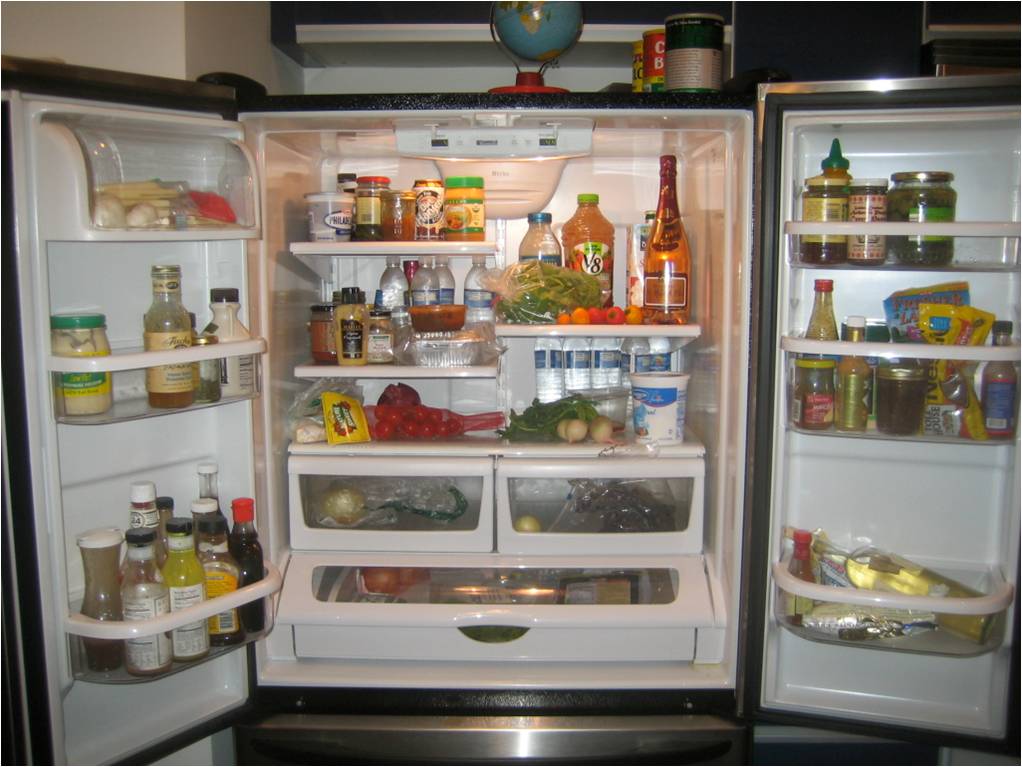
fridge2Many people are in vacation mode at the moment.  In some organisations it is impossible to hold meetings because of non-overlapping holidays, unless of course you work in countries where everyone goes on holiday at the same time – try getting in or out of Paris on certain weekends in August!  We have been away already and when we got back home one question that was asked is ‘What was the fridge/freezer doing while it was set on vacation mode?’  Fridge and freezers are one of the largest consumers of power in most households so saving energy while we are away on vacation makes sense and there are a number of strategies adopted by different manufacturers.  The most common one is to raise the temperature of the fridge compartment to around 39°F or 4°C which is just cold enough to prevent bacterial growth. Energy movement due to heat transfer is proportional to the temperature difference. Hence, if the temperature difference between the fridge and its surroundings is reduced then there will be less heat transfer into the fridge and less energy will be expended to remove it and keep the contents cold.  Of course the door being shut thoroughout the vacation helps.

In normal use, when we open the door there is heat transfer into the fridge from the warmer room which raises the energy level inside the fridge.  This energy is stored as internal energy in the air and fridge contents and temperature is a measure of this internal energy level, i.e. the temperature goes up.  The fridge has to perform work to remove the internal energy and reduce the temperature.  The situation is exacerbated by the light inside the fridge which comes on when the door is opened because the light bulb generates heat, this is the basis of Everyday Engineering Example about the extra cost of running of a fridge when the light stays on permanently because the switch is broken.

Back to vacation mode for a moment, most fridge/freezers also de-activate the automatic defrost function in vacation mode as well, to save energy.

Sources:

Alison for asking the question – thank you.

Information on safe food storage – Food Safety and Inspection Service

Sounds of the city

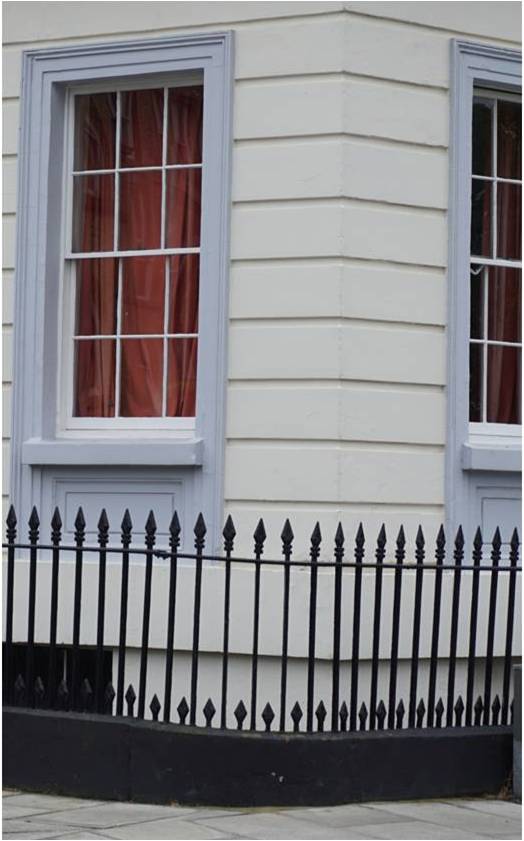
cornerRegular readers of this blog will know that I spent a relaxing day painting railings a few weeks ago [see post entitled ‘Engineering archaeology‘ on July 23rd, 2014].  A day or so later, I went out with my pail of whitewash to paint the walls of the light-well that the railings protect.  ‘The summer world was bright and fresh, and brimming with life’ but unlike Tom Sawyer I was not looking for Jim to do my white-washing for me.  I was looking forward to another therapeutic session painting the walls at the front of our house.  It was an interesting standing in the light-well facing the wall, un-noticed by most passers-by.  We live on a city street close to tourist attractions and there is a constant stream of coaches and taxis stopping to drop-off and pick-up tourists. I have written about the noise insulation in our house before [see Noise Transfer on April 13th, 2013] which means that we don’t notice the constant growl of diesel engines outside but I did while I was painting.  However, there were other sounds in the city.  The voices of pedestrians  deep in conversation as they passed by on the pavement just above my head.  I recognised Chinese, French, Italian and English but there were many different languages that I didn’t recognise.  There were young children asking parents questions as they walked down the street.  For a while I could hear cathedral bells.  When there was a pause in the traffic then it was possible to hear the cooing of pigeons, a neighbour’s radio or television and an ever-present idling diesel engine which I discovered was an ice-cream van dispensing a constant trickle of black soot and an occasional ice-cream.  It is curious that as a society we tolerant high levels of noise pollution at tourist attractions, especially ones that are meant to be places of calm and contemplation. Most tourists are, almost by definition, on holiday seeking relaxation and a lowering of stress levels – how much more pleasant would it be to glide to your destination in a silent electric coach or taxi?

We have the technology to provide such a service [see Are electric cars back? on May 28th, 2014]. Yes, it requires some investment by tour operators and taxi firms in hybrid or electric vehicles and by the city council in re-charging facilities. Induction charging stations at tourist attractions would allow vehicles to recharge while dropping off and picking up passengers. The technology is available and has been used by buses in Genoa and Turin for more than a decade.  So a little bit a regulatory pressure and investment from city councils acting together could create a calmer, quieter and cleaner environment for everyone.

Can we look forward to solar-powered ice-cream vans?

Sources: Thank you to Richard for reminding me about Tom Sawyer.

Engineering archaeology

Last week I spent a relaxing day painting the old railings in front of our house. Since I am not a painter and decorator by trade the end result is not perfect but they look much better in shiny black than two-tone rust and matt black.   One of the fleurs de lis on our railings had been knocked off when either we moved in or the previous occupiers moved out.  It’s a way of life being an engineer, so the shape of the failure surface on the broken railing was bugging me while I was painting the rest.  You would expect wrought iron railings to be ductile, i.e. to deform significantly prior to fracture, and to have a high tensile strength.  Wrought iron’s properties are derived from its very low carbon content (less than 0.25%) and the presence of fibrous slag impurities (typically about 2%), which almost make it a composite material.  It was historically used for railings and gates.  However, my broken railing had exhibited almost no deformation prior to fracture, i.e. it was a brittle failure, and the fleur de lis had broken in half on impact with the stone flags.  So on one of the rainy days last week, when I couldn’t paint outside, I did a little bit of historical research and discovered that in the late 1790s and early 1800s, which is when our house was built, cast iron started to be used for railings.  Cast iron has a high carbon content, typically 2 to 4%, and also contains silicon at between 1 and 3% by weight.  Cast iron is brittle, i.e. it shows almost no deformation prior to fracture, so the failure surface tends be to flat and smooth just like in my fleur de lis.

This seems like a nice interdisciplinary, if not everyday, engineering example.  It would be vandalism to go around breaking iron railings in front of old buildings.  So, if you want Everyday Engineering Examples of ductile and brittle behaviour, then visit a junk shop and buy an old china dinner plate and a set of cutlery.  The ceramic of the china plate is brittle and will fracture without deformation – have some fun and break one!  The stainless steel of the fork and spoon is ductile and can be easily bent, i.e. it is easy to introduce large deformation, in this case permanent or plastic deformation, prior to failure.  In fact you will probably have to bend the fork back and forth repeatedly before it will snap with each bending action introducing additional damage.

The more curious will be wondering why some materials are ductile and others brittle.  The answer is associated with their microstructures, which in turn is dependent on their constituents, as hinted above.  However, I am not going to venture into material science to explain the details.  I have probably already given materials scientists enough to complain about because my Everyday Engineering Examples are not directly analogous at the microstructural level to wrought iron and cast iron but they are more fun.

Sources: http://www3.westminster.gov.uk/spgs/publications/Railings.pdf