Tag Archives: design

Old is beautiful

An often forgotten but key element of sustainability is the concept of repairing objects.  We are encouraged to recycle but this usually means putting your paper, plastics and aluminium in the appropriate bin so that they can be processed in a huge recycling plant.  Our modern consumer society does not encourage us to repair items because manufacturers want us to buy new ones so that they can make more money.  As reported by Edwin Heathcote in the Financial Times on 30/31 March, 2013 [ http://www.ft.com/cms/s/2/903545ea-9612-11e2-b8dd-00144feabdc0.html#axzz2QzPabqi1 ], in 1932 during the last Great Depression, Bernard London published a pamphlet entitled ‘Ending the Depression through Planned Obsolescence’ in which he encouraged built-in obsolescence has a way of accelerating the economy out of its recession.  However, this is not an acceptable approach today because, as was predicted by Vance Packard in 1960, it has lead to ‘wasteful, debt-ridden, permanently discontented individuals’ and we live in world of finite resources (see my posts entitled ‘Unavoidable Junk’ on January 14th, 2013, and Open-world Mind-set’ on January 4th, 2013).

We have learn to love old but serviceable belongings.  They are good enough and will suffice.  If they break then we should have them repaired, preferably locally in order to stimulate our economy rather than replacing them with something made abroad.  This will require engineers to think more about repairs when designing artefacts and consumers to learn to regard the patina of age and use as something of beauty.

Risk definition

A section from a photoelastic model of turbine disc with a single blade viewed in polarised light to reveal the stress distribution.

Risk is defined as the possibility of something happening multiplied by the consequences when it does happen.  The public understanding of risk sometimes only extends to the first half of this definition.  Engineers seek to reduce the risks associated with component failure.  This means accepting a non-zero probability of failure happening and then designing for least catastrophic consequences.  So for instance in a jet engine, this implies designing so that if a crack develops it is in a blade rather than the disc to which all of the blades are attached.  The engine casing can be designed to contain a single blade breaking off and thus protect the rest of the plane from flying debris, but not to contain the rupture of an entire disc and set of blades.

For more information on the photoelastic stress analysis techniques used to generate the image, see http://www.experimentalstress.com

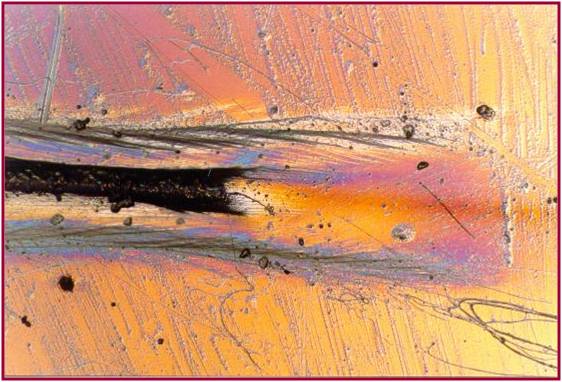
Unlikely failure

High magnification image of a crack in polycarbonate viewed in polarised light which reveals fringes that a proportional to the stress in the material.

I used the term ‘unlikely to fail’ in my last post, in the context of engineering designs.  This might appear alarming, since people might assume that engineers design things to never fail.  However it is impossible to design with a certainty that failure will not happen.  There are several reasons for this, including: the conflicting requirements of less material to reduce cost and achieve sustainability and of more material to protect against failure; our lack of knowledge about in-service and exceptional operating conditions; and the extent, or otherwise, that the computational model used in the design analysis represents the real world.

Hence the phrase ‘unlikely to fail’.  We can reduce the likelihood, or probability, of failure, usually at additional financial and resource cost, but we can never reduce the probability to zero, i.e. there is always a risk of failure, although we do our best to ensure that designs are ‘unlikely to fail’.