Why is thermodynamics so hard?

boltzmannAn understanding of the second law of thermodynamics has been equated to reading Shakespeare in terms of its cultural significance [see my post entitled ‘Two Cultures‘ on March 5th, 2013].  So why do so few people understand it?

Perhaps it is the way that it is traditionally taught starting from a series of corollaries. Oops.  There is the first problem. Most students don’t know what a corollary is.  It is a statement that builds on a previous statement.

It is hard to find a simple statement of the second law of thermodynamics. There is the Clausius statement: no process is possible, the sole result of which is that heat is transferred from a cold body to hot body.  Then there is the Kelvin-Planck statement and if you really want to be confused then try the Carathéodory formulation.  You can read them at the bottom of this post to reassure yourself that they are impenetrable.  They were formulated when steam engines were the main source of energy and it is hard to see their relevance today in biology, chemistry and culture.

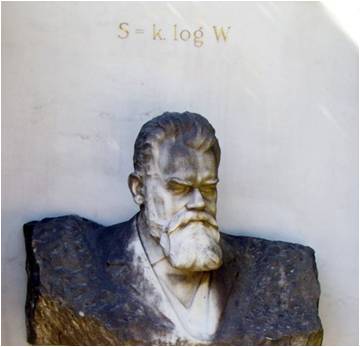
A more generic expression of the second law of thermodynamics is ‘entropy always increases’.  Oh, but now I’ve introduced entropy.  Entropy is a measure of disorder [see my posts entitled ‘Entropy management for bees and flights‘ on November 5th, 2014 and ‘Zen and entropy‘ on December 11th, 2013 ].  So according to the second law, the level of disorder must always increase. Boltzmann proposed that the level of disorder of a system could be quantified as a universal constant [k] multiplied by the logarithm of the number of ways [W] a system could be arranged with the same energy content.  Ok, so that’s getting complicated again.  But Boltzmann was so proud of it that it is carved on his grave stone [see picture] and the constant is known as the Boltzmann’s constant [=ratio of the molar gas constant and Avogadro’s number].

In an attempt to express the second law in everyday language, Bob and I re-wrote the second law as ‘you can’t have it just anyway you like it‘ in our book, The Entropy Vector.  In other words there always has to be some unwanted disorder created.


Statements (corollaries) of the second law of thermodynamics:

Clausius statement: no process is possible, the sole result of which is that heat is transferred from a cold body to hot body.

Kelvin-Planck statement: no process is possible, the sole result of which is that a body is cooled and work is performed.

Carathéodory’s formation: in every neighbourhood of every equilibrium state there is at least one state which cannot be accessed by an adiabatic process.


Sources:

Thess A., The Entropy Principle: Thermodynamics for the Unsatisfied, Springer-Verlag, Berlin, 2011.

Handscombe RD., & Patterson, EA., The Entropy Vector: Connecting Science and Business, World Scientific Press, Singapore, 2004.

Dream machine

Painting by Katy Gibson

Painting by Katy Gibson

A machine that can do work indefinitely without any external input of energy.  It would solve the world’s energy problems, eliminate global warming and make the inventor very rich.  There have been so many attempts to design such a machine that a classification system has been established.  My machine, that does work indefinitely with no energy input, would be a perpetual motion machine of the first type because energy is not conserved – a contradiction of the first law of thermodynamics.  The second type contravene the second law of thermodynamics, usually by spontaneously converting heat into work, and the third type eliminates friction and, or other dissipative forces.

I said ‘my machine’ in the sense that I have an on-going sporadic correspondence with the inventor of a machine that is claimed to produce ‘power above the primary power that drives it’.  It is an epistemic impossibility, which means that it cannot exist within our current understanding of the real world.  In other words, if a perpetual motion machine was to be proven to exist then the laws of thermodynamics would have to be rewritten.  This would probably lead to an invitation to Stockholm to collect a Nobel prize.

Such arguments make no difference to inventors of perpetual motion machines.  Many appear to start from the premise that the laws of thermodynamics have not been proven and hence they must not be universally applicable, i.e. there is space for their invention.  Whereas the laws of thermodynamics form part of our current understanding of the world because no one has demonstrated their falsity despite many attempts over the last two hundred years.  This is consistent with the philosophical ideas introduced by Karl Popper in the middle of the last century.  He proposed that a hypothesis cannot be proven to be correct using observational evidence but its falsity can be demonstrated.

So, inventors need to build and demonstrate their perpetual motion machines in order to falsify the relevant law of science.  At this stage money as an input usually becomes an issue rather than energy!


The painting by Katy Gibson is from a series made as part from an art and engine collaboration between Okemos High School Art Program and the Department of Mechanical Engineering at Michigan State University.


Enabling or disruptive technology for nuclear engineering?

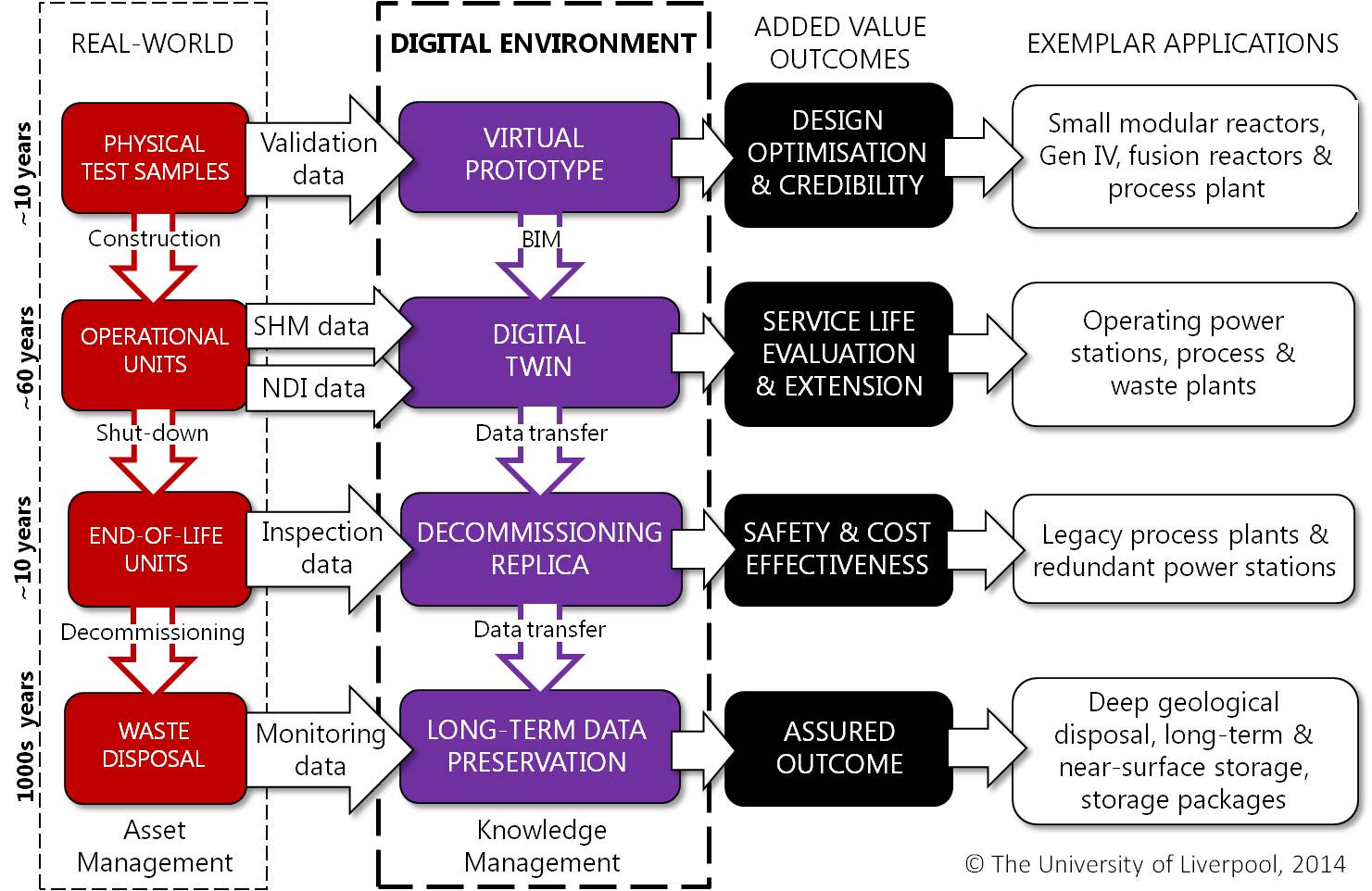
INDEA couple of weeks ago [see ‘Small is beautiful and affordable in nuclear power-stations’  on January 14th, 2015] I ranted about the need to develop small modular reactors whose components can be mass-produced in a similar way to the wings, cockpit, tail-planes, fuselage and engines of an Airbus aeroplane that are manufactured in factories in different countries in Europe prior to final assembly and commissioning in Toulouse, France. The aerospace industry is heavily dependent on computer-aided engineering to design, test, manufacture, operate and maintain aircraft in a series of processes involving a huge number of organisations. The civil engineering and building services industries are following the same model through the introduction of BIM, or Building Information Modelling. I have recently suggested that the nuclear industry needs to adopt the same approach through an Integrated Nuclear Digital Environment (INDE) that has the potential to reduce operating and decommissioning costs and increase reliability and safety for existing and planned power-stations but more importantly would enable a move towards mass-production of modular power-stations.

Recently I presented a paper at a NAFEMS seminar on Modelling and Simulation in the Nuclear Industry held on November 19th 2014 in Manchester, UK.  To judge from the Q&A session afterwards, the paper divided the audience into those who could see the enormous potential (the enablers?) and those who saw only massive problems that rendered it unworkable (the potentially disrupted?). The latter group tends to cite the special circumstances of the nuclear industry associated with its risks and regulatory environment. These are important factors but are not unique to the industry. From my perspective of working with many other industrial sectors, the nuclear industry is unique in its slow progress in exploiting the potential of digital technologies.  Perhaps in the end, as one of my academic colleagues believes, research on solar power will produce such efficient solar cells that even in cold and cloudy England we will be able to meet all of our power needs from solar energy [given incoming solar radiation is about 340 Watts/square meter], in which case perhaps the nuclear power industry will become extinct unless it has evolved.

Schematic diagram showing the digital environment (second column from left in purple), its relationships to the real-world (left column in red) and the potential added value (third column from left) together with exemplar applications (right column). Coloured arrows are processes and coloured boxes represent physical (red) or digital (purple) infrastructure.

Schematic diagram showing the digital environment (second column from left in purple), its relationships to the real-world (left column in red) and the potential added value (third column from left) together with exemplar applications (right column). Coloured arrows are processes and coloured boxes represent physical (red) or digital (purple) infrastructure [from Patterson & Taylor, 2014].

The diagram is an extract from Patterson & Taylor, 2014.  The views expressed in this blog post are those of the author and not necessarily of those of his co-authors on other publications, or their employers.

Six NYC subway trains

Distribution of blog visitors in 2014

Distribution of blog visitors in 2014 (from WordPress.com)

It would take six New York City subway trains to hold the number of visitors to this blog last year, according the Annual Report sent to me by WordPress.com.  That’s more than double the number of visitors in 2013 which is quite an impressive increase.  The visitors came from more 100 countries which makes it a truly global blog, unless I have some globe-trotting readers who visited all of those countries between them during 2014.

The blog is also being published on Tumblr now, which my youngest daughter told me would be a waste of time because users of Tumblr are not interested in the sort of things I write about. However, an original objective of the blog was to increase public understanding of engineering and so this is small step to reach a wider public.

I wrote 54 posts last year so that there are more 120 posts in the archive now of which the five most frequently read are, in descending order:

Closed systems in nature? published on December 21st, 2012

100 Everyday engineering examples published on April 23rd, 2014

Small is beautiful published on October 10th, 2012

Benford’s law published on August 15th, 2014

Zen and entropy published on December 11th, 2013

If you only started reading the blog recently or you are visiting for the first time then you might enjoy some these old favourites.