Category Archives: Uncategorized

Digital hive mind

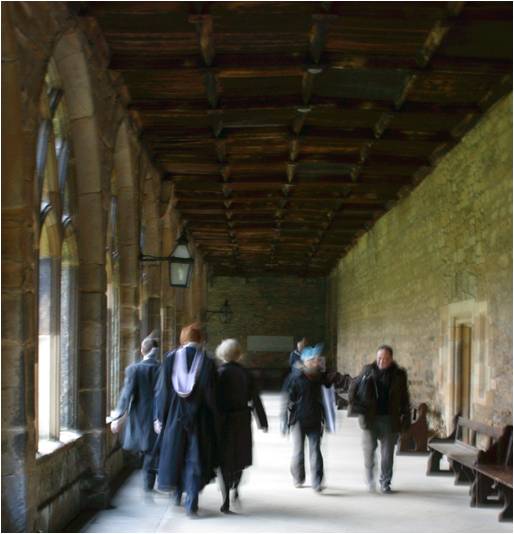
durham-cloistersFor many people Durham Cathedral will be familiar as a location in the Harry Potter movies.  However, for me it triggers memories of walking around the cloisters discussing Erwin Schrodinger’s arithmetical paradox: there seems to be a great number of conscious egos creating their own worlds but only one world.  Each of us appears to construct our own domain of private consciousness and Schrodinger identifies the region where they all overlap as the ‘real world around us’.  However, he raises questions such as, is my world really the same as yours?  Schrodinger proposes two solutions to the paradox: either there are a multitude of worlds with no communication between them or a unification of minds or consciousness.

Schrodinger found ‘it utterly impossible to form an idea about’ how his ‘own conscious mind should have originated by the integration of the consciousness of the cells (or some of them)’ that formed his body.  Recently this has been addressed by Susan Greenfield, who has proposed that short-lived coalitions of millions of neurons are responsible for consciousness.  These ‘neuronal assemblies’, which last for fractions of a second, link local events in individual cells with large scale events across the brain and many of ‘these assemblies flickering on and off somehow come together to provide a collective continuous experience of consciousness’.  In other words, our consciousness arises as an emergent behaviour of the myriad of interacting networks in our brain.  It seems no less fanciful that our individual minds networked together to generate a further level of emergent behaviour equivalent to the unified mind that Schrodinger conceived though, like Schrodinger, I find it utterly impossible to form an idea about how this might happen.

Perhaps, at some level we are creating a unified mind via the digital hive mind being formed by the digital devices to which we delegate some of the more mundane aspects of modern life [see my post entitled ‘Thinking out of the skull‘ on 18th March, 2015].  However, Greenfield worries about a very sinister potential impact of our digital devices, which is associated with the stimulation they provide to millions of the younger generation.  She thinks it could lead to small-scale neuronal assemblies becoming ‘the default setting in the consciousness of the digital native, to an extent it has never been in previous generations’.  In other words we might be losing the ability to create the emergent behaviour required for consciousness and shifting it to our digital devices.

Perhaps we are closer than we think to the vision in Maria Lassnig’s painting of the lady with her half of her brain outside her skull? [see my post entitled ‘Science fiction becomes virtual reality‘ on October 6th, 2016.

Sources:

Erwin Schrodinger, ‘Mind and Matter – the Tarner Lectures’ in What is Life?, Cambridge: Cambridge University Press, 1967.

Susan Greenfield, A day in the life of the brain: the neuroscience of consciousness from dawn to dusk, Allen Lane, 2016.

Clive Cookson, Know your own mind, FT Weekend, 15/16 October 2016, reviewing Greenfield’s book.

Nilanjana Roy ‘What it means to be human’ FT Weekend, 17/18 September 2016.

Will it all be over soon?

milkywayNASAAs you may have gathered from last week’s post [Man, the Rubbish-Maker on October 26th, 2016], I have been reading Italo Calvino’s Complete Cosmicomics.  In one story, ‘World Memory’ the director of a project to document the entire world memory in the ‘expectation of the imminent disappearance of life on Earth’ is explaining to his successor that ‘we have all been aware for some time that the Sun is halfway through its lifespan: however well things went, in four or five billion years everything would be over’.  The latter is one of the scientific conclusions around which Calvino weaves these short stories and this one put into perspective the concerns expressed by some of my students on both my undergraduate course and MOOC in thermodynamics the prospect of a cosmic heat death resulting from the inevitable consequences of the second law of thermodynamics [see my post ‘Cosmic Heat Death‘ on February 18th, 2015].  The second law requires ‘entropy of the universe to increase in all spontaneous processes’.   Entropy was defined by Rudolf Clausius about 160 years ago as the heat dissipated in a process divided by the temperature of the process.  The dissipated heat flows into random motion of molecules from which it is never recovered.  So, as William Thomson observed, this must eventually create a universe of uniform temperature – an equilibrium state corresponding to maximum entropy where nothing happens and life cannot exist.   Entropy has been increasing since the Big Bang about 13.5 billion years ago.  And as Calvino writes, the sun is about halfway through its life – it is expected to collapse into a white dwarf in 4 to 5 billion years when its supply of hydrogen runs out.  These are enormous timescales: the first human cultures appeared about 70,000 years ago [see my post ‘And then we discovered thermodynamics‘ on February 3rd, 2016]  and history would suggest that our civilization will disappear long before the sun expires or cosmic heat death occurs.  A more immediate existential threat is that our local production of entropy on Earth destroys the delicate balance of conditions that allows us to thrive on Earth.  See my post on Free Riders on April 6th, 2016 for thoughts on avoiding this threat.

Sources:

Italo Calvino, The Complete Cosmicomics, London: Penguin Books, 2002.


Man, the Rubbish Maker

167-6734_IMGBruce Sterling wrote that our current civilisation would be best described as ‘Man, the Rubbish Maker’ if we were to be judged by our efforts that will best survive the passage of time.  Paleontologists have found flint-knapping workshops more than two million years old that have out-lasted any record of the speech, culture or beliefs of the craftsmen that laboured in them.  Pollution and waste is not consumed and hence tends to persist while useful things wear out.  In a short story called ‘Daughters of the Moon’ published in 1968 as part of his third collection of Cosmicomics, Italo Calvino describes a world in which cars wear out more quickly than the soles of your shoes.  He goes on to describe a region where the road petered out in a hilly area created by ‘the layers of things that had been thrown away: everything that the consumerist city expelled once it had quickly used it up so it could immediately enjoy the pleasure of handling new things’.  Calvino was imagining a future world but we are rapidly approaching his vision, or perhaps we are already there.  Our junk, rubbish, and trash, is a form of entropy – an increase in the level of disorder created by the processes that provide our man-made lifestyle and required as a consequence of the second law of thermodynamics [see my post ‘Unavoidable junk‘ published on January 14th, 2013].  And ‘entropy requires no maintenance’, to quote Sterling, so much of our rubbish will still be here long after we have disappeared.

If we want to avoid Calvino’s vision of cities surrounded by layers of discarded things, then we have to learn to love old but serviceable belongings.  They are good enough and will suffice.  If they break then we should have them repaired, preferably locally in order to stimulate our economy and reduce our ecological footprint rather than replacing them with something made abroad.  This will require engineers to think more about repairs when designing artefacts and consumers to learn to appreciate the patina of age and usage as a virtue, something of beauty.

Sources:

Bruce Sterling, Shaping Things, Boston: MIT Press, 2005.

Italo Calvino, The Complete Cosmicomics, London: Penguin Books, 2002.

Edwin Heathcote, Make and Mend, Financial Times, 30/31 March, 2013.

Science fiction becomes virtual reality

vecI have a new print in my office. It’s called ‘Small Science Fiction Self-Portrait’ and is by Maria Lassnig (1919-2014) [see: http://www.painters-table.com/link/contemporary-art-daily/maria-lassnig]. I am disappointed to admit that I had never heard of her until I went to a special exhibition at the Tate Liverpool a few weeks ago, which featured her work and that of Francis Bacon. I was expecting the works by Bacon to be the main attraction but instead I thought Lassnig ‘stole the show’. Nearly all of her paintings in the exhibition were self-portraits in which she attempts to represent on canvas her ‘body sensation’ or ‘body awareness’. This seems to echo the synaesthesia pursued by Georgia O’Keeffe when she represented her feelings from various senses in her paintings [see my post entitled ‘Engineering Synaesthesia‘ on September 21st, 2016].  Two of Lassnig’s paintings resonanted with me: one, which was on the front of the programme, called Lady with Brain was painted in 1991 and shows the head of a lady with a proportion of her brain outside of her skull – not in a damaged way but as if it had grown there. This reminded me of the ideas on our increasing use of out-of-skull memory and processing power in our mobile devices that I wrote about under the heading ‘Thinking out of Skull’ [see my post of that title on March 18th, 2015]. The second is the print in my office, painted in 1995, that shows the artist wearing a virtual reality headset that looks almost identical to those we use in our Virtual Engineering Centre. I was amazed by Lassnig’s vision.