Category Archives: Uncategorized

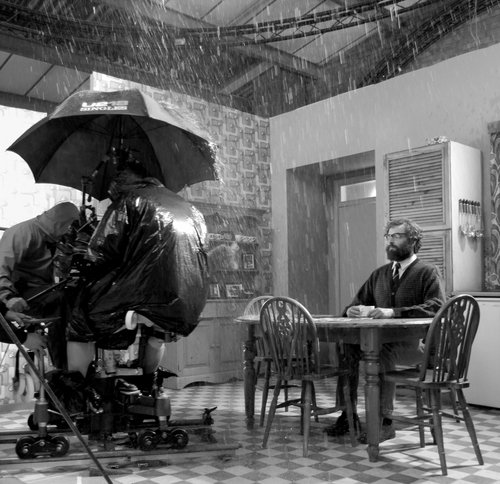
‘Rain bringing out the contours in everything’

16blindness9-custom1Last October I cited John Hull’s audio diary in which he said ‘Cognition is beautiful.  It is beautiful to know.’ [See my post entitled ‘Cognition is beautiful‘ on October 19th, 2016]  Last week, I watched the film ‘Notes on Blindness‘ based on his book ‘Touching the Rock‘.  We found it a moving and life-enriching experience. At one point, John Hull, after he has lost all of his sight, opens his front door during a rain storm and describes the beauty of the rain.  “Rain has a way of bringing out the contours of everything; it throws a coloured blanket over previously invisible things; instead of an intermittent and thus fragmented world, the steadily falling rain creates continuity of acoustic experience.”  You can read more of this extract at www.johnmhull.biz/Touching the Rock.html in which John wishes that rain could fall inside a room to give him a sense of the things in the room.  This seemed particularly poignant to me, a sighted person, who benefits from photons raining down on everything around us during daylight or when the light is switched on.  The photons cause light waves to radiate from every surface in a similar way that the rain drops cause sound waves to radiate from everything as John experienced. Our eyes are amazing with 137 million separate ‘seeing’ elements on the retina, or in digital camera terms, that’s 137 megapixels.  But to quote the Roman poet, Lucretius who in his poem ‘De Rerum Natura’ wrote “Nothing in the body is made that we may use it.  What happens to exist is the cause of its use.”  In other words, we do not have eyes so that we can see but we see because we have eyes.  John Hull discovered new ways to experience the world using what was available to him although he struggled with what he had lost.  It is difficult to imagine losing one’s sight but his diary and the film bring us considerably closer to an appreciation of the loss.

Yes, I know I switched from a particle to wave description of light but I wanted to emphasize that the photons don’t just bounce off surfaces, otherwise all surfaces would look the colour of the illuminating light.


Sources:

John M. Hull, Touching the Rock: an experience of blindness, London: SPCK, 2016

Lucretius (author), Alicia Stallings (translator), The Nature of Things, London: Penguin Classics, 2007.

Charles Sherrington, Making of the eye, in The Faber Book of Science, John Carey (ed), London: Faber & Faber, 1995.

Picture: A production still from the film, Notes on Blindness, from NY Times on January 16th, 2016.


 

Digital limits analogue future

Feet on Holiday I 1979 Henry Moore OM, CH 1898-1986 Presented by the Henry Moore Foundation 1982 http://www.tate.org.uk/art/work/P02699

Feet on Holiday I 1979 Henry Moore OM, CH 1898-1986 Presented by the Henry Moore Foundation 1982 http://www.tate.org.uk/art/work/P02699

Digital everything is trendy at the moment.  I am as guilty as everyone else: my research group is using digital cameras to monitor the displacement and deformation of structural components using a technique called digital image correlation (see my post on 256 Shades of grey on January 22nd, 2014) .  Some years ago, in a similar vein, I pioneered a technique known as ‘digital photoelasticity’ (se my post on ‘Cow bladders lead to strain measurement‘ on January 7th, 2015..  But, what do we mean by ‘digital’?  Originally it meant related to, resembling or operated by a digit or finger.  However, electronic engineers will refer us to A-to-D and D-to-A converters that transform analogue signals into digital signals and vice versa.  In this sense, digital means ‘expressed in discrete numerical form’ as opposed to analogue which means something that can vary continuously .  Digital signals are ubiquitous because computers can handle digital information easily.  Computers could be described as very, very large series of switches that can be either on or off, which allows numbers to be represented in binary.  The world’s second largest computer, Tianhe-2, which I visited in Guangzhou a couple of years ago, has about 12.4 petabytes (about 1016 bytes) of memory which compares to 100 billion (1012) neurons an average human brain.  There’s lots of tasks at which the world’s largest computers are excellent but none of them can drive a car, ride a bicycle, tutor a group of engineering students and write a blog post on the limits of digital technology all in a few hours.  Ok, we could connect specialized computers together wirelessly under the command of one supercomputer but that’s incomparable to the 1.4 kilograms of brain cells in an engineering professor’s skull doing all of this without being reprogrammed or requiring significant cooling.

So, what’s our brain got that the world latest computer hasn’t?  Well, it appears to be analogue and not digital.  Our consciousness appears to arise from assemblies of millions of neurons firing in synchrony and because each neuron can fire at an infinite number of levels, then our conscious thoughts can take on a multiplicity of forms that a digital computer can never hope to emulate because its finite number of switches have only two positions each: on and off.

I suspect that the future is not digital but analogue; we just don’t know how to get there, yet.  We need to stop counting with our digits and start thinking with our brains.

Illusion of self

A few weeks ago, I wrote that some neuroscientists believe consciousness arises from the synchronous firing of assemblies of neurons [see my post ‘Digital hive mind‘ on November 30th, 2016].  Since these assemblies exist for only a fraction of a second before triggering other ones that replace them, this implies that what you think of as ‘yourself’ is actually a continuously changing collection of connected neurons in your brain, or as VS Ramachandran has described it ‘what drives us is not a self – but a hodgepodge of processes inside the skull’.

According to Kegan’s schema of cognitive development, new born babies perceive the world as an extension of themselves.  However, as our consciousness develops, the idea of a ‘self’ evolves as a construct of the brain that allows us to handle the huge flow of sensory inputs arriving from our five senses and we begin to separate ‘self’ from the objects around us.  This leads to us perceiving the world around us as separate to us but there to serve our needs, which we see as paramount.  Fortunately, the vast majority of us (more than 90%) move beyond this state and our relationships with other people become the dominant driver of our actions and identity.  Some people (about 35%) can separate their relationships and identity from ‘self’ and hence are capable of more nuanced decision-making – this is known as the Institutional stage. About one percent of the population are capable holding many identities and handling the paradoxes that arise from deconstructing the ‘self’ in the Inter-individual stage.

Of course, Kegan’s stages of cognitive development are also a construct to helps us describe and understand the behaviour and levels of cognition observed in those around us.  There is some evidence that deeper more complex thought processes, associated with higher levels of cognition, involve the firing of larger, more widespread assemblies of neurons across the brain; and perhaps these larger neuronal assemblies are self-reinforcing; in other words, the more we think deeply the more capable we are of thinking deeply and, just occasionally, this leads to an original thought.  And, maybe the one percent of individuals who are capable of handling paradoxical thoughts have brains capable of sustaining multiple large neuronal assemblies.  A little bit like lightning triggered from multiple points in the sky during a (brain)storm.

How does this relate to engineering?  Well, we touch on Kegan’s stages of cognitive development in our continuing professional development courses [see my post on ‘Technology Leadership’ on January 18th, 2017] for engineers and scientists aspiring to become leaders in research and development because we want to advance their cognitive development and, also allow them to lead teams consisting of individuals at the institutional and inter-individual stages that will be capable of making major breakthroughs.

Sources:

V.S. Ramachandran, ‘In the hall of illusions’, in ‘We are all stardust‘ by Stefan Klein, London: Scribe, 2015.

Kegan, R., In over our heads: the mental demands of modern life, Cambridge, MA: Harvard University Press, 1994.

Kegan, R., The evolving self: problem and process in human development, Cambridge, MA: Harvard University Press, 1982.

Technology leadership

zennor head

Some of us have followed compassionate, courageous, transformative leaders and some of us aspire to be this type of leader.  Good leadership results in teams to which people want to belong and can transform an organization.  However, good leaders are remarkably rare, at least in science and engineering.  Is that because leaders are born rather than created?  This is part of the nature versus nurture debate and recent research, reported in Nature Genetics, suggests that the influence of genetics and environment on human traits is pretty much equal, based on a fifty-year study of 1.4 million twin pairs.  This implies that there is opportunity to nurture leaders and as individuals to hone our leadership skills, which is something I have working on recently.

Over the past fifteen months I have been working, with colleagues from one of the UK’s national laboratories, on developing a set of new courses to support aspiring leaders in research and development organizations.  Last semester we offered these courses as credit-bearing continuous professional development (CPD) for the national lab’s employees.  You can enroll on the next offering of the courses next semester if you can get to London one day each month from March to June [sciencetechnologyleadership.wordpress.com].  If you joined us then you would be involved in discussions about: gathering, using and presenting evidence; marrying detailed evidence with a ‘big picture’ perspective; communicating using concise narratives; thinking ‘just’ out-of-the box and challenging the norm; as well as personal integrity and doing the right thing.  To stimulate these discussions, we’ll ask you to read books such as ‘The Five Dysfunctions of a Team‘  by Patrick Lencioni, ‘The Complete Cosmicomics‘ by Italo Calvino and ‘We Are All Stardust‘ by Stefan Klein.  You will have noticed the influence of the last two books in posts on this blog during 2016 and you can expect a few more in 2017!

Engineers and scientists need to work in teams nowadays and someone needs to lead these teams; however our education as scientists and engineers tends to focus on management without examining the skills associated with successful leadership.  Management is about organising resources and tasks whereas leadership is about inspiring and motivating people.  The analytical skills honed by a technical education equip us well to perform management tasks but prepare us poorly for leadership roles in which nothing is well-defined or easily described.

Sources:

Polderman TJC, Benyamin B, de Leeuw CA, Sullivan PF, van Bochoven A, Visscher PM, Posthuma D, Meta-analysis of the heritability of human traits based on fifty years of twin studies, Nature Genetics, 47: 702–709 (2015).

Patrick Lencioni, The five dysfunctions of a team, Lafayette, CA: Table Group Inc.,

Italo Calvino, The Complete Cosmicomics, London: Penguin Books, 2002.

Stefan Klein, We are all stardust, London: Scribe, 2015.