Category Archives: energy science

Wind power

Winds are generated by uneven heating of the earth’s atmosphere by the sun, which causes hotter, less dense air to rise and more dense, colder air to be pulled into replace it.  Of course, land masses, water evaporation over oceans, and the rotation of the earth amongst other things added to the complexity of weather systems.  However, essentially weather systems are driven by natural convection, a form of heat or energy transfer, as I hinted in my recent post entitled ‘On the beach’ [24th July, 2013].

If you are thinking of building a wind turbine to extract some of the energy present in the wind, then you would be well-advised to conduct some surveys of the site to assess the potential power output.  The power output of a wind turbine [P] can be defined as a half of the product of the air density [d] multiplied by the area swept by the blades [A] multiplied by the cube of the velocity [v].  So the wind velocity dominates this relationship [P = ½dAv3] and it is important that a site survey assesses the wind velocity.  But the wind velocity is constantly changing so how can this be done meaningfully?

Engineers might tackle this problem by measuring the wind speed for ten minute intervals, or some other relatively short time period, and calculating the average speed for the period.  This process would be repeated over a long period of time, perhaps weeks or months and the results plotted as frequency distribution, i.e. the results would be assigned to ‘bins’ labelled for instance 0.0 to 1.9 m/s, 2.0 to 3.9 m/s, 4.0 to 5.9 m/s etc and then the number of results in each bin plotted to create a bar chart.  The number of results in a bin divided by the total number of results provides the probability that a measurement taken at any random moment would yield a wind speed that would be assigned to that bin.  Consequently, the mathematical function used to describe such a bar chart is called a probability density function.  Now returning to the original relationship, P = ½dAv3 and using the probability density function instead of the wind velocity yields a power density function that can be used to predict the annual output of the turbine taking account of the constantly changing wind velocity.

If you struggled with my very short explanation of probability density functions, then you might try the Khan Academy video on the topic found on Youtube at http://www.youtube.com/watch?v=Fvi9A_tEmXQ

Engineers use probability density functions to process information about lots of random or stochastic events such as forces ocean waves interacting with ships and oil-rigs, flutter in aircraft wings, the forces experienced by a car as its wheels bounce along a road or the motion of an artificial heart valve.  These are all activities for which the underlying mechanics are understood but there is an element of randomness in their behaviour, with respect to time, that means we cannot predict precisely what will be happening at an instant in time; and yet engineers are expected to achieve reliable performance in designs which will encounter stochastic events.  Frequency distributions and probability density functions are one popular approach used by engineers.  Traditionally engineers have studied applied mathematics that was equated to mechanics in high school but increasing they need to understand statistics.


On the beach

beachMaybe you are lying on the beach reading this, or if not dreaming about lying on the beach.  We enjoy lying on the beach, or next to a swimming pool, in part because it involves doing nothing and in part because of the heat transfer.  Heat transfer is transfer of energy from a high to a lower temperature zone.  It can occur in four ways: conduction, free convection, forced convection and radiation; and all of them occur on the beach on a hot day.

Conduction occurs as a flow of kinetic energy from one molecule to the next by direct contact.  When you are lying on the beach it occurs between you and the surface that you are lying on.  When you first lie down on hot sand, then the energy flows from the hot sand to your cooler body by conduction.

Free or natural convection is heat transfer carried by a rising current of fluid due to buoyancy effects created by the hotter fluid being less dense.  This tends to happen above your warm body after you have been lying in the sun for a while.  It also happens above the hot sand and you can sometimes see a heat haze caused by the rising hot air that has a lower density and thus different refractive index compared to the surrounding air.

Forced convection also involves heat transfer by a moving current of fluid but in this case the flow is caused by an external source.  So if there is breeze across the beach then you will be cooled by forced convection as you lie on the beach.

Radiation consists of electromagnetic waves in the infrared spectrum travelling away from a source in all directions.  This is the heat from the sun that makes it so pleasant to lie on the beach on a sunny day.

Ok, shut your eyes and go back to sleep.  The heat transfer lesson is over – though some of you might want to think about whether that breeze is really forced convection since it is probably caused by natural convection on a climatic scale.

Sizzling sausages

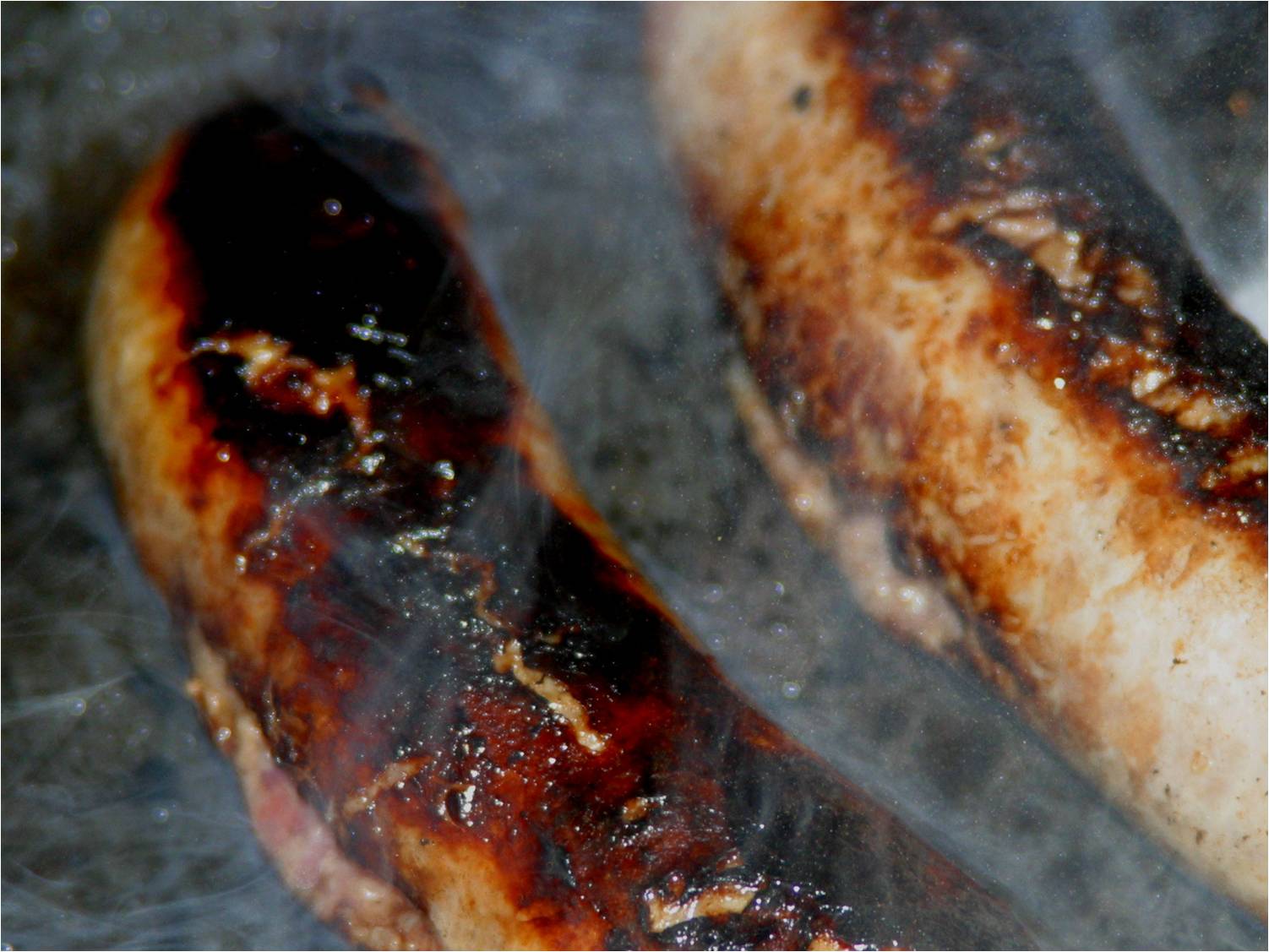
130-3071_IMGIn my post on 19th June 2013 [Closed system on the BBQ], I discussed the thermodynamics of sausages cooking on a barbeque in the context of the first law of thermodynamics.  This is an everyday example of engineering principles [see my post entitled ‘Bridging cultures’ on June 12th, 2013].  I mentioned that the energy gained by a sausage causes it to be cooked and for the water-content to boil as the temperature is raised.  The rise in temperature causes the pressure inside the sausage to increase, which is Gay-Lussac’s law in action.  When the water-content of the sausage starts to boil, the steam produced raises the pressure even further providing the sausage skin remains impervious to the transfer of matter, i.e. the steam.  The sausage as a closed system that becomes a miniature pressure vessel.

Pressure vessels fail as a result of the stresses in their wall.  In engineering, stress is defined as force divided by the area of  material carrying the force.  My sausages always fail longitudinally, i.e. they burst open with splits running along their length.  This is because the stress across the split, known as the circumferential or hoop stress, is the largest stress in the skin.

It is relatively simple to use Newton’s Third Law, about there being an equal and opposite reaction for every action force, to show that the circumferential stress is larger than the longitudinal stress; but it is a level of detail beyond what I feel is appropriate here.  Bursting sausages are a good illustration of Everyday  Examples of Engineering, which became the ‘poster-child’ of the NSF-funded project that developed them in the USA .  The pedagogy underpinning the use of Everyday Examples is explained in detail in a paper in the European Journal of Engineering Education (vol 36, pages 211-224, 2011) and a 5Es lesson plan is available here [for more on 5Es lesson plans see my post entitled ‘Disease of the modern age’ on June 26th, 2013].

You can see a video of me talking about these sausages at http://www.youtube.com/watch?v=nsSxKuRo4H0

EJEE paper: http://www.tandfonline.com/doi/abs/10.1080/03043797.2011.575218#.UbG9TZyPMx4

Closed system on BBQ

sausagecloseupMy post of December 21st, 2012 on ‘Closed systems in nature?’ is my most popular  based on the statistics from WordPress.  These statistics led me to go back and read it again, which set me thinking along the same lines while tending the barbeque in our backyard.  A sausage is a nice example of a closed system with a boundary, or skin, that is impervious to mass or material moving across the boundary but which allows energy transfer in the form of heat.

Heat transfers into the system [sausage] through the boundary [skin] adjacent to the hot charcoal in my barbeque and heat transfers out on the opposite side.  Heat is simply energy transfer that occurs along a temperature gradient or across a temperature difference, from a higher to a lower temperature.

The temperature difference between the hot charcoal at about 375 degrees Centigrade and a sausage starting to cook at about 70 degrees is larger than the difference between the sausage and the air above it at say 35 degrees Centigrade, so more heat [energy] is transferred into than out of the sausage.  The difference between the energy in and out is used to heat and cook the sausage including starting to boil the water-content and trigger chemical reactions associated with cooking.  This is a manifestation of the first law of thermodynamics for the closed system, i.e. heat transfer in minus heat transfer out equals the change in the energy content of the system.  The net flux of heat into the sausage causes it to get hot and be cooked.

You can’t avoid thermodynamics, it gets involved in everything!