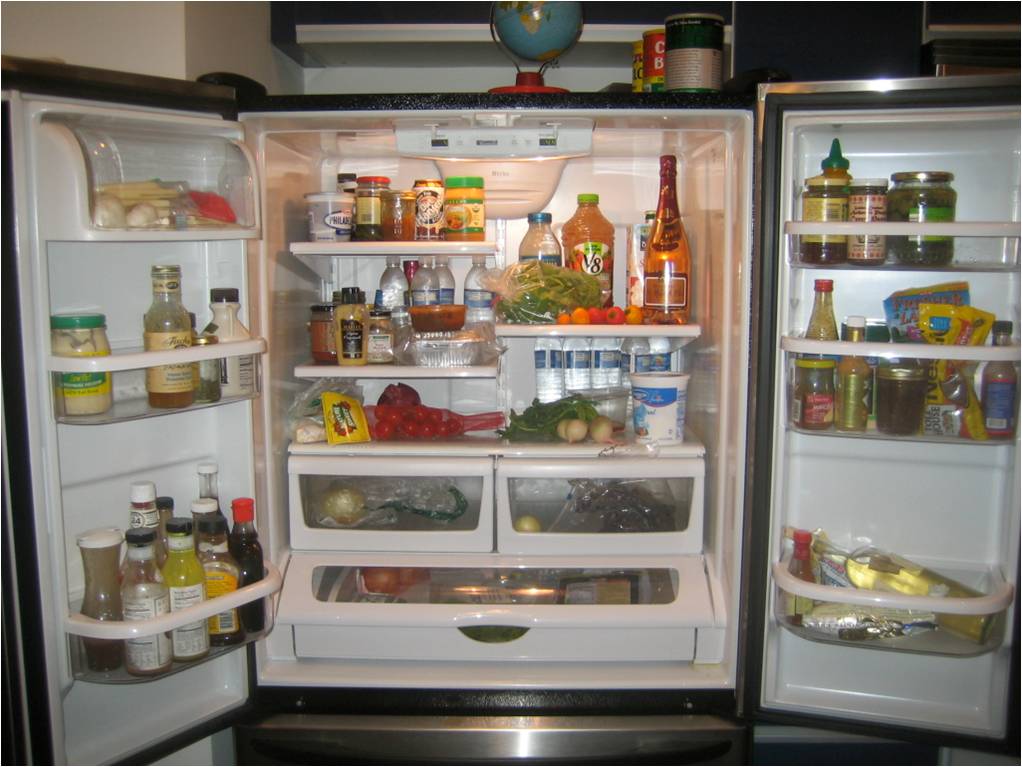
We sense the passage of time by the changes that occur around us (see ‘We inhabit time as fish live in water‘ on July 24th, 2019) and these changes are brought about by processes that generate entropy. Entropy is often referred to as the arrow of time because forwards in time is always the direction in which the entropy of the universe increases, as demanded by the second law of thermodynamics (see for example ‘Subtle balance of sustainable orderliness‘ on June 22nd, 2016). The temperature in a refrigerator is sufficiently low that it slows down the processes of decay in the food stored in it (see’ Life-time battle‘ on January 30th, 2013) which effectively slows down time locally in the fridge. However, there is a price to pay because the process of creating of the cold zone in the fridge increases the entropy in the universe and moves the universe infinitesimally closer to cosmic heat death (see ‘Will it all be over soon?‘ on November 2nd, 2016). So, cooling the food in your fridge slows down time locally but brings the end of the universe a tiny bit closer. Perhaps that’s not worth worrying about until you start thinking about how many fridges there are in the world (about half a billion are sold every year) and how many other devices are generating entropy. The end of the universe might still be billions of years away but all that anthropogenic entropy is contributing to the increase in the temperature of the Earth’s ecosystem.
Category Archives: sustainability
When you invent the ship, you also invent the shipwreck
I recently came across this quote from Paul Virilio, a French philosopher who lived from 1932 to 2018. Actually, it is only the first part of a statement he made during an interview with Philippe Petit in 1996. ‘When you invent the ship, you also invent the shipwreck; when you invent the plane you also invent the plane crash; and when you invent electricity, you invent electrocution. Every technology carries its own negativity, which is invented at the same time as technical progress.’ These events have a catastrophic level of negativity; however, there is a more insidious form of negativity induced by every new technology. It arises as a consequence of the second law of thermodynamics which demands that the entropy of the universe increases in all real processes. In other words, that the degree of disorder in the universe is increased every time we use technology to do something useful, in fact whenever anything happens the second law ensures some negativity. This implies that the capacity to do something useful, often measured in terms of energy, is decreased not just by doing the useful thing but also by creating disorder. Technology helps us to do more useful things more quickly; but the downside is that faster processes tend to create more entropy and disorder. Most of this negativity is not as obvious as a shipwreck or plane crash but instead often takes the form of pollution that eventually and inexorably disrupts the world making it a less hospitable home for us and the rest of nature. The forthcoming COP26 conference is generating much talk about the need for climate action but very little about the reality that we cannot avoid the demands of the second law and hence need to rethink how, when and what technology we use.
Sources:
Elaine Moore, When Big Dating leaves you standing, FT Weekend, July 8th, 2021.
Paul Virilio, and Petit Philippe. Politics of the Very Worst, New York: Semiotext(e), 1999, p. 89 (available from https://mitpress.mit.edu/books/politics-very-worst).
Hot air is good for balloons but cold air is better for cars
Cars that run on air might seem like a fairy tale or an April Fools story; but it is possible to use air as a medium for storing energy by compressing it or liquifying it at -196°C. The MDI company in Luxembourg has been developing and building a compressed air engine which powers a small car, or Airpod 2.0 and a new industrial vehicle, the Air‘Volution. When the compressed air is allowed to expand, the energy stored in it is released and can be used to power the vehicle. The Airpod 2.0 weighs only 350 kg, has seats for two people, 400 litres of luggage space and an urban cycle range of 100 to 120 km at a top speed of 80 km/h. So, it is an urban runabout with zero emissions and no requirement for lithium, nickel or cobalt for batteries but a limited range. A couple of years ago I tasked an MSc student with a project to consider the practicalities of a car running on liquid air, based on the premise that it should be possible to store a higher density of energy in liquified air (about 290 kJ/litre) than in compressed air (about 100 kJ/litre). His concept design used a rolling piston engine to power a family car capable of carrying 5 passengers and 346 litres of luggage over a 160 km. So, his design carried a bigger payload for further than the Airpod 2.0; however, like the electric charging system described a few weeks ago [see ‘Innovative design too far ahead of the market’ on May 5th, 2021], the design never the left the drawing board.
Innovative design too far ahead of the market?
The forthcoming COP26 conference in Glasgow is generating much discussion about ambitions to achieve net zero carbon emissions. These ambitions tend to be articulated by national governments or corporate leaders and there is less attention paid to the details of achieving zero emissions at the mundane level of everyday life. For instance, how to recharge an electric car if you live in an apartment building or a terraced house without a designated parking space. About six years ago, I supervised an undergraduate engineering student who designed an induction pad integrated into a kerbstone for an electric vehicle. The kerbstone looked the same as a conventional one, which it could replace, but was connected to the mains electricity supply under the pavement. A primary coil was integrated into the kerbstone and a secondary coil was incorporated into the side skirt of the vehicle, which could be lowered towards the kerbstone when the vehicle was parked. The energy transferred from the primary coil in the kerbstone to the secondary coil in the vehicle via a magnetic field that conformed to radiation safety limits for household appliances. Payment for charging was via a passive RFID card that connected to an app on your mobile phone. The student presented her design at the Future Powertrain Conference (FCP 2015) where her poster won first prize and we discussed spinning out a company to develop, manufacture and market the design. However, a blue-chip engineering company offered the student a good job and we decided that the design was probably ahead of its time so it has remained on the drawing board. Our technopy, or technology entropy was too high, we were ahead of the rate of change in the marketplace and launching a new product in these conditions can be disastrous. Maybe the market is catching up with our design?
For more on technopy see Handscombe RD and Patterson EA ‘The Entropy Vector: Connecting Science and Business‘, World Scientific, Singapore, 2004.