Category Archives: Soapbox

Engineering global change

‘Engineering is the most important profession: the future of our planet, and the quality of human life upon it, depends on engineering more than it does on any discipline.’

This bold statement was made as an opening gambit by one of my colleagues, Matt during a University Open Day for potential undergraduate students.  These events are particularly important for engineering because students usually don’t study engineering at school and so have little idea about what it involves.  Matt continued to say that ‘a decision to study engineering provides you with an opportunity to make a real and lasting impact on the world’.

Medical doctors and nurses have a considerable impact on our individual health and welfare, lawyers help us to resolve disputes and administer justice, philosophers advise us on how we should think while journalists and bloggers attempt to tell us what we should think but engineers manage the conception, design, development, manufacture or construction, maintenance, recycling or disposal of everything in our man-made world, i.e. products, processes & systems.  As Theodore von Karman, the great aeronautical engineer said ‘scientists discover the world that exists; engineers create the world that never was’.  Engineers tend to supply what society wants and so have to share with society responsibility for the massive consumption of the world’s resources but engineers are also working to create solutions.  We need a massive level of innovation to create sustainable technologies that will allow everyone to enjoy the lifestyle of the average American or European.

‘If you really want to change the world then choose a career in engineering, and I mean real engineering, not financial engineering’ Lord Mandelson, March 2009

Disease of the modern age

hot flatThomas Friedman described ‘continuous partial attention’ as a disease of the modern age in his book ‘Hot, Flat and Crowded – Why we need a green revolution and how it can renew America’ [Farrar, Straus & Giroux, New York, 2008].  Most university students suffer from this disease, which makes it difficult for lecturers to attract and hold their attention.  An NSF-funded consortium of university engineering departments in the USA has developed a strategy based on using Everyday Examples of Engineering to engage students (for exemplars see http://www.engageengineering.org/?page=161 ).

A Biological Science Curriculum Study in the 1980s developed the concept of 5Es as a framework for lecture or lesson plans based on the earlier work of Atkin and Karplus [Atkin JM, & Karplus R, Discovery or invention? Science Teacher, 29(5):45, 1962].  The 5Es are: ENGAGE, EXPLORE, EXPLAIN, ELABORATE and EVALUATE.

I have edited a series of lesson plans which combine the 5Es framework and Everyday Examples of Engineering principles [see http://www.engineeringexamples.org ], which are intended to support lecturers who want to use these examples in their teaching.  The lesson plans describe how the engineering principles can be applied and explained as well as providing worked analyses of the examples.  The worked analyses will also be useful to students although full explanations of the underlying principles are not included because it is assumed that these are well-known to the lecturer.

In my post about ‘Bridging cultures’ on June 12th, 2013, I made a commitment to write a series of posts about Everyday Examples of Engineering concepts.  When they are relevant, I intend to attached 5E lesson plans to these posts.

To quote Samuel Johnson: “the two most engaging powers of an author are to make new things familiar, familiar things new”; I aspire to this and through the lesson plans help others to achieve it in the classroom.

Bridging cultures

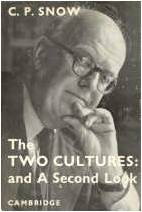
cpsnowAs long ago as 1959, Sir Charles Snow identified two cultures in modern society, which could be summarised as those that understand the consequences of the second law of thermodynamics and those that don’t [see my post entitled Two Cultures on March 5, 2013].

The main aim in writing this blog is to help in bridging the gap between these cultures by commenting on and explaining engineering concepts, ideas and principles in a way that non-engineers can appreciate and might read.  One of the reasons for the gap between the cultures within our society is that ‘technology is really a way of thinking’ [see reference below].  Engineering educators spend a lot of time teaching prospective engineers how to think and, in particular, how to solve engineering problems.  However, these same educators often forget when introducing engineering students  to the principles of engineering for the first time that the students are not familiar with the language or culture.  The students are just starting to cross the gap and their educators, who are on the other side of the gap, fail to appreciate the width of the gap.  The result is that educators fail to engage the students which results in poor recruitment and retention of engineering students.  This failing is recognised by some people, see for instance http://www.engageengineering.org/

One solution to help students cross the gap is to use familiar everyday examples to explain engineering concepts.  I have made a short video about the underlying pedagogy together with some examples that you can find at http://www.youtube.com/watch?v=qAh4QHC8ya0&feature=youtu.be .  There is also a series of booklets [ http://www.engineeringexamples.org/ ] designed to support university teachers who want to teach in this way.  I plan to rewrite the examples in these booklets as periodic posts on this blog for a wider, non-technical audience.  So watch this space!

‘Technology is really a way of thinking’: http://www.atse.org.au/Documents/Publications/Reports/Education/ATSE%20Technology%20Education%20A%20Way%20of%20Thinking%202004.pdf

Impossible perfection

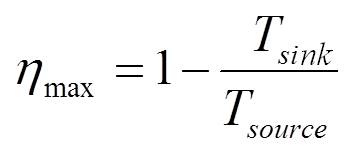
Carnot's equation for ideal efficiency of a cyclic device converting heat to work and operating between two temperatures specified on the Kelvin scale

Carnot’s equation for ideal efficiency of a cyclic device converting heat to work and operating between two temperatures specified on the Kelvin scale

In my last post [National efficiency on 29th May, 2013] I calculated the efficiency of the nationwide process of electricity generation in the UK [35.8%] and made no comment on the relatively low value.  It will be similarly in all industrialised countries as a consequence of the second law of thermodynamics and the requirement for all real processes to increase entropy.  A French engineer / scientist, Sadi Carnot [1796-1832] demonstrated from the second law, that the maximum efficiency achievable in ideal conditions by a process operating in a cycle to convert heat into work is a ratio of the temperatures of the heat source and cold sink to which excess heat is dumped.  In a power station the heat source might be a fossil-fuelled furnace, a nuclear reactor or a solar concentrator.  The cold sink is usually the environment, perhaps in the form of river or sea water.  So both source and sink temperatures are limited.  The sink by the local climate and the source by the temperatures that modern materials can withstand.

The very best efficiency based on Carnot’s expression for a maximum material temperature of 350 degrees Centigrade [=623 Kelvin] and environment temperature of 5 degrees Centigrade [278 Kelvin] is 55%.  Of course a real power station will never operate at this level because ideal conditions are not achievable – perfection is impossible.

The ideal efficiency improves as the operating temperatures of the heat source and sink are moved further apart and this quest to raise this temperature difference drives a substantial proportion of materials research.  However, even operating with a heat source at 800 degrees Centigrade, using expensive, high temperature alloys, such as Hastelloy N  [a nickel-chromium alloy], on a winter day in the Canadian capital, Ottawa where the average January daytime temperature is -7 degrees Centigrade, the Carnot efficiency of a power station would be only 75%  [=1-(266/1073)].