Tag Archives: entropy

Thermodynamic Whoopee

man without a countryThe success of our students in the MyCopter project inspired me a couple of weeks ago to write about the prospect for flying cars [see post on October 2nd, 2014 entitled ‘Origami car-planes‘], which are not good essentially because we don’t know how to manipulate gravity. Everything in the universe is controlled by four forces, i.e. electromagnetic, gravitational, weak nuclear and strong nuclear. Adam Frank, described our understanding and control of electromagnetic forces as god-like because we can manipulate photons, electrons and atoms with enormous precision in flat screen TVs, mobile phones, microwave ovens and much more.

Strong nuclear forces hold protons and neutrons together in the nucleus of atoms and weak nuclear forces control the fusion process in stars. We have managed to take a few tottering steps to control nuclear forces in nuclear power stations but we are blundering apprentices compared to our skills with electromagnetism. However, with gravitational forces we are like toddlers trying to feed ourselves – we have some idea about what we are supposed to be doing but we waste an enormous amount in trying to hit the target. So we use our expertise in electromagnetism to combust fuel in an engine which drives an aerofoil through air faster enough to generate lift. This usually involves burning vast amount of fossil fuel and it gets worse when you want to hover with rotating blades or a vertical jet. Kurt Vonnegut in a ‘A Man without a Country‘ has described our reckless use of fossil fuel as making ‘thermodynamic whoopee’ but if we want fly long distances with significant payloads we don’t have much choice at the moment.

If physicists could work out how to manipulate gravitational forces it would not take engineers long to design and build flying cars that would be as advanced relative to today’s private jet as your tablet computer is relative to an abaqus.

Source:

I was promised flying cars‘ by Adam Frank in the New York Times on June 6th, 2014
Entropy management for bees and flights

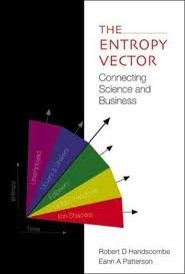
entropy_vectorEngineers like to apply the second law of thermodynamics to chemical processes and power generation cycles. However, it has some useful lessons for everyday life since it can be paraphrased as ‘whenever you organise any process expect some disorder, or entropy to be generated’, so a shrewd person plans for disorder and designs in a bit of slack or redundancy.

Bob and I gave an example of this in our book, ‘The Entropy Vector’.  We pointed out that if you plan your flight schedule to use all of the available gates at an airport then you will have unhappy passengers when flights are delayed, unless you plan for buses to unload planes parked away from the terminal. European airports tend to be good at this whereas US ones tend to leave passengers in planes that are unable to dock at the terminal.

Our example was inspired by frustrating experiences when we were writing the book. A more topical and important example was raised by Mark Winston in the New York Times on July 14th, 2014 in reporting the importance of bees to farming. His research team found that crop yields were maximised when large acreages were left uncultivated to support wild pollinators. He postulated that a variety of wild plants means a healthier, more diverse bee population which will be more active in the planted fields next door. Their numbers were startling with profits more than doubling for farmers that left a third of their acreage fallow. Winston highlights that this contravenes conventional wisdom that bees and fields can be micromanaged.

This seems like reinventing the wheel because I remember being taught about the importance of crop rotation, including a fallow period, in my ‘middle’ school geography classes. Oh dear, now I am showing my age.

The bottom-line is don’t micromanage. Allow for a bit of inefficiency, not too much of course or your competitors will get ahead! It’s a question of balance.

Zen and entropy

Picture1Last weekend I went to a performance of Handel’s Messiah in our local cathedral.  The atmosphere in the vast cathedral was wonderful and for part of the performance I was transformed into a zen-like state by the music.

However, there were quite of lot of disturbances during the performance including some that went beyond the usual coughing and sneezing.  It is interesting that a sneeze in the quiet environment of a cathedral or library causes a large disturbance while the same sneeze in a busy street goes unnoticed.  Of course, it is about the change in the noise level, and as a percentage, the added noise of a sneeze is much greater in the quiet library than the busy street.  Noise is a form of energy that becomes dispersed and dissipated as it propagates and so it is easy to equate it to heat which exhibits the same behaviour.  Heat transfers from hot to cold places while noise propagates from loud to quiet places, and neither does the reverse, which was Clausius’ observation that lead to the Second Law of Thermodynamics.  Clausius also defined change in entropy as the heat transfered divided by the temperature at which it occurs.  So the same heat transfer creates more entropy at low than at high temperatures, just as a sneeze causes more disorder/disruption in a quiet than a loud environment.  We can equate entropy to the level of disorder present in any system or environment.

And the second law of thermodynamics states that the entropy of an isolated system will always increase until it reaches a maximum at equilibrium.

Productive cheating?

I cut out a Dilbert cartoon from the New York Times a few weeks ago that I found amusing and shared it with my new Head of School.  Dilbert informs his boss that he will be taking advantage of the new unlimited vacation policy by being away for 200 days in the coming year but will still double his productivity.  His boss replies that there is no way to measure productivity for engineers.

Of course, bosses are very interested in measuring productivity and marketing executives like to brag about the productivity or efficiency of whatever it is they are selling.  Engineers know that it is easy to cheat on measures of productivity and efficiency, for instance, by carefully drawing the boundaries of the system to exclude some inputs or some wasteful outputs [see my post on ‘Drawing Boundaries’ on December 19th, 2012 ].  So claims of productivity or efficiency that sound too good to be true probably aren’t what they seem.

Also in the New York Times [on October 15th, 2013] Mark Bittman discussed the productivity of the two food production systems found in the world, i.e. industrial agriculture and one based on small landholders, what the ETC group refers to as peasant food webs.  He reports that the industrial food chain uses 70% of agricultural resources to provide 30% of the world’s food while peasant farming produces the remaining 70% with 30% of the resources.  The issue is not that industrial agriculture’s claims for productivity in terms of yields per acre are wrong but that the industry measures the wrong quantity.  Efficiency is defined as desired output divided by required input [see my post entitled ‘National efficiency‘ on May 29th, 2013].  In this case the required output is people fed not crop yield and a huge percentage of the yield from industrial agriculture never makes to people’s mouths [see my post entitled ‘Food waste’ on January 23rd, 2013].

Sources:

http://www.nytimes.com/2013/10/15/opinion/how-to-feed-the-world.html?ref=markbittman&_r=0

http://www.etcgroup.org/content/poster-who-will-feed-us-industrial-food-chain-or-peasant-food-webs