Tag Archives: Engineering

Cosmic heat death

MSUSpartans_Logo.svgWhen I was at Michigan State University, Lou Anna Simon, the President was fond of talking about constructive tension as a source of innovation and progress. In other words, creative or productive work arises out of differences, for instance between aspirations and reality, or between supply and demand.  Rudolf Clausius in the 1850’s identified the irreversibility of heat flow across a temperature difference from hot to cold [see last week’s post on ‘Why is thermodynamics so hard?].  Sadi Carnot worked out the productivity of this difference in terms of the maximum efficiency with which work could be extracted from it [see my post ‘Impossible perfection‘ on June 5th, 2013].

William Thomson [1827-1907] followed a much more sinister line of thought and concluded that if all heat flows from hot to cold then eventually everything must end up at a uniform temperature, i.e. no differences.  He argued that no temperature differences implies no work could be extracted.  And nothing at all happens.  This is known as ‘cosmic heat death’.

A fellow Scotsman, James Clerk Maxwell [1831-1879] believed that this challenged human free will.  He proposed a loophole in the second law of thermodynamics to demonstrate its falsity and invalidate the cosmic heat death argument.  Imagine Maxwell’s demon, as it became known, controlling a trapdoor separating two clouds of gas initially at the same temperature, which means the gas molecules in the two clouds have the same average internal energy.  The demon allows ‘hot’ molecules (i.e. those with higher than average internal energy) to one pass way through the trapdoor and ‘cold’ molecules (i.e. those with lower than average internal energy) to move the other way. After a period of time, all the ‘hot’ molecules will be on one side of the trapdoor and all the ‘cold’ molecules will be on the other side.  Heat has moved from colder (initial average temperature) to hotter (on one side of the trapdoor) and the second law has been contravened.

Maxwell created hope for the inventors of perpetual motion machines! [see my post entitled ‘Dream machine‘ on February 4th , 2015]  But then along came Leó Szilárd in 1929, who pointed out that the demon would have to expend energy [do work] to identify the internal energy of the molecules and to open the trap-door.  The second law was saved and cosmic heat death became a prospect once again although a very, very distant one.  Some modern physicists, though not Professor Brian Cox, reject the possibility of cosmic heat death by suggesting that the universe is too complex and our understanding too incomplete to allow Thomson’s simple reasoning to be applied.  John Updike protested against the idea in his poem ‘Ode to Entropy‘.  And on a human timescale, it is hard to believe that all tensions will ever be resolved.

Sources:

Ball, P., A demon-haunted theory, Physics World, April, 2013, p.36-9

Updike, J., ‘Ode to Entropy‘ available in the Faber Book of Science edited by John Carey 2005

Cox, B., Death of the Universe, World Space Week Special BBC Wonders of the Universe, 2013

Why is thermodynamics so hard?

boltzmannAn understanding of the second law of thermodynamics has been equated to reading Shakespeare in terms of its cultural significance [see my post entitled ‘Two Cultures‘ on March 5th, 2013].  So why do so few people understand it?

Perhaps it is the way that it is traditionally taught starting from a series of corollaries. Oops.  There is the first problem. Most students don’t know what a corollary is.  It is a statement that builds on a previous statement.

It is hard to find a simple statement of the second law of thermodynamics. There is the Clausius statement: no process is possible, the sole result of which is that heat is transferred from a cold body to hot body.  Then there is the Kelvin-Planck statement and if you really want to be confused then try the Carathéodory formulation.  You can read them at the bottom of this post to reassure yourself that they are impenetrable.  They were formulated when steam engines were the main source of energy and it is hard to see their relevance today in biology, chemistry and culture.

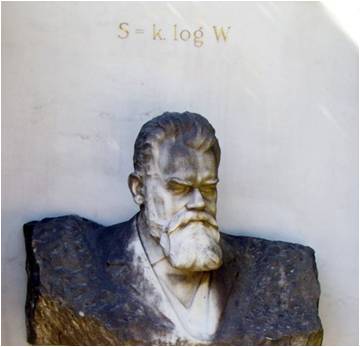
A more generic expression of the second law of thermodynamics is ‘entropy always increases’.  Oh, but now I’ve introduced entropy.  Entropy is a measure of disorder [see my posts entitled ‘Entropy management for bees and flights‘ on November 5th, 2014 and ‘Zen and entropy‘ on December 11th, 2013 ].  So according to the second law, the level of disorder must always increase. Boltzmann proposed that the level of disorder of a system could be quantified as a universal constant [k] multiplied by the logarithm of the number of ways [W] a system could be arranged with the same energy content.  Ok, so that’s getting complicated again.  But Boltzmann was so proud of it that it is carved on his grave stone [see picture] and the constant is known as the Boltzmann’s constant [=ratio of the molar gas constant and Avogadro’s number].

In an attempt to express the second law in everyday language, Bob and I re-wrote the second law as ‘you can’t have it just anyway you like it‘ in our book, The Entropy Vector.  In other words there always has to be some unwanted disorder created.


Statements (corollaries) of the second law of thermodynamics:

Clausius statement: no process is possible, the sole result of which is that heat is transferred from a cold body to hot body.

Kelvin-Planck statement: no process is possible, the sole result of which is that a body is cooled and work is performed.

Carathéodory’s formation: in every neighbourhood of every equilibrium state there is at least one state which cannot be accessed by an adiabatic process.


Sources:

Thess A., The Entropy Principle: Thermodynamics for the Unsatisfied, Springer-Verlag, Berlin, 2011.

Handscombe RD., & Patterson, EA., The Entropy Vector: Connecting Science and Business, World Scientific Press, Singapore, 2004.

Small is beautiful and affordable in nuclear power-stations

Most of you will have domestic carbon footprints that are similar to mine, i.e. dominated by energy consumption, probably mainly your car and climate control in your home, and you will struggle to reduce your footprint [see my post entitled ‘New Year Resolution’ on December 31st, 2014]. We live in a fossil fuel economy and so even if you make your home entirely powered by electricity and buy a plug-in car then your utility provider is still very likely to use fossil fuel to generate the electricity supplied to you and your carbon emissions will have been simply moved elsewhere. If you are lucky enough to live in a suitable location then installing geothermal, solar or wind power for your home might be viable; but otherwise the majority of us are dependent on power-stations for our electricity.

I discussed the impossibility, with today’s technology, of providing all of our electrical power needs using renewable sources in my post entitled ‘Energy Blending‘ on May 22nd, 2013. The alternatives are either to reduce our power consumption dramatically, which seems unlikely to happen given that everyone would like to enjoy the lifestyle of typical readers of blogs, or to build a very large number of nuclear power stations.  The scale of the problem facing China was the topic of my post entitled ‘Mass-produced nuclear power plants‘ on November 12th, 2014 and it is many times large on a global scale.

A major obstacle to building nuclear power-stations is their exorbitant capital cost, e.g. £24 billion for the planned Hinckley Point C reactor in the UK. This level of investment is beyond the reach of most companies and the construction of a fleet of such power-stations to provide national needs is beyond the budget of most national governments. Small modular reactors (SMR), whose components could be mass-produced and assembled on-site, have been proposed and both their small size and the manufacturing approach would lead to considerable reductions in unit costs. Although many designs for SMRs are under development, with mature designs in China and India, progress towards implementation and mass-production is slow so that the situation is ripe for a disruptive technology from another industrial sector to transform the nuclear power landscape. One possible candidate is the fusion reactor being developed by Lockheed Martin’s Skunk works [see my post entitled ‘Mass-produced nuclear power plants‘ on November 12th, 2014] or the Travelling Wave Reactor being developed by the spin-out company TerraPower.

We need to think big about small affordable solutions instead of thinking and spending big money on massive projects that tend towards a big unaffordable solution.

Also see Bill Gates on Energy-Miracles

Stimulating students with caffeine

milk in coffeeFood and drink seems to have been a recurring theme in my undergraduate lectures recently which as we are approaching a festive season is perhaps not inappropriate. At the moment, I am teaching thermodynamics to three hundred first year undergraduate students.  Zeroth and first laws of thermodynamics before the Christmas break and then the second and third laws in the New Year. Toast, pizza, barbecued steaks, hot coffee, bottled water, and cold milk shakes have all featured as Everyday Engineering Examples of thermodynamic systems in recent lectures. We can define a thermodynamic system as a quantity of matter capable of exchanging energy with its environment. And, most food preparation processes involve heating, chilling and, or doing work on the food by stirring, beating etc. which are all forms of energy exchange, so the opportunities for Everyday Engineering Examples are many and varied.

In one recent lecture, I asked the class to consider the quickest way to cool your coffee with milk. It was a multiple choice question to which students could respond in real-time using their phones and a website called polleverywhere.com. There was more than one correct answer depending on the assumptions you made about the quantity and temperature of the milk as well as the temperature of the coffee and environment. The core issue is that the rate of cooling is proportional to the temperature difference. While discussing the possible answers, I made a throw-away remark about stirring the coffee involving doing work on the coffee and thus increasing its internal energy and temperature, which would be a step in the wrong direction. I was delighted when one of my students picked me up on this and sent me this link about stirring tea.

It is great to know that at least one student is listening and sufficiently engaged to do a little research. Only 299 left to inspire!

Footnote:

The hot coffee will transfer heat to its cooler surroundings by natural convection and radiation at its free surface and by conduction through the ‘walls’ of the cup. Similarly, the cup will transfer heat to its surroundings by natural convection and radiation from its outer surfaces. This process will establish a temperature gradient in the coffee that will induce a very slow convection flow that would be accelerated by stirring, i.e. introducing forced convection. This is likely to increase heat transfer slightly by carrying hotter coffee to the surfaces. The additional heat transfer (loss) might be more or less than the work done to stir the coffee. Who would have thought something as simply as stirring coffee or tea could be so complicated!

Previous posts on Zeroth Law:  ‘All Things Being Equal ‘ on December 4th, 2014, ‘Arbitrary Zero‘ on February 13th, 2013 and ‘Lincoln on Equality‘ on February 6th, 2013.

Previous posts on First Law:Thunderous Applause‘ on July 16th, 2014,  ‘Sizzling Sausages‘ on July 3rd, 2013, ‘Closed system on BBQ‘ on June 19th, 2013 and ‘Renewable energy‘ on January 7th, 2013

Sources:

The Thermodynamics of Pizza‘ by Harold J. Morowitz, Rutger University Press, 1992.

http://what-if.xkcd.com/71/