Tag Archives: consciousness

Limits of imagination

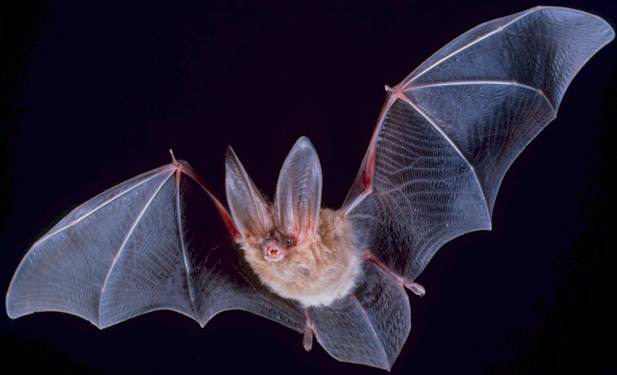
What’s it like being a bat?  ‘Seeing’ the world through your ears, or at least a sophisticated echo-location system. Or, what’s it like being an octopus?  With eight semi-autonomous arms that I wrote about a couple of weeks ago [see ‘Intelligent aliens?’ on January 16th, 2019]. For most of us, it’s unimaginable. Perhaps, because we are not bats or octopuses, but that seems to be dodging the issue.  Is it a consequence of our education and how we have been taught to think about science?  Most scientists have been taught to express their knowledge from a third person perspective that omits the personal point of view, i.e. our experience of science.  The philosopher, Julian Baggini has questioned the reason for this mode of expression: is it that we haven’t devised a framework for understanding the world scientifically that captures the first and third person points of view; is it that the mind will always elude scientific explanation; or is that the mind simply isn’t part of the physical world?

Our minds have as many neurons as there are stars in the galaxy, i.e. about a hundred billion, which is sufficient to create complex processes within us that we are never likely to understand or predict.  In this context, Carlo Rovelli has suggested that the ideas and images that we have of ourselves are much cruder and sketchier than the detailed complexity of what is happening within us.  So, if we struggle to describe our own consciousness, then perhaps it is not surprising that we cannot express what it is like to be a bat or an octopus.  Instead we resort to third person descriptions and justify it as being in the interests of objectivity.  But, does your imagination stretch to how much greater our understanding would be if we did know what is like to be a bat or an octopus?  And, how that might change our attitude to the ecosystem?

BTW:  I would answer yes, yes and maybe to Baggini’s three questions, although I remain open-minded on all of them.

Sources:

Baggini J, The pig that wants to be eaten and 99 other thought experiments, London: Granta Publications, 2008.

Rovelli C, Seven brief lessons on physics, London, Penguin Books. 2016.

Image: https://www.nps.gov/chis/learn/nature/townsends-bats.htm
Entropy on the brain

It was the worst of times, it was the worst of times.  Again.  That’s the things about things.  They fall apart, always have, always will, it’s in their nature.’  They are the opening three lines of Ali Smith’s novel ‘Autumn’.  Ali Smith doesn’t mention entropy but that’s what she is describing.

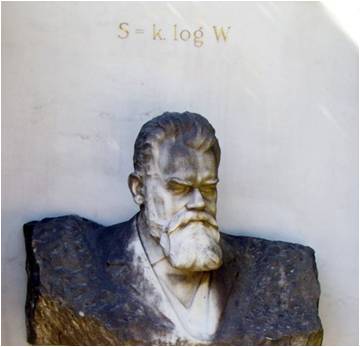
My first-year lecture course has progressed from the first law of thermodynamics to the second law; and so, I have been stretching the students’ brains by talking about entropy.  It’s a favourite topic of mine but many people find it difficult.  Entropy can be described as the level of disorder present in a system or the environment.  Ludwig Boltzmann derived his famous equation, S=k ln W, which can be found on his gravestone – he died in 1906.  S is entropy, k is a constant of proportionality named after Boltzmann, and W is the number of arrangements in which a system can be arranged without changing its energy content (ln means natural logarithm).  So, the more arrangements that are possible then the larger is the entropy.

By now the neurons in your brain should be firing away nicely with a good level of synchronicity (see my post entitled ‘Digital hive mind‘ on November 30th, 2016 and ‘Is the world comprehensible?‘ on March 15th, 2017).  In other words, groups of neurons should be showing electrical activity that is in phase with other groups to form large networks.  Some scientists believe that the size of the network was indicative of the level of your consciousness.  However, scientists in Toronto led by Jose Luis Perez-Velazquez, have suggested that it is not the size of the network that is linked to consciousness but the number of ways that a particular degree of connectivity can be achieved.  This begins to sound like the entropy of your neurons.

In 1948 Claude Shannon, an American electrical engineer, stated that ‘information must be considered as a negative term in the entropy of the system; in short, information is negentropy‘. We can extend this idea to the concept that the entropy associated with information becomes lower as it is arranged, or ordered, into knowledge frameworks, e.g. laws and principles, that allow us to explain phenomena or behaviour.

Perhaps these ideas about entropy of information and neurons are connected; because when you have mastered a knowledge framework for a topic, such as the laws of thermodynamics, you need to deploy a small number of neurons to understand new information associated with that topic.  However, when you are presented with unfamiliar situations then you need to fire multiple networks of neurons and try out millions of ways of connecting them, in order to understand the unfamiliar data being supplied by your senses.

For diverse posts on entropy see: ‘Entropy in poetry‘ on June 1st, 2016; ‘Entropy management for bees and flights‘ on November 5th, 2014; and ‘More on white dwarfs and existentialism‘ on November 16th, 2016.

Sources:

Ali Smith, Autumn, Penguin Books, 2017

Consciousness is tied to ‘entropy’, say researchers, Physics World, October 16th, 2016.

Handscombe RD & Patterson EA, The Entropy Vector: Connecting Science and Business, Singapore: World Scientific Publishing, 2004.

Digital hive mind

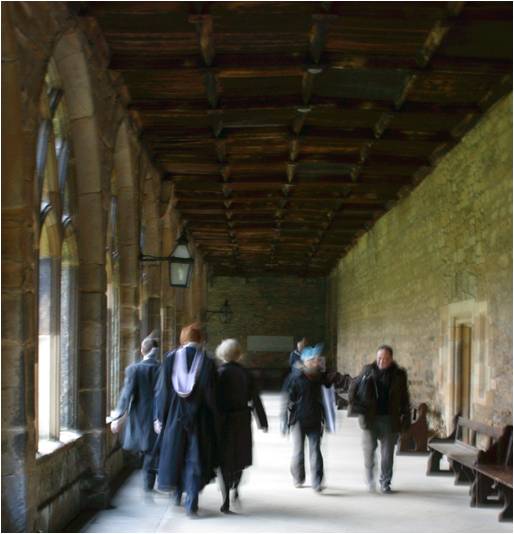
durham-cloistersFor many people Durham Cathedral will be familiar as a location in the Harry Potter movies.  However, for me it triggers memories of walking around the cloisters discussing Erwin Schrodinger’s arithmetical paradox: there seems to be a great number of conscious egos creating their own worlds but only one world.  Each of us appears to construct our own domain of private consciousness and Schrodinger identifies the region where they all overlap as the ‘real world around us’.  However, he raises questions such as, is my world really the same as yours?  Schrodinger proposes two solutions to the paradox: either there are a multitude of worlds with no communication between them or a unification of minds or consciousness.

Schrodinger found ‘it utterly impossible to form an idea about’ how his ‘own conscious mind should have originated by the integration of the consciousness of the cells (or some of them)’ that formed his body.  Recently this has been addressed by Susan Greenfield, who has proposed that short-lived coalitions of millions of neurons are responsible for consciousness.  These ‘neuronal assemblies’, which last for fractions of a second, link local events in individual cells with large scale events across the brain and many of ‘these assemblies flickering on and off somehow come together to provide a collective continuous experience of consciousness’.  In other words, our consciousness arises as an emergent behaviour of the myriad of interacting networks in our brain.  It seems no less fanciful that our individual minds networked together to generate a further level of emergent behaviour equivalent to the unified mind that Schrodinger conceived though, like Schrodinger, I find it utterly impossible to form an idea about how this might happen.

Perhaps, at some level we are creating a unified mind via the digital hive mind being formed by the digital devices to which we delegate some of the more mundane aspects of modern life [see my post entitled ‘Thinking out of the skull‘ on 18th March, 2015].  However, Greenfield worries about a very sinister potential impact of our digital devices, which is associated with the stimulation they provide to millions of the younger generation.  She thinks it could lead to small-scale neuronal assemblies becoming ‘the default setting in the consciousness of the digital native, to an extent it has never been in previous generations’.  In other words we might be losing the ability to create the emergent behaviour required for consciousness and shifting it to our digital devices.

Perhaps we are closer than we think to the vision in Maria Lassnig’s painting of the lady with her half of her brain outside her skull? [see my post entitled ‘Science fiction becomes virtual reality‘ on October 6th, 2016.

Sources:

Erwin Schrodinger, ‘Mind and Matter – the Tarner Lectures’ in What is Life?, Cambridge: Cambridge University Press, 1967.

Susan Greenfield, A day in the life of the brain: the neuroscience of consciousness from dawn to dusk, Allen Lane, 2016.

Clive Cookson, Know your own mind, FT Weekend, 15/16 October 2016, reviewing Greenfield’s book.

Nilanjana Roy ‘What it means to be human’ FT Weekend, 17/18 September 2016.