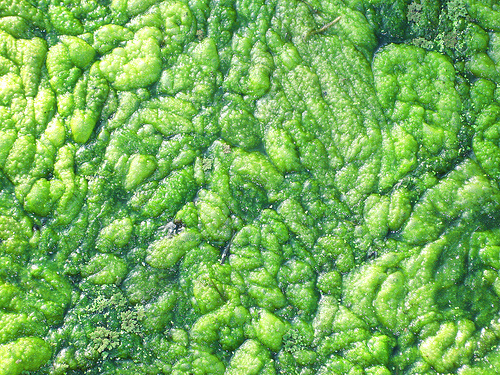
Recently, I attended an event organised by Airbus which included a film about their vision of aviation in 2050 followed by a question and answer session with their VP for Engineering in the UK, Neil Scott. A strong theme that I took away from the event was maintaining air transport as fossil fuels become scarce and expensive through the use of oceanic algae farmed and harvested to generate biofuels. This could be a good solution but we will need to consider the environmental impact of the massive level of ocean agriculture required to supply our airline system. Airbus propose a more balanced, diverse approach to sourcing biofuel in this short video on their website: http://videos.airbus.com/channel/iLyROoafYvHb.html; so perhaps I took away the wrong message from the event I attended.
More material
In previous posts I have mentioned the need for ‘more material’ in order to reduce the probability of failure. This is a little sloppy, since there are, at least, two options buried in these statements. Namely, the simple one, which is to add a greater mass of material; and the alternative, which is to use a stronger but lighter material, i.e. a more sophisticated material, e.g. a composite. These are usually also more expensive but can also provide opportunities to incorporate sustainability via bio-based recyclability [for information on bio-based composites see http://www.ag.ndsu.edu/bioepic/documents/symposium/NDS%20Bio-BasedMaterials-DRZAL-10-07-final.pdf%5D.
Risk definition

A section from a photoelastic model of turbine disc with a single blade viewed in polarised light to reveal the stress distribution.
Risk is defined as the possibility of something happening multiplied by the consequences when it does happen. The public understanding of risk sometimes only extends to the first half of this definition. Engineers seek to reduce the risks associated with component failure. This means accepting a non-zero probability of failure happening and then designing for least catastrophic consequences. So for instance in a jet engine, this implies designing so that if a crack develops it is in a blade rather than the disc to which all of the blades are attached. The engine casing can be designed to contain a single blade breaking off and thus protect the rest of the plane from flying debris, but not to contain the rupture of an entire disc and set of blades.
For more information on the photoelastic stress analysis techniques used to generate the image, see http://www.experimentalstress.com
Unlikely failure

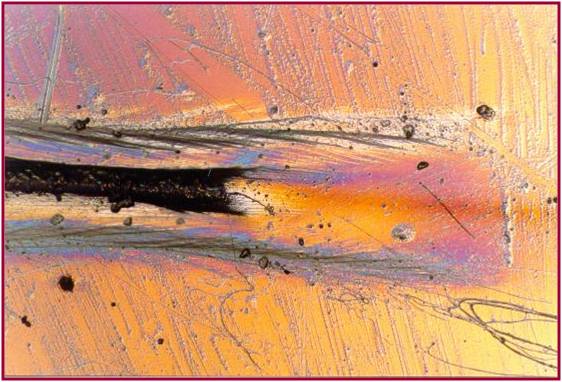
High magnification image of a crack in polycarbonate viewed in polarised light which reveals fringes that a proportional to the stress in the material.
I used the term ‘unlikely to fail’ in my last post, in the context of engineering designs. This might appear alarming, since people might assume that engineers design things to never fail. However it is impossible to design with a certainty that failure will not happen. There are several reasons for this, including: the conflicting requirements of less material to reduce cost and achieve sustainability and of more material to protect against failure; our lack of knowledge about in-service and exceptional operating conditions; and the extent, or otherwise, that the computational model used in the design analysis represents the real world.
Hence the phrase ‘unlikely to fail’. We can reduce the likelihood, or probability, of failure, usually at additional financial and resource cost, but we can never reduce the probability to zero, i.e. there is always a risk of failure, although we do our best to ensure that designs are ‘unlikely to fail’.