Category Archives: energy science

Trees are made of air

162-6273_IMGYes, it is April Fools Day but I am serious.  Trees are made of air.  Think about it.  What happens when they are burned?  You are left with a small pile of ash.  So where did the rest of the tree go?  When the tree ‘is burned, in the flaming heat is released the flaming heat of the sun which was bound in to convert air into the tree’.  These words are from Richard Feynman, who explains it much better than me.  Watch him on Youtube.
Sources:

Max Tegmark, Our Mathematical Universe, Penguin Books Ltd, 2014.

National Public Radio blog

Press button for an exciting ride

Painting by Katy Gibson

Artist: Katy Gibson

Someone has suggested that I should write more about what engineers do.  So here is the first in a series of posts in that vein.

A few weeks ago, I went to the ‘Future Powertrains Conference‘ held at the National Motorcycle Museum near Birmingham, UK.  A ‘powertrain’ is the system that creates and delivers power to the wheels of vehicles.  It is at the heart of a motorcycle but they were not discussed at the conference and instead the discussion was about cars and commercial vehicles.  There was a big focus on achieving the EU commitment under the Kyoto Protocol to reduce greenhouse gas emissions (GHG) to below 18% of 1990 levels.

Electric powertrains figured strongly and would certainly improve the air quality in our urban environment but they shift the GHG emissions problem to our powerstations [see my post on ‘Energy Blending‘ on May 22nd, 2013 and on ‘Small is beautiful and affordable in nuclear powerstations‘ on January 14th, 2015]. Even so, the high energy density of fossil fuels means that they remain a very attractive option.  The question that engineers are trying to answer is whether their GHG emissions can be reduced to below 18% of their 1990 levels.

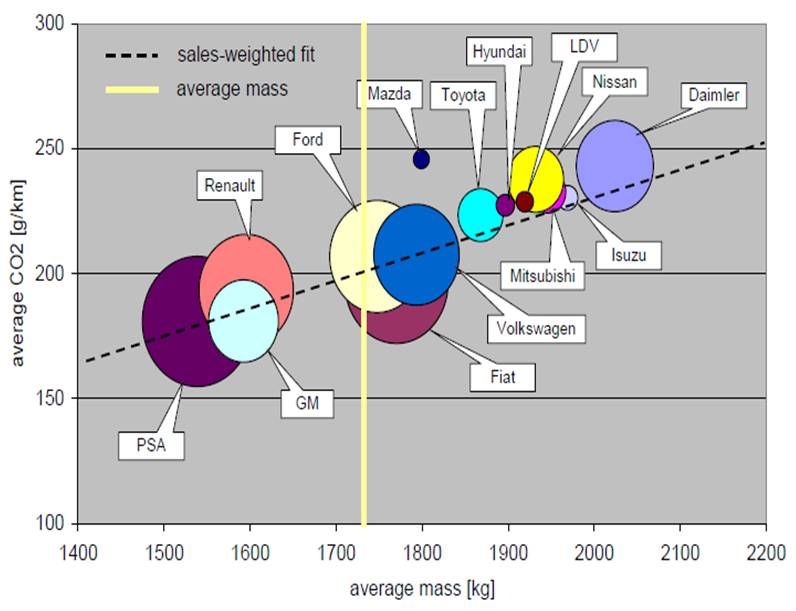
CO2 emissions vs mass of light commercial vehicles (see source below)

CO2 emissions vs mass of light commercial vehicles

When you plot CO2 emissions as a function of kerb weight for all passenger cars the graph reveals that the best in class achieve about 0.1 grams CO2 emitted per kilogram of kerb weight.  Kerb weight is the term used for the weight of a car without passengers or luggage but with a full fuel tank.  Of course, this means the simple answer is that we should all drive lighter cars!

The EU has assumed that most of us will not opt for lighter cars and has introduced legislation which is forcing manufacturers towards 0.02 grams CO2 per kg, which is a huge challenge that is being tackled at the moment by engineers, such as Paul Freeman at Mahle Powertrain Ltd who spoke at the conference.  To help meet this challenge, the UK Automotive Council has produced a series of technology roadmaps such as the one shown below and discussed by Dr Martin Davy from Oxford University during the conference.

As an alternative, we could move more quickly towards driverless cars which would both use the powertrain more efficiently and reduce the risk of accidents to almost zero.  A very small risk of accidents would allow lighter cars to be designed without a heavy crash-resistant cage.  But, as one conference delegate commented on ‘driving’ a driverless car “where would be the fun in that!”  Perhaps that shows a lack of imagination. After all, we can create exciting and safe fairground rides in which you have no control over the ‘vehicle’ into which you are strapped.  So why shouldn’t there be an ‘extra excitement’ button in a driverless car in just the same way that some modern cars have a ‘sport’ button.

passenger_vehicle_roadmap

Source:

Top graphic: http://ec.europa.eu/clima/events/docs/0019/final_report_lcv_co2_250209_en.pdf

Bottom graphic: http://www.automotivecouncil.co.uk/wp-content/uploads/2013/09/Automotive-Council-Roadmaps.pdf


Cosmic heat death

MSUSpartans_Logo.svgWhen I was at Michigan State University, Lou Anna Simon, the President was fond of talking about constructive tension as a source of innovation and progress. In other words, creative or productive work arises out of differences, for instance between aspirations and reality, or between supply and demand.  Rudolf Clausius in the 1850’s identified the irreversibility of heat flow across a temperature difference from hot to cold [see last week’s post on ‘Why is thermodynamics so hard?].  Sadi Carnot worked out the productivity of this difference in terms of the maximum efficiency with which work could be extracted from it [see my post ‘Impossible perfection‘ on June 5th, 2013].

William Thomson [1827-1907] followed a much more sinister line of thought and concluded that if all heat flows from hot to cold then eventually everything must end up at a uniform temperature, i.e. no differences.  He argued that no temperature differences implies no work could be extracted.  And nothing at all happens.  This is known as ‘cosmic heat death’.

A fellow Scotsman, James Clerk Maxwell [1831-1879] believed that this challenged human free will.  He proposed a loophole in the second law of thermodynamics to demonstrate its falsity and invalidate the cosmic heat death argument.  Imagine Maxwell’s demon, as it became known, controlling a trapdoor separating two clouds of gas initially at the same temperature, which means the gas molecules in the two clouds have the same average internal energy.  The demon allows ‘hot’ molecules (i.e. those with higher than average internal energy) to one pass way through the trapdoor and ‘cold’ molecules (i.e. those with lower than average internal energy) to move the other way. After a period of time, all the ‘hot’ molecules will be on one side of the trapdoor and all the ‘cold’ molecules will be on the other side.  Heat has moved from colder (initial average temperature) to hotter (on one side of the trapdoor) and the second law has been contravened.

Maxwell created hope for the inventors of perpetual motion machines! [see my post entitled ‘Dream machine‘ on February 4th , 2015]  But then along came Leó Szilárd in 1929, who pointed out that the demon would have to expend energy [do work] to identify the internal energy of the molecules and to open the trap-door.  The second law was saved and cosmic heat death became a prospect once again although a very, very distant one.  Some modern physicists, though not Professor Brian Cox, reject the possibility of cosmic heat death by suggesting that the universe is too complex and our understanding too incomplete to allow Thomson’s simple reasoning to be applied.  John Updike protested against the idea in his poem ‘Ode to Entropy‘.  And on a human timescale, it is hard to believe that all tensions will ever be resolved.

Sources:

Ball, P., A demon-haunted theory, Physics World, April, 2013, p.36-9

Updike, J., ‘Ode to Entropy‘ available in the Faber Book of Science edited by John Carey 2005

Cox, B., Death of the Universe, World Space Week Special BBC Wonders of the Universe, 2013

Why is thermodynamics so hard?

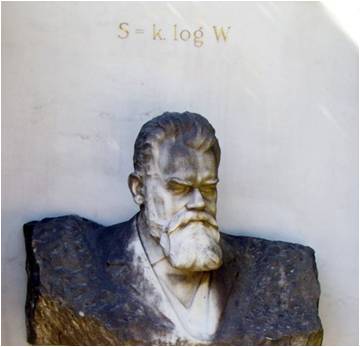
boltzmannAn understanding of the second law of thermodynamics has been equated to reading Shakespeare in terms of its cultural significance [see my post entitled ‘Two Cultures‘ on March 5th, 2013].  So why do so few people understand it?

Perhaps it is the way that it is traditionally taught starting from a series of corollaries. Oops.  There is the first problem. Most students don’t know what a corollary is.  It is a statement that builds on a previous statement.

It is hard to find a simple statement of the second law of thermodynamics. There is the Clausius statement: no process is possible, the sole result of which is that heat is transferred from a cold body to hot body.  Then there is the Kelvin-Planck statement and if you really want to be confused then try the Carathéodory formulation.  You can read them at the bottom of this post to reassure yourself that they are impenetrable.  They were formulated when steam engines were the main source of energy and it is hard to see their relevance today in biology, chemistry and culture.

A more generic expression of the second law of thermodynamics is ‘entropy always increases’.  Oh, but now I’ve introduced entropy.  Entropy is a measure of disorder [see my posts entitled ‘Entropy management for bees and flights‘ on November 5th, 2014 and ‘Zen and entropy‘ on December 11th, 2013 ].  So according to the second law, the level of disorder must always increase. Boltzmann proposed that the level of disorder of a system could be quantified as a universal constant [k] multiplied by the logarithm of the number of ways [W] a system could be arranged with the same energy content.  Ok, so that’s getting complicated again.  But Boltzmann was so proud of it that it is carved on his grave stone [see picture] and the constant is known as the Boltzmann’s constant [=ratio of the molar gas constant and Avogadro’s number].

In an attempt to express the second law in everyday language, Bob and I re-wrote the second law as ‘you can’t have it just anyway you like it‘ in our book, The Entropy Vector.  In other words there always has to be some unwanted disorder created.


Statements (corollaries) of the second law of thermodynamics:

Clausius statement: no process is possible, the sole result of which is that heat is transferred from a cold body to hot body.

Kelvin-Planck statement: no process is possible, the sole result of which is that a body is cooled and work is performed.

Carathéodory’s formation: in every neighbourhood of every equilibrium state there is at least one state which cannot be accessed by an adiabatic process.


Sources:

Thess A., The Entropy Principle: Thermodynamics for the Unsatisfied, Springer-Verlag, Berlin, 2011.

Handscombe RD., & Patterson, EA., The Entropy Vector: Connecting Science and Business, World Scientific Press, Singapore, 2004.