Category Archives: Soapbox

Impossible perfection

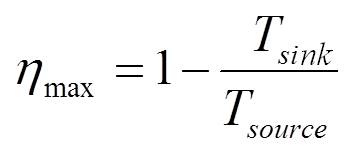
Carnot's equation for ideal efficiency of a cyclic device converting heat to work and operating between two temperatures specified on the Kelvin scale

Carnot’s equation for ideal efficiency of a cyclic device converting heat to work and operating between two temperatures specified on the Kelvin scale

In my last post [National efficiency on 29th May, 2013] I calculated the efficiency of the nationwide process of electricity generation in the UK [35.8%] and made no comment on the relatively low value.  It will be similarly in all industrialised countries as a consequence of the second law of thermodynamics and the requirement for all real processes to increase entropy.  A French engineer / scientist, Sadi Carnot [1796-1832] demonstrated from the second law, that the maximum efficiency achievable in ideal conditions by a process operating in a cycle to convert heat into work is a ratio of the temperatures of the heat source and cold sink to which excess heat is dumped.  In a power station the heat source might be a fossil-fuelled furnace, a nuclear reactor or a solar concentrator.  The cold sink is usually the environment, perhaps in the form of river or sea water.  So both source and sink temperatures are limited.  The sink by the local climate and the source by the temperatures that modern materials can withstand.

The very best efficiency based on Carnot’s expression for a maximum material temperature of 350 degrees Centigrade [=623 Kelvin] and environment temperature of 5 degrees Centigrade [278 Kelvin] is 55%.  Of course a real power station will never operate at this level because ideal conditions are not achievable – perfection is impossible.

The ideal efficiency improves as the operating temperatures of the heat source and sink are moved further apart and this quest to raise this temperature difference drives a substantial proportion of materials research.  However, even operating with a heat source at 800 degrees Centigrade, using expensive, high temperature alloys, such as Hastelloy N  [a nickel-chromium alloy], on a winter day in the Canadian capital, Ottawa where the average January daytime temperature is -7 degrees Centigrade, the Carnot efficiency of a power station would be only 75%  [=1-(266/1073)].

Energy blending

As I write this post, the electricity demand in the UK is 37.5 GW [=37,500,000,000 Watts].  The industry claims that wind turbines typically supply about 30 to 40% of their capacity, while the National Wind Watch in the US claims 15 to 30%.  In other words, a large wind turbine rated at 3MW [3,000,000 Watts] would will typically generate 1MW from its 50m blades that give it a total height of about 130m [about 30% higher than St Paul’s Cathedral in London].  So 37,500 such wind turbines would be required to meet current electricity demand in the UK, or one for every 1.6 miles on a square grid covering the country, which is why blending of energy sources is essential [see posting on May 15th, 2013 on Energy diversity].

We can do similar calculations for solar panels, which typically produce 250 Watts /square metre but for only perhaps 4 hours per day in the UK, so that 150 square kilometres of solar panels would be needed to meet current demand, if the sun was shining which it is not – another reason for blending energy sources.

Fossil fuel fired power stations make up 70% of the blend in the UK and are responsible for about 25% of the UK carbon emissions.  The UK government aims to reduce carbon emissions by 80% by 2050 (based on 1990 levels), so about 65% of the UK powerstations have to be changed in the next 35 years to provide a more sustainable blend of energy sources.  This is not long given the scale of the infrastructure projects required and the situation is the same in many countries around the world.  So there is plenty for engineers to do once the decisions have been made on the blend.

[ http://www.gov.uk/government/uploads/system/uploads/attachment_data/file/65897/5939-energy-flow-chart-2011.pdf ]

[ http://www.gov.uk/government/policies/reducing-the-uk-s-greenhouse-gas-emissions-by-80-by-2050 ]

Energy diversity

Probably most people never give a thought to where the power comes from to switch on the light or their TV.  Engineers are primarily responsible for ensuring that the right number of power stations are available to supply exactly the right amount of electricity to match demand.  If supply exceeds demand then energy needs to stored, for instance at the Dinorwig storage scheme [ http://www.fhc.co.uk/dinorwig.htm ]; however if demand exceeds supply then someone’s lights will dim or go out until an additional power station can be switched on or the output increased from one that is running.  The latter is a relatively quick process but switching on a power station takes longer than half time in a televised football match when everyone switches on the kettle or makes some toast.

You can see how national demand in the UK varies in real-time at the National Grid website [ http://www.nationalgrid.com/uk/Electricity/Data/Realtime/Demand/demand24.htm ].  There is a similar “national electricity meter”  for Spain  [ https://demanda.ree.es/demandaEng.html ], which also shows the blend of energy sources being used.

Blending sources such as fossil fuels, hydro, nuclear, solar, tidal and wind is the key to a cost-effective sustainable energy supply with the diversity to adapt to unexpected circumstances.

Sustainable democracy

The concept of a continuously growing economy does not seem compatible with the creation of a sustainable society.  It is not possible to carry on producing more and more in a world that has finite resources, see my post on an ‘Open-world Mind-set’ on 4th January 2013.

Eventually, engineers and scientists will solve the problems of providing a sustainable and high quality of life to the global population.  However, one likely consequence is a world economy that does not grow, at least not as currently measured.  Modern Western-style democracy is based ‘on the ability of competing parties to offer voters a better material future (more stuff) year by year’ [Andrew Marr, A History of the World, MacMillan, 2012].  What is going to happen when voters acknowledge this vision is unrealizable?

Perhaps it is happening already in the US and Europe.  The turnout in elections is low – between 30 and 40% in local elections in the UK last week.  The PR industry is playing a bigger role in politics and selling a brand rather than policies.  Economic growth has all but stopped, and is proving difficult to re-start.

I suspect that sustainable engineering is going to be easy to achieve compared to eliminating the dependence of our democracies on growth.  Let’s hope the patient does not die before being cured of the addiction!