We are privileged to have magnificent views of the river and mountains beyond from our city centre house. However, the house was built before the motor car was invented when the loudest event outside might have been rowdy party-goers heading for home. We still have some party-goers walking home under our bedroom window at night but most of them travel by noisy taxis. I look forward to when the price of fossil fuels, or legislation will force taxis to become electric-powered. In the meantime, we have been designing secondary glazing that will offer a high resistance to noise transmission and be in keeping with the early 19th century windows. Noise is a form of energy transfer by vibrations, acoustic energy would be an alternative term for it, and so the combined resistance of the outside wall of my bedroom can be calculated using Kirchhoff’s law, as discussed for heat transfer in my last post [Born in a barn, 20th March, 2013]. In this case, the thin and badly-fitting but antique glass is the dominant component of both the heat and noise resistance. We were happy to deal with the poor resistance to heat transfer by using plenty of bedclothes, i.e. adding a large resistance in series, but the same approach does not work with noise because earplugs are uncomfortable, fall out in your sleep and have a low resistance at the frequency of taxi-generated noise. So, the solution is secondary glazing and the best performance is achieved using an acoustic laminate consisting of a polymer sandwiched between two sheets of glass which should be different thickness to avoid resonant effects. Of course this will also improve the resistance to heat transfer which will be advantageous in winter, but perhaps not in summer…
Tag Archives: Thermodynamics
Born in a barn
In my previous post [Traffic hold-ups, 13th March 2013] the application of Kirchhoff’s Law to the flow of electrons, water and traffic was discussed. In this context, electrical current or electrons were conceived as flowing. Instead, electrical current can be considered as electrical energy being transferred across a potential difference, or voltage. When this terminology is used, then it is only a short step to extend the use of Kirchhoff’s law to consider the combined effect of multiple resistance to other forms of energy transfer, such as heat transfer. Heat transfer occurs across a temperature difference, from hot to cold, and some materials offer more resistance than others, e.g. wood compared to glass. Kirchhoff’s law can be used to calculate the total resistance to heat transfer of complex structure such as a house wall that some components in series, e.g. layers of brick, insulation and plasterboard, and some in parallel, e.g. doors and windows. This information is important in designing a house to achieve minimum energy consumption and to specify the heating and cooling systems required. Note that the inverse form of Kirchhoff’s Law means that the low resistance to heat transfer of a door or window dominates the heat transfer characteristics of a well-insulated structure. Of course, the extreme case is when you leave the door open and on a cold day someone shouts at you: ‘Were you born in a barn?’.
Two Cultures
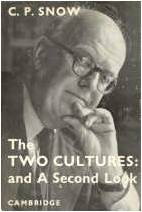
The term ‘Two Cultures’ was coined by Sir Charles Snow more than fifty years ago in his 1959 Rede Lecture to describe the gulf that existed then and persists today between scientists and non-scientists. He equated not knowing the second law of thermodynamics to never having read anything by Shakespeare. A number of my posts have referred to the Second Law of Thermodynamics because it explains why engines run and chemical reactions occur but to quote Peter Atkins, it is also ‘the foundation for understanding those most exquisite consequences of chemical reactions – acts of literary, artistic and musical creativity that enhance our culture‘.
Snow, C.P., The Two Cultures: and A Second Look, Cambridge University Press, Cambridge, 1964.
Atkins, P., The Laws of Thermodynamics – A Very Short Introduction, Oxford University Press, Oxford, 2010.
Something for nothing?
Let’s try a thought experiment, following on from my previous post (Beyond Zero on 20th February, 2013). Imagine two equal amounts of matter, A and B at -350 Kelvin and 350 Kelvin respectively. We would expect heat to flow from the hot one, that’s B to A, the cold one. This would cause the internal energy of B to decrease with a corresponding rise in the internal energy of A so that B gets colder while A gets hotter, i.e. they both move closer to absolute zero with corresponding decreases in entropy. The Second Law of Thermodynamics does not allow this to happen and in fact the reverse would occur, i.e. heat would flow from the cold one A to B, lowering the temperature of A and raising the temperature of B so that they both move away from absolute zero with corresponding increases in entropy.
IF we could actually make this happen then we would able to design engines with efficiencies higher that 100%. One corollary of the Second Law of Thermodynamics is that heat cannot be converted into work without some of the heat being wasted or lost as entropy. In a power station, heat is taken from a hot source (e.g. a nuclear reactor, solar concentrator or gas furnace) and some of it converted into shaft work, which turns a generator to produce electricity, while the remainder is dumped into a cold sink usually the environment via cooling towers. However, if our cold sink was at a negative temperature on the Kelvin scale then we could take heat from the cold sink and the hot source at the same time! Why aren’t we doing this? Well, we don’t have any naturally occurring cold sinks at below zero Kelvin and to create one uses more energy than we would gain in our super-efficient power station – that’s the Second Law kicking in again. So you can’t have something for nothing.