Tag Archives: sustainability

Renewable energy?

115-1558_IMG

Old Faithful

‘Renewable energy’ is an interesting use of words because the first law of thermodynamics tells that energy is always conserved while the second law implies that during all processes the quality or usefulness of energy is degraded.  Both energy ‘generation’ and ‘consumption’ are processes in which energy is converted from one form to another with some degradation in quality or usefulness; how much degraded energy is produced compared to useful energy or electricity in a generation process is a measure of the efficiency of the process.  Whereas in a consumption process we expected most of the energy to be degraded to the point of uselessness, often in the form of heat or noise.  So the concept of renewable energy suggests that we can somehow refresh or recover the quality and usefulness of energy degraded in consumption processes.  In practice it is not possible to refresh or renew the energy, instead we replenish it with new ‘high quality’ energy arriving from the sun.

The picture shows Old Faithful Geyser in Yellowstone National Park in the USA.

Open-world mind-set

Can we consider the world to be a closed system?  The universe surrounding the Earth is largely a vacuum so that only the occasional meteorite enters the system and gravity prevents anything leaving, besides a rocket now and then.  Thus, it is not unreasonable to approximate the Earth as a closed system but it is not an insulated system because there is a continuous transfer in and out of energy derived from the sun.  There is a nice summary diagram of this energy transfer in a paper by Kiehl and Trenberth (1997) [http://www.cgd.ucar.edu/cas/abstracts/files/kevin1997_1.html].  The premise of the movement towards sustainability is that our world is closed system which thus contains finite material resources although there is a continuous supply of energy into the system from the sun, which provides us with the concept of ‘renewable energy’.  At the beginning of the industrial revolution our consumption of the world’s resources seemed miniscule compared to the available resources, which appeared effectively infinite and led to an ‘open-world’ mindset, i.e. an approach to living that assumed a continuous supply of energy and material into an open system.  Today, our consumption of resources has grown enormously and we close to exhausting some supplies, which is typified by the fact that the average person on Earth uses 5.7 acres of biologically productive land to supply resources and absorb waste, but only 4.7 acres/person are available for the current global population.  To achieve sustainability we need to switch from an open-world or open-system mind-set to a closed-world or closed-system way of thinking.  A report entitled ‘The New Sustainable Frontier’ published in 2009 by the US GSA Office of Governmentwide Policy [http://www.gsa.gov/graphics/ogp/2009_New_Sustainable_Frontier_Complete_Guide.pdf] is much more eloquent than me on this subject.  See also my ‘Two Earths’ post on August 13th, 2012.

Drawing boundaries

147-4792_IMGMy family and I have been settling into a new home during the last few months, which is why there have been no posts for some time.  You could say that we have new boundaries which define our space in the city.  Indeed, as part of the process of buying our house we received copies of the entry in the UK Land Registry which defined the extent of the property we were purchasing. On a larger scale, ‘boundaries are lines drawn on a map and fought over by man’; this is a quote that I came across sometime ago but unfortunately I have lost the source.  It implies that the judgments made in drawing national or regional boundaries are fraught with difficulty.

Engineers have to draw boundaries in order to define a system for analysis.  In thermodynamics, which is the study of energy, a system is defined as the part of the universe that is the centre of attention and everything outside of the system is described as the ‘surroundings’.  This approach provides enormous freedom in defining the system for analysis and as a consequence there is some significant skill involved in drawing the boundaries so that an analysis is both viable and useful.  Students learning thermodynamics might say it was ‘fraught with difficulty’.

Drawing appropriate boundaries to define a system allows us to evaluate energy and mass transfers in and out of the system and thus assess the capabilities and efficiency of the system.  The system could be a jet engine, a refrigerator or a biological cell.  Of course, the freedom available in drawing system boundaries is open to abuse because organisations can draw the boundaries to optimise the claimed efficiency of their product, so we need to be careful about accepting such claims.  For instance, fuel efficiency values for electric cars look impressive alongside a conventional petrol or diesel vehicle and thus imply less use of the world’s resources; however, such values rarely take account of the generation of electricity at the power station, which might be oil-fired depending on where you live.  Thus a ‘well-to-wheel’ efficiency would be more appropriate if you are interested in global sustainability, or Euros/kilometre if you are more interested in financial efficiency.

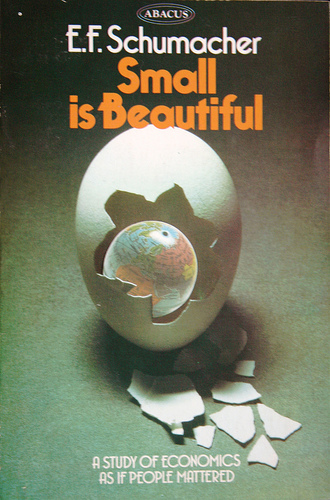
Small is beautiful

In the context of using algae to produce aviation fuel (see my previous post), ‘small is beautiful’ to cite the title of the famous book by E.F. Schumacher.  As a society we have tended towards achieving perceived economies of scale that lead to a uniformity of approach and a lack of diversity. ‘Perceived’ because often the boundary for the economic calculation is defined in a way that excludes the entropy demanded by the second law of thermodynamics and which should be included on the deficit side of the calculation.  Engineers learn about drawing appropriate boundaries for systems and looking for the source of entropy creation.  Sometimes, perhaps as in the case of the algae-based biofuels, we are unaware of the form and magnitude of the entropy being generated and hence there is a considerable risk that we will be surprised when we find out about it.  The entropy might take the form of heat, disorder, pollution, climatic disruption or combinations of these phenomena. So, pursuing a diverse set of approaches at a modest level, reduces the risk of an unpleasant surprise with substantial ecological and, or financial consequences.