Tag Archives: neuronal assemblies

Digital limits analogue future

Feet on Holiday I 1979 Henry Moore OM, CH 1898-1986 Presented by the Henry Moore Foundation 1982 http://www.tate.org.uk/art/work/P02699

Feet on Holiday I 1979 Henry Moore OM, CH 1898-1986 Presented by the Henry Moore Foundation 1982 http://www.tate.org.uk/art/work/P02699

Digital everything is trendy at the moment.  I am as guilty as everyone else: my research group is using digital cameras to monitor the displacement and deformation of structural components using a technique called digital image correlation (see my post on 256 Shades of grey on January 22nd, 2014) .  Some years ago, in a similar vein, I pioneered a technique known as ‘digital photoelasticity’ (se my post on ‘Cow bladders lead to strain measurement‘ on January 7th, 2015..  But, what do we mean by ‘digital’?  Originally it meant related to, resembling or operated by a digit or finger.  However, electronic engineers will refer us to A-to-D and D-to-A converters that transform analogue signals into digital signals and vice versa.  In this sense, digital means ‘expressed in discrete numerical form’ as opposed to analogue which means something that can vary continuously .  Digital signals are ubiquitous because computers can handle digital information easily.  Computers could be described as very, very large series of switches that can be either on or off, which allows numbers to be represented in binary.  The world’s second largest computer, Tianhe-2, which I visited in Guangzhou a couple of years ago, has about 12.4 petabytes (about 1016 bytes) of memory which compares to 100 billion (1012) neurons an average human brain.  There’s lots of tasks at which the world’s largest computers are excellent but none of them can drive a car, ride a bicycle, tutor a group of engineering students and write a blog post on the limits of digital technology all in a few hours.  Ok, we could connect specialized computers together wirelessly under the command of one supercomputer but that’s incomparable to the 1.4 kilograms of brain cells in an engineering professor’s skull doing all of this without being reprogrammed or requiring significant cooling.

So, what’s our brain got that the world latest computer hasn’t?  Well, it appears to be analogue and not digital.  Our consciousness appears to arise from assemblies of millions of neurons firing in synchrony and because each neuron can fire at an infinite number of levels, then our conscious thoughts can take on a multiplicity of forms that a digital computer can never hope to emulate because its finite number of switches have only two positions each: on and off.

I suspect that the future is not digital but analogue; we just don’t know how to get there, yet.  We need to stop counting with our digits and start thinking with our brains.
Digital hive mind

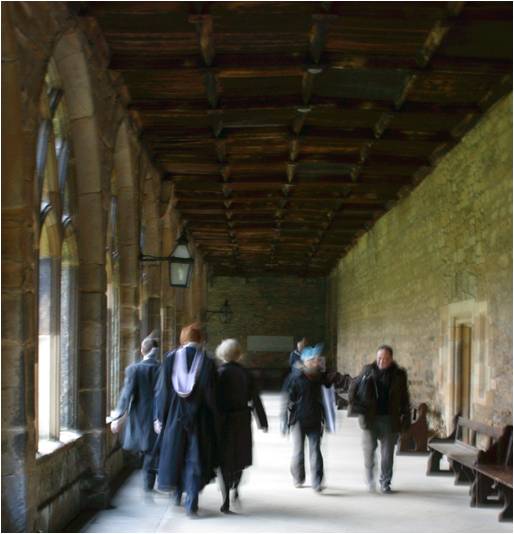
durham-cloistersFor many people Durham Cathedral will be familiar as a location in the Harry Potter movies.  However, for me it triggers memories of walking around the cloisters discussing Erwin Schrodinger’s arithmetical paradox: there seems to be a great number of conscious egos creating their own worlds but only one world.  Each of us appears to construct our own domain of private consciousness and Schrodinger identifies the region where they all overlap as the ‘real world around us’.  However, he raises questions such as, is my world really the same as yours?  Schrodinger proposes two solutions to the paradox: either there are a multitude of worlds with no communication between them or a unification of minds or consciousness.

Schrodinger found ‘it utterly impossible to form an idea about’ how his ‘own conscious mind should have originated by the integration of the consciousness of the cells (or some of them)’ that formed his body.  Recently this has been addressed by Susan Greenfield, who has proposed that short-lived coalitions of millions of neurons are responsible for consciousness.  These ‘neuronal assemblies’, which last for fractions of a second, link local events in individual cells with large scale events across the brain and many of ‘these assemblies flickering on and off somehow come together to provide a collective continuous experience of consciousness’.  In other words, our consciousness arises as an emergent behaviour of the myriad of interacting networks in our brain.  It seems no less fanciful that our individual minds networked together to generate a further level of emergent behaviour equivalent to the unified mind that Schrodinger conceived though, like Schrodinger, I find it utterly impossible to form an idea about how this might happen.

Perhaps, at some level we are creating a unified mind via the digital hive mind being formed by the digital devices to which we delegate some of the more mundane aspects of modern life [see my post entitled ‘Thinking out of the skull‘ on 18th March, 2015].  However, Greenfield worries about a very sinister potential impact of our digital devices, which is associated with the stimulation they provide to millions of the younger generation.  She thinks it could lead to small-scale neuronal assemblies becoming ‘the default setting in the consciousness of the digital native, to an extent it has never been in previous generations’.  In other words we might be losing the ability to create the emergent behaviour required for consciousness and shifting it to our digital devices.

Perhaps we are closer than we think to the vision in Maria Lassnig’s painting of the lady with her half of her brain outside her skull? [see my post entitled ‘Science fiction becomes virtual reality‘ on October 6th, 2016.

Sources:

Erwin Schrodinger, ‘Mind and Matter – the Tarner Lectures’ in What is Life?, Cambridge: Cambridge University Press, 1967.

Susan Greenfield, A day in the life of the brain: the neuroscience of consciousness from dawn to dusk, Allen Lane, 2016.

Clive Cookson, Know your own mind, FT Weekend, 15/16 October 2016, reviewing Greenfield’s book.

Nilanjana Roy ‘What it means to be human’ FT Weekend, 17/18 September 2016.