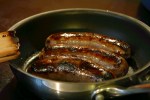
 In my post on 19th June 2013 [Closed system on the BBQ], I discussed the thermodynamics of sausages cooking on a barbeque in the context of the first law of thermodynamics. This is an everyday example of engineering principles [see my post entitled ‘Bridging cultures’ on June 12th, 2013]. I mentioned that the energy gained by a sausage causes it to be cooked and for the water-content to boil as the temperature is raised. The rise in temperature causes the pressure inside the sausage to increase, which is Gay-Lussac’s law in action. When the water-content of the sausage starts to boil, the steam produced raises the pressure even further providing the sausage skin remains impervious to the transfer of matter, i.e. the steam. The sausage as a closed system that becomes a miniature pressure vessel.
Pressure vessels fail as a result of the stresses in their wall. In engineering, stress is defined as force divided by the area of material carrying the force. My sausages always fail longitudinally, i.e. they burst open with splits running along their length. This is because the stress across the split, known as the circumferential or hoop stress, is the largest stress in the skin.
It is relatively simple to use Newton’s Third Law, about there being an equal and opposite reaction for every action force, to show that the circumferential stress is larger than the longitudinal stress; but it is a level of detail beyond what I feel is appropriate here. Bursting sausages are a good illustration of Everyday Examples of Engineering, which became the ‘poster-child’ of the NSF-funded project that developed them in the USA . The pedagogy underpinning the use of Everyday Examples is explained in detail in a paper in the European Journal of Engineering Education (vol 36, pages 211-224, 2011) and a 5Es lesson plan is available here [for more on 5Es lesson plans see my post entitled ‘Disease of the modern age’ on June 26th, 2013].
You can see a video of me talking about these sausages at http://www.youtube.com/watch?v=nsSxKuRo4H0
EJEE paper: http://www.tandfonline.com/doi/abs/10.1080/03043797.2011.575218#.UbG9TZyPMx4
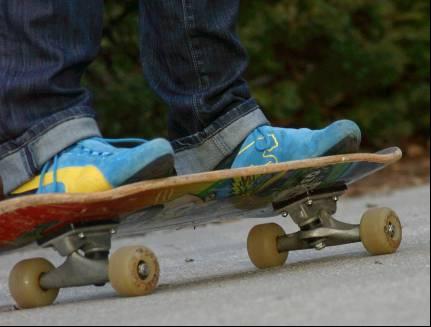 Walking through campus last week I saw a stonemason carving small chamfers every 30cm or so around the edge of plinth being prepared to receive a new sculpture. A few days later there were metal tabs fitted in the chamfers, presumably to discourage skateboarders from using the plinth for acrobatics. These metal tabs are becoming as common in our public places as the skateboarders they are designed to discourage. I can understand old people being worried by fast moving youngsters on skateboards, but the speed and freedom of movement is part of the attraction for young people. As a teacher of engineering, I see the skateboard as another everyday example of engineering with which to liven up the classroom and grab students’ attention. Try riding a board into class to engage attention!

 Realize Engineering