Tag Archives: heat transfer

Emergent properties

storm over canyonPerhaps my strongest memory of being taught at school is that of the head of chemistry combining hydrogen and oxygen using an old glass drinks bottle and a burning taper.  The result was explosive, exciting and memorable.  It certainly engaged the attention of everyone in the class.  As far as I am aware, the demonstration was performed at least once per year for decades; but modern health and safety regulations would probably prevent such a demonstration today.

One of the interesting things about combining these two gases at room temperature is that the result is a liquid: water.  This could be construed as an emergent property because an examination of the properties of water would not lead you to predict that it was formed from two gases.  The philosopher C.D. Broad (1887-1971) coined the term ’emergent properties’ for those properties that emerge at a certain level of complexity but do not exist at lower levels.

Perhaps a better example of emergent properties is the pressure and temperature of steam.  We know that water molecules in a cloud of steam are whizzing around randomly,bouncing into one another and the walls of the container – this is the kinetic theory of gases.  If we add energy to the steam, for instance by heating it, then the molecules will gain kinetic energy and move around more quickly.  The properties of pressure and temperature emerge when we zoom out from the molecules and consider the system of the steam in a container.  The temperature of the steam is a measure of the average kinetic energy of the molecules and the pressure is the average force with which the molecules hit the walls of the container.

Manuel Delanda takes these ideas further in a brilliant description of modelling a thunderstorm in his book Philosophy and Simulation: The Emergence of Synthetic Reason.  There are no equations and it is written for the layman so don’t be put off by the title.  He explains that emergent properties can be established by elucidating the mechanisms that produce them at one scale and then these emergent properties become the components of a phenomenon at a much larger scale. This allows engineers to construct models that take for granted the existence of emergent properties at one scale to explain behaviour at another, so for example we don’t need to model molecular movement to predict heat transfer. This is termed ‘mechanism-independence’.

Ok, that’s deep enough for one post!  Except to mention that Capri & Luisi have proposed that life is an emergent property that is not present in the constituent parts of living things and which only appears when the parts are assembled.  Of course, it also disappears when you disassemble a living system, i.e. dissect it.

Sources:

Chapter 1 ‘The Storm in the Computer’ in Philosophy and Simulation: The Emergence of Synthetic Reason by Manuel Delanda, published by Continuum, London, 2011 (pages 7-21).

Fritjof Capra and Luigi Luisi, The Systems View of Life: A Unifying Vision, Cambridge University Press, 2014.

Cold power

Last week I wrote about heat transfer into fridges in the context of operation in vacation mode.  It is tempting to think that if energy is moving into the fridge as a result of heat transfer from the warm room to the cold food compartment in the fridge, then why can’t we use the energy to power the fridge.  A fridge that operated on this basis would be categorised as a perpetual motion machine of the second type because it would contravene the second law of thermodynamics and so it can’t exist.  One of the great pioneers of thermodynamics, Rudolf Clausius expressed the second law as ‘heat does not pass from a body at a low temperature to one at high temperature without an accompanying change elsewhere’.  In other words, something has to be done, generally in the form of work, to move energy from a cold to hot place, e.g. from the food compartment of the fridge to the warmer room.

refrigeration cycle


In a domestic fridge, the work is supplied in the form of electricity to drive a compressor – that’s the thing making most of the noise coming from your fridge.  It is compressing a refrigerant gas (typically from atmospheric pressure to about 8 times atmospheric pressure) and in the process raising its temperature (perhaps by 80°C) as it pushes the gas into a condenser.  In the condenser, the hot refrigerant transfers heat to the colder room and in the process condenses from a gas to liquid dropping its temperature, perhaps by 30°C.  Then, the liquid refrigerant flows into an expansion valve where its rapid expansion to a gas lowers both its temperature (perhaps to -20°C) and pressure (typically from 8 times atmospheric pressure back to atmospheric) before it is sucked into the heat exchanger inside the food compartment where its very low temperature causes heat transfer from the compartment to the refrigerant, i.e. it removes the unwanted energy.  The compressor sucks the gas out of the heat exchanger and the whole cycle starts again with the unwanted energy being dumped into the room by the condenser, which is the warm panel on the back of your fridge.

If you understood all of that then well done, if not then try again following the steps on the schematic diagram.

The temperatures and pressures are expressed rather vaguely because they depend on the design of the fridge and the settings you select on the control panel.

Vacation mode

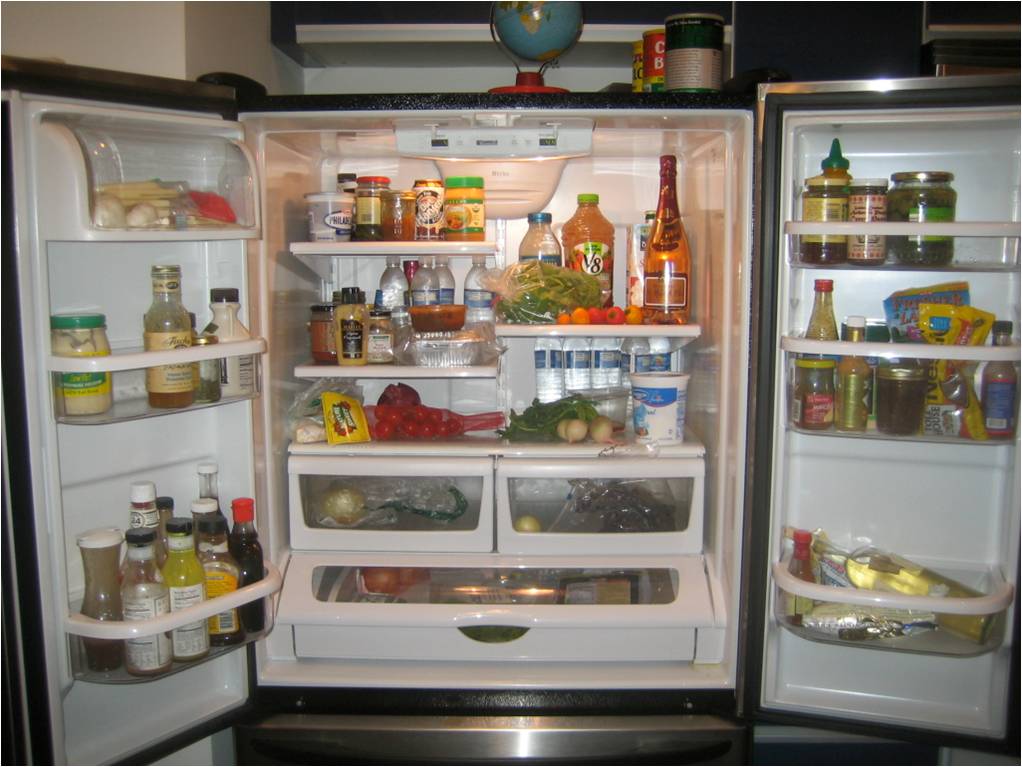
fridge2Many people are in vacation mode at the moment.  In some organisations it is impossible to hold meetings because of non-overlapping holidays, unless of course you work in countries where everyone goes on holiday at the same time – try getting in or out of Paris on certain weekends in August!  We have been away already and when we got back home one question that was asked is ‘What was the fridge/freezer doing while it was set on vacation mode?’  Fridge and freezers are one of the largest consumers of power in most households so saving energy while we are away on vacation makes sense and there are a number of strategies adopted by different manufacturers.  The most common one is to raise the temperature of the fridge compartment to around 39°F or 4°C which is just cold enough to prevent bacterial growth. Energy movement due to heat transfer is proportional to the temperature difference. Hence, if the temperature difference between the fridge and its surroundings is reduced then there will be less heat transfer into the fridge and less energy will be expended to remove it and keep the contents cold.  Of course the door being shut thoroughout the vacation helps.

In normal use, when we open the door there is heat transfer into the fridge from the warmer room which raises the energy level inside the fridge.  This energy is stored as internal energy in the air and fridge contents and temperature is a measure of this internal energy level, i.e. the temperature goes up.  The fridge has to perform work to remove the internal energy and reduce the temperature.  The situation is exacerbated by the light inside the fridge which comes on when the door is opened because the light bulb generates heat, this is the basis of Everyday Engineering Example about the extra cost of running of a fridge when the light stays on permanently because the switch is broken.

Back to vacation mode for a moment, most fridge/freezers also de-activate the automatic defrost function in vacation mode as well, to save energy.

Sources:

Alison for asking the question – thank you.

Information on safe food storage – Food Safety and Inspection Service

Watched kettle never boils

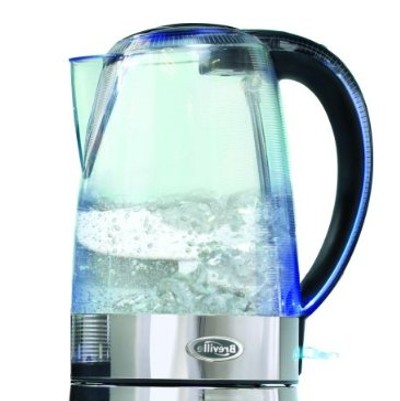
boiling kettleThe phrase ‘a watched kettle never boils’, or a watched pot as Americans might prefer say, is a familiar phrase.  We have probably all stood waiting for water boil thinking it is taking a long time.  This might be in part because the rate of boiling does indeed slow down during the heating process and then speed up towards the end.

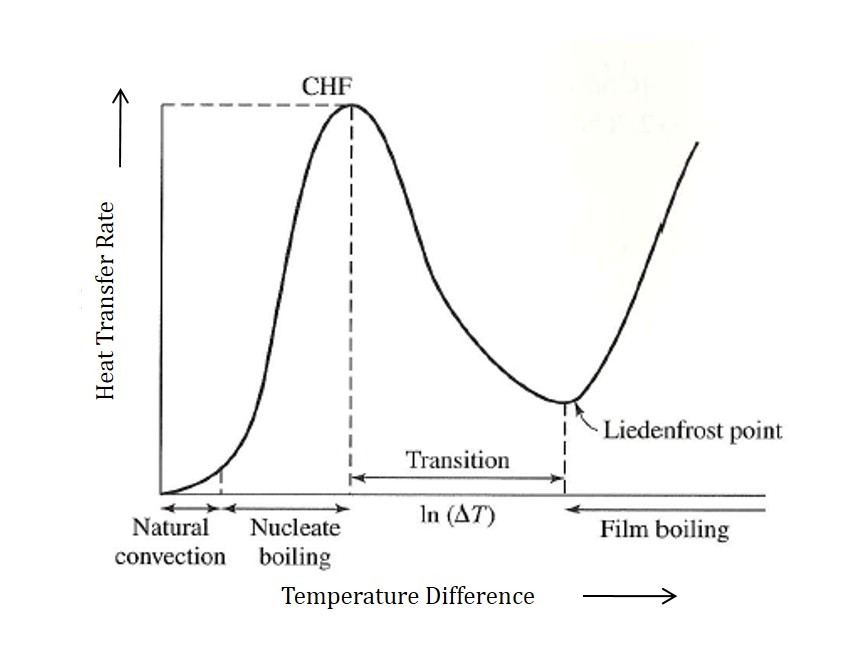
When an electric kettle is first switched on the element in the bottom of the kettle heats up causing heat to be transferred by conduction to the water.  The water adjacent to the element rises in temperature becomes less dense, moves towards the surface and transfers heat by natural convection to the contents of the kettle.  As the temperature of the water rises, tiny bubbles form on the element due to local boiling.  Bubbles are dislodged by new ones forming and float up to the surface giving the appearance that complete boiling is imminent.  However, as the temperature rises further the element becomes completely covered by a film of vapour that insulates the element from the water and slows down heat transfer to the water.  This delays boiling until the element has pumped enough energy (heat) into this film for heat transfer to occur across it from the element to the water. Sections of the film tend to break away and belch onto the surface of the water.  This process of large bubble formation and belching on the surface usually establishes itself fairly quickly once the first one has broken free and we see the familiar violent boiling of the kettle.

So the watched kettle has boiled but only after what might have seem like an interminable delay.  If you have a transparent electric kettle then you can watch this happen, otherwise you could watch a YouTube video – possible the most boring video on YouTube?

The process described above is known as the Liedenfrost effect and is illustrated graphically in the chart below, which is based on Figure 6.16 in ‘The Design and Simulation of Thermal Systems‘ by NV Suryanarayana and Oner Arici published by McGraw-Hill.  There are a number of more comprehensive explanations available, for example by Jearl Walker.  The Leidenfrost effect is also responsible for the way water disperses in liquid droplets across a very hot surface instead of evaporating as steam, see this Youtube clip for more explanation.

boiling graph