Tag Archives: gadget stress

Horizon therapy

A couWP_20160401_003ple of weeks ago I discovered a new expression: ‘horizon therapy’.  I came across it in an exhibition at the British Museum in London.  I had spent two days at a symposium on inclusivity in engineering education and when it finished, I sauntered into the British Museum for a bit of mind-wandering [see my post entitled ‘Mind-wandering‘ on September 3rd, 2014]  because the museum had late-night opening and I had a couple of hours before my evening train home.  I wandered into an exhibition called ‘Living and Dying’ that contained an installation called ‘Cradle to Grave‘ by Pharmacopoeia and funded by the Wellcome Trust.

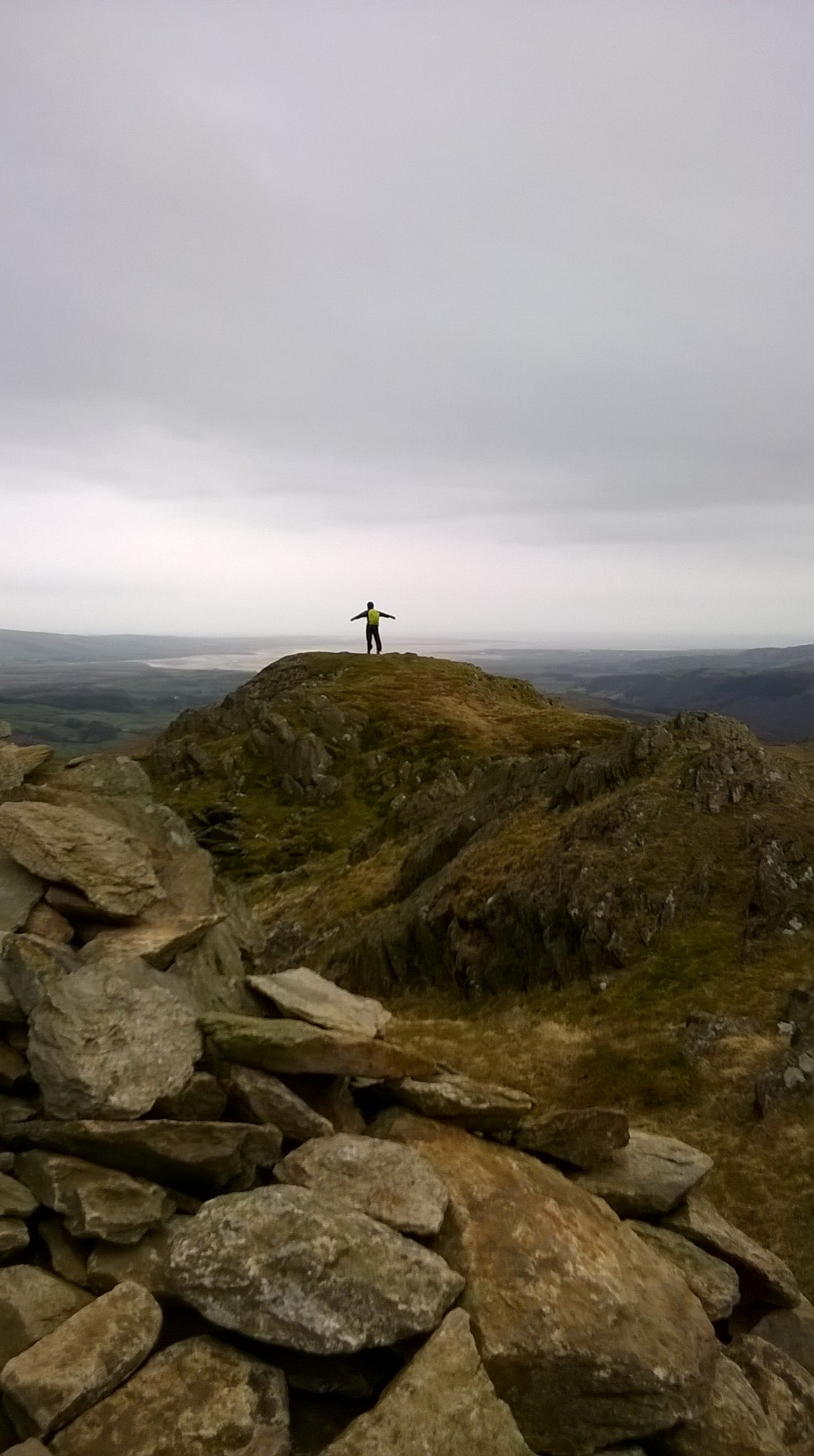
No explanation was given for the term ‘horizon therapy’ that appeared under a snap-shot of a man admiring a sea-view.  However, I assumed it meant achieving that feeling of well-being that derives from looking at a distant horizon with a ‘big’ sky above it.  It induces a sense of oneness with the world and a sense of calm associated with the wide-open space.  I find it can happen at sea, on the beach, in the mountains or on the open plains.  I suspect that it’s part of the reason so many city-dwellers head out to these places at every opportunity.  We did during the Easter break and the photo shows one of my daughters soaking up ‘horizon therapy’ on the top of Stickle Pike in the English Lake District.

So, next time you are feeling hemmed in by the problems and pressures around you, seek out some horizon therapy; even if there is only time to climb to the top floor of the nearest tall building and soak up the view.

BTW the exhibition has induced other reactions, see for example:

http://www.theguardian.com/artanddesign/jonathanjonesblog/2009/jul/24/medicine-cabinet-british-museum

https://herenowhealing.com/truth-beauty/files/cradle-to-grave-british-museum.html

https://humanitiesandhealth.wordpress.com/2011/04/18/pharmacopoiea-or-how-many-pills-do-we-take-in-a-lifetime-a-wellcome-trust-exhibition-at-the-british-museum/

Talk to people not computers

liverpoolplayhouseRecently, we went to see the Glass Menagerie by Tennessee Williams at the Liverpool Playhouse.  There is a wonderful line in it ‘People go to the movies instead of moving’ when Tom Wingfield comments on everyone living life vicariously through the action-packed life of Hollywood stars.  The play was written in the 1940s long before the advent of smart phones.  Nowadays people interact with their smart phones rather than with the people around them but still live vicariously through the lives of celebrities.  Recent research has found that many people today would actually prefer to deal with computers that appear to understand them rather than with other people, according to Richard Waters.  This is a shame because one of the things that makes humans different to computers is our ‘inbuilt propensity for social interaction’.  Computers are unlikely ever to replicate our emotions, curiosity, irrationality or creativity (See my post entitled ‘Engineers are slow, error-prone…‘ on April 29th, 2015).  So put down your phone or switch off your computer and interact with your fellow human beings.

Sources:

Richard Waters, Jobs for droids, Essay in Financial Times, Weekend 17/18 October 2015

Deep vacation

117-1735_IMG

I have just returned from a deep vacation. If you are reading this then may be you are not, in which case I hope you have enjoyed one already or have one planned. If you are not sure what I am talking about then read my earlier posts entitled ‘Mind wandering‘ on September 3rd, 2014 and ‘Love an engineer‘ on September 24th, 2014. Meanwhile enjoy the picture – its better than the fracture surfaces from last week [see my post entitled ‘Forensic engineering‘ on July 22nd, 2015]!

Mind wandering

IMG_0116 (2)

Photo credit: Tom

Most of us have returned from vacation by now but I wonder how refreshed you are feeling.  Was you vacation like the character in the cartoon published recently in the New York Times (INYT Friday, August 8th, 2014), i.e. still connected to the grid?  Or did you follow my advice in the posts entitled ‘Gadget stress‘ (April 9th, 2014) and ‘Reading offline‘ (March 19th, 2014) by engrossing yourself in reading a few good books with all gadgets switched off.  I know some of my colleagues did not because I have received automatic vacation replies to my emails followed by detailed email responses a few hours later or even a minute or two later in one case, often including a reminder that they are on vacation!   David Levitin writing in the NYT (on August 9th, 2014) asserts that a ‘vacation isn’t a luxury’ and I agree with him.  We went to an undisclosed location with no telephone, no internet and no mobile phone signal and even then we thought that two weeks was not long enough!

David Levitin goes on to say that we should not skimp on daydreaming.  He describes how our brains have two modes of operation: central executive mode and mind-wandering mode.  We tend to operate in one mode or the other and the switching between them is controlled by the insula, which is located in our brain about 25mm below the top surface of your skull.  Tasks requiring focussed attention, such as learning and problem-solving are performed in central executive mode while day-dreaming and surfing from one idea to another is undertaking in mind-wandering mode.  Scientists believe that switching too frequently between the modes makes you feel tired.  Central executive mode functions better without distractions and in sustained periods spent on single tasks as recommended in my post entitled ‘Silence is golden‘ [January 14, 2014].  Creativity tends arise from mind-wandering, which can be stimulated by listening to music or taking a walk in nature [see my post entitled ‘The Charismatic Engineer‘ on June 4th, 2014], and allowing ideas to shuffle into perspective or the great breakthrough to emerge, apparently miraculously.

So the recipe for intellectual productivity and creativity seems to be to focus on tasks for sustained periods of times, Levitin suggests 30 to 50 minutes with email closed and phones muted.  Take short breaks and go for a stroll, eight minutes is sufficient according Stanford researchers, Marily Oppezzo and Dan Schwartz.  Set aside specific time to deal with email each day and also time for mind-wandering.

For more, see:

http://www.huffingtonpost.com/tag/working-vacation

http://www.psychologytoday.com/blog/maybe-its-just-me/201408/why-you-might-not-want-hit-the-reset-button-in-your-brain