Merseyside Totemy

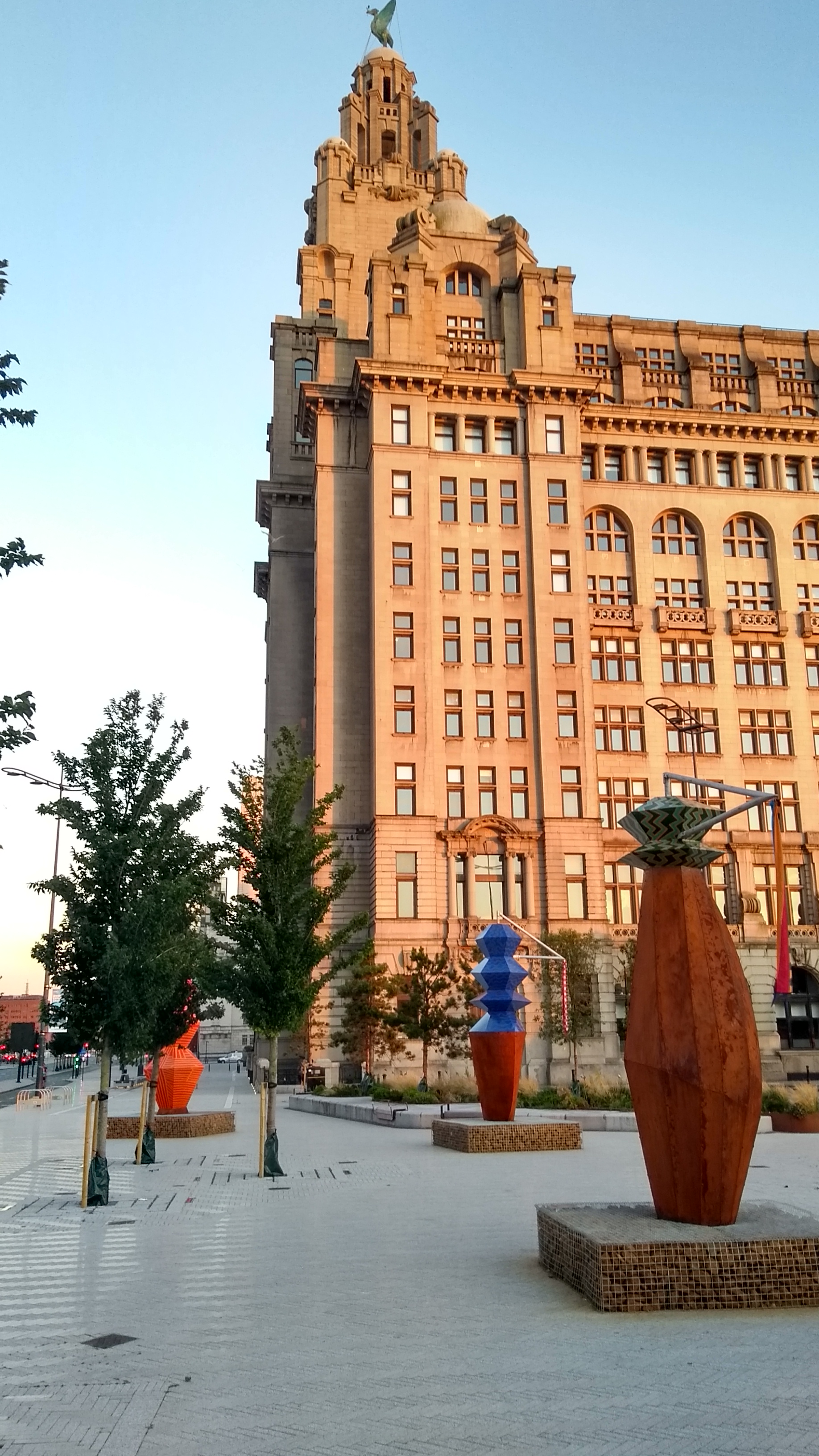
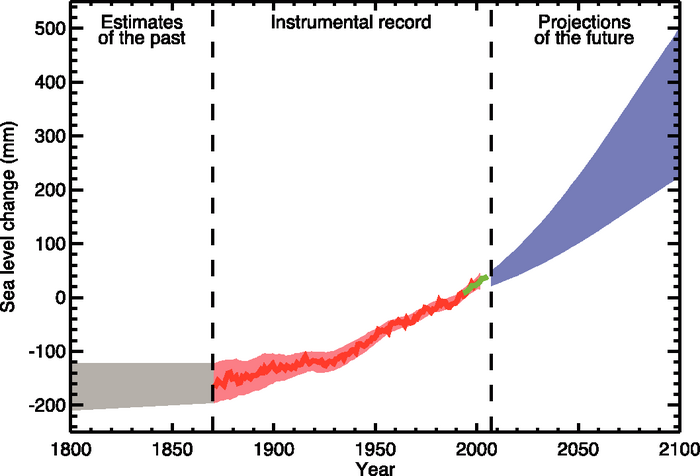
The recent extreme weather is perhaps leading more people to appreciate the changes in our climate are real and likely to have a serious impact on our way of life [see ‘Climate change and tides in Liverpool‘ on May 11th, 2016].  However, I suspect that most people do not appreciate the likely catastrophic effect of global warming.  For example, during the 20th century, the average rise is sea level was 1.7 mm per year; however, since the early 1990s it has been rising at 3 mm per year, and sea levels are currently rising at about 4mm per year according to the Intergovernmental Panel on Climate Change.  It is difficult to translate  statistics of this type into a meaningful format – the graph below helps in recognising the trends but does not convey anything about the impact.  However, I am impressed by a new art installation on the Liverpool waterfront by Alicja Biala called ‘Merseyside Totemy’ which illustrates the percentage of each of three high-risk local areas that will be underwater by 2080 if current trends continue: Birkenhead (centre of photograph), Formby (left) and Liverpool City Centre (right behind tree) [see www.biennial.com/collaborations/alicjabiala].  Perhaps using data for 30 years time rather than 60 years would have focussed people’s attention on the need to make changes to alleviate the impact.

Figure 1 from

Figure 1. Time series of global mean sea level (deviation from the 1980-1999 mean) in the past and as projected for the future. For the period before 1870, global measurements of sea level are not available. The grey shading shows the uncertainty in the estimated long-term rate of sea level change. The red line is a reconstruction of global mean sea level from tide gauges, and the red shading denotes the range of variations from a smooth curve. The green line shows global mean sea level observed from satellite altimetry. The blue shading represents the range of model projections for the SRES A1B scenario for the 21st century, relative to the 1980 to 1999 mean, and has been calculated independently from the observations. Beyond 2100, the projections are increasingly dependent on the emissions scenario. Over many centuries or millennia, sea level could rise by several metres. From https://archive.ipcc.ch/publications_and_data/ar4/wg1/en/faq-5-1-figure-1.html

Enjoying open spaces and large horizons

Moonlight on Lizard PointI am on vacation and off-grid so just a picture this week. It is a night time view from the cottage we stayed at in 2017 on the Lizard in Cornwall. If you have withdrawal symptoms from this blog then follow the links to find out why you need a vacation too! Gone walking posted on April 19th, 2017. Digital detox with a deep vacation posted on August 10th, 2016. Deep vacation posted on July 29th, 2015.

Experiencing silence

Here is the second in a series of reprints while I am on vacation.  This one is from five years ago. It was published on August 9th 2017 under the title ‘Blinded by the light‘.

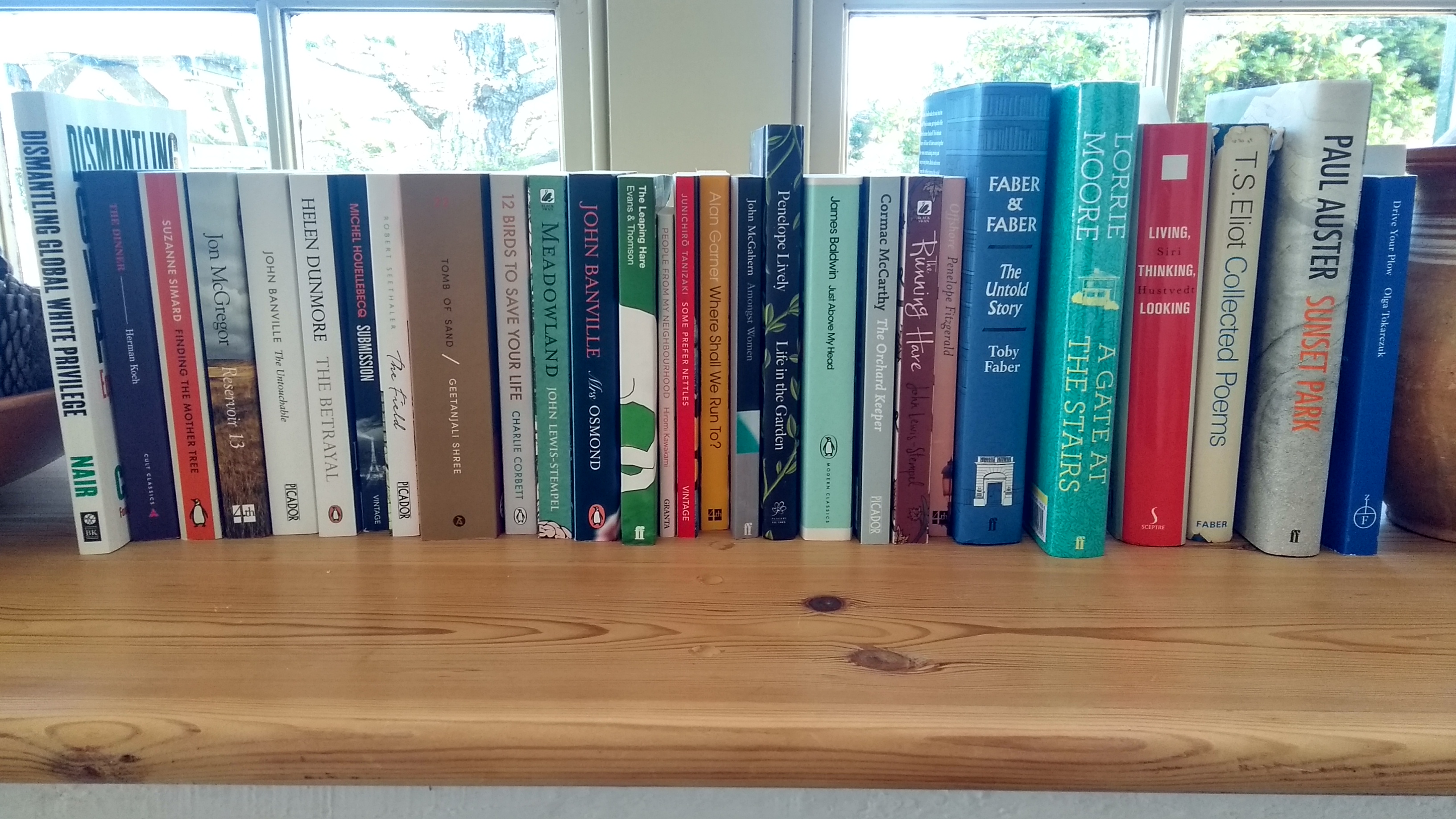
It has become a habit during our summer vacation to read the novels short-listed for Bailey’s Women’s Prize for Fiction.  Unusually this year, we were not only unanimous in our choice of the best novel but we also agreed with the judges and selected the ‘The Power‘ by Naomi Alderman.  In another of the books, Do Not Say We Have Nothing by Madeleine Thien, a Chinese composer called Sparrow thinks ‘about the quality of sunshine, that is, how daylight wipes away the stars and planets, making them invisible to human eyes, might daylight be a form of blindness? Could it be that sound was also be a form of deafness? If so, what was silence?’.  I felt some resonance between these thoughts and John Hull’s writings on blindness and my earlier blog posting on ‘Listening with your eyes shut‘ [on May 31st, 2017].  In our everyday life, we are bombarded with sounds from people living around us, from traffic and from devices in our homes and places of work.  We rarely experience silence; however, when we do, perhaps on holiday staying in a remote rural location, then a whole new set of sounds becomes apparent: waves breaking on the shore in the distance, the field mouse rooting around under the floorboards, or the noises of cattle enjoying the lush grass in the field next door.  Okay, so you have to be in the right place to hear these sounds of nature but you also need silence otherwise you are deaf to them, as Sparrow suggests.

The same is true for knowledge and understanding because our minds have finite capacity [see my post entitled ‘Silence is golden‘ on January 14th, 2014].  When you are bombarded with information and data it is easy to become overwhelmed and unable to structure the information in a way that makes it useful or meaningful.  In our connected society, information has become like white noise, or daylight obscuring the stars and planets.  Information is blinding us to knowledge and understanding.  We need to aggressively filter the information flow in order to gain insight and knowledge.  We should switch off the digital devices, which bombard us with information constantly, to leave our minds free for conceptual and creative thinking because that’s one of the few tasks in which we can outperform the smartest machine [see my post entitled ‘Smart machines‘ on February 26th, 2014].

In a similar vein see: ‘Ideas from a balanced mind‘ on August 24th, 2016 and ‘Thinking out-of-the-skull‘ on March 18th, 2015.

Still relevant after ten years

I am on vacation for the next month so I will not be writing new posts. Instead I have decided to delve into my back catalogue of more than 500 posts [see ‘500th post‘ on February 2nd, 2022] and republish posts from ten, five and one year ago. The short post below was published on September 15th, 2012 under the title ‘Innovation jobs‘. It seems as relevant today as it was in 2012.

Yesterday, I listened to an interesting talk by Dr Liang-Gee Chen, President of the National Applied Research Laboratories of Taiwan at the UK-Taiwan Academic-Industry & Technology Transfer Collaboration Forum organised by the British Council.  He presented some statistics from the Kaufmann Foundation, which demonstrated that nearly all new jobs in the USA are generated by new companies.  When you combine this with my conclusion in my posting on ‘Population crunch’, that we need a higher level of innovation in engineering, then we need to review the education programmes provided for our engineers to ensure that they include innovation and entrepreneurship.  These need to be integrated in engineering education programmes [see Handscombe et al, 2009].  We seem to have lost the plot in the UK and retreated to teaching engineering science, design and management orientated towards the employers with the loudest voice, i.e. multi-nationals, who are not likely to be the source of innovation jobs that will pull us out of the global recession.

Handscombe, R.D., Rodriguez-Falcon, E., Patterson, E.A., 2009, ‘Embedding enterprise in engineering’, IJ Mechanical Engineering Education, 37(4):263-274.