Tessellating bikes

pelaton

Photo credit: Isobel

Whoosh!  The unexpectedly exhilarating experience of standing on the kerb as more than a hundred cyclists raced past less than an arm’s length away during Stage 1 of the Tour of Britain on a beautifully hot sunny day.  We had walked from our house down to the finish line adjacent to Liverpool’s waterfront and watched from behind crowd-control barriers as the riders raced past on a couple of the eight laps of the course around the city.  The crowds, big screens and team buses at the finish line created a party atmosphere; however it was much more exciting being close enough to feel the riders’ slipstream when we watched in the quieter street next to Cain’s Brewery where there were no barriers and fewer spectators. It was thrilling on the last lap when the pelaton caught up with break away leaders and they all sped downhill in a single charge.

Of course the bikes are marvels of light-weight engineering and make excellent everyday engineering examples for students but we were more fascinated by how the teams tessellated eight or more spare bikes onto the roof of their support cars that cruised along behind them!tesselated

For Everyday Engineering Examples in Dynamics see lesson plans D6, D7 and D11; and in Mechanics of Solids see S2, S3, S7 and S8 for a unicyclist!

Mind wandering

IMG_0116 (2)

Photo credit: Tom

Most of us have returned from vacation by now but I wonder how refreshed you are feeling.  Was you vacation like the character in the cartoon published recently in the New York Times (INYT Friday, August 8th, 2014), i.e. still connected to the grid?  Or did you follow my advice in the posts entitled ‘Gadget stress‘ (April 9th, 2014) and ‘Reading offline‘ (March 19th, 2014) by engrossing yourself in reading a few good books with all gadgets switched off.  I know some of my colleagues did not because I have received automatic vacation replies to my emails followed by detailed email responses a few hours later or even a minute or two later in one case, often including a reminder that they are on vacation!   David Levitin writing in the NYT (on August 9th, 2014) asserts that a ‘vacation isn’t a luxury’ and I agree with him.  We went to an undisclosed location with no telephone, no internet and no mobile phone signal and even then we thought that two weeks was not long enough!

David Levitin goes on to say that we should not skimp on daydreaming.  He describes how our brains have two modes of operation: central executive mode and mind-wandering mode.  We tend to operate in one mode or the other and the switching between them is controlled by the insula, which is located in our brain about 25mm below the top surface of your skull.  Tasks requiring focussed attention, such as learning and problem-solving are performed in central executive mode while day-dreaming and surfing from one idea to another is undertaking in mind-wandering mode.  Scientists believe that switching too frequently between the modes makes you feel tired.  Central executive mode functions better without distractions and in sustained periods spent on single tasks as recommended in my post entitled ‘Silence is golden‘ [January 14, 2014].  Creativity tends arise from mind-wandering, which can be stimulated by listening to music or taking a walk in nature [see my post entitled ‘The Charismatic Engineer‘ on June 4th, 2014], and allowing ideas to shuffle into perspective or the great breakthrough to emerge, apparently miraculously.

So the recipe for intellectual productivity and creativity seems to be to focus on tasks for sustained periods of times, Levitin suggests 30 to 50 minutes with email closed and phones muted.  Take short breaks and go for a stroll, eight minutes is sufficient according Stanford researchers, Marily Oppezzo and Dan Schwartz.  Set aside specific time to deal with email each day and also time for mind-wandering.

For more, see:

http://www.huffingtonpost.com/tag/working-vacation

http://www.psychologytoday.com/blog/maybe-its-just-me/201408/why-you-might-not-want-hit-the-reset-button-in-your-brain

Cold power

Last week I wrote about heat transfer into fridges in the context of operation in vacation mode.  It is tempting to think that if energy is moving into the fridge as a result of heat transfer from the warm room to the cold food compartment in the fridge, then why can’t we use the energy to power the fridge.  A fridge that operated on this basis would be categorised as a perpetual motion machine of the second type because it would contravene the second law of thermodynamics and so it can’t exist.  One of the great pioneers of thermodynamics, Rudolf Clausius expressed the second law as ‘heat does not pass from a body at a low temperature to one at high temperature without an accompanying change elsewhere’.  In other words, something has to be done, generally in the form of work, to move energy from a cold to hot place, e.g. from the food compartment of the fridge to the warmer room.

refrigeration cycle


In a domestic fridge, the work is supplied in the form of electricity to drive a compressor – that’s the thing making most of the noise coming from your fridge.  It is compressing a refrigerant gas (typically from atmospheric pressure to about 8 times atmospheric pressure) and in the process raising its temperature (perhaps by 80°C) as it pushes the gas into a condenser.  In the condenser, the hot refrigerant transfers heat to the colder room and in the process condenses from a gas to liquid dropping its temperature, perhaps by 30°C.  Then, the liquid refrigerant flows into an expansion valve where its rapid expansion to a gas lowers both its temperature (perhaps to -20°C) and pressure (typically from 8 times atmospheric pressure back to atmospheric) before it is sucked into the heat exchanger inside the food compartment where its very low temperature causes heat transfer from the compartment to the refrigerant, i.e. it removes the unwanted energy.  The compressor sucks the gas out of the heat exchanger and the whole cycle starts again with the unwanted energy being dumped into the room by the condenser, which is the warm panel on the back of your fridge.

If you understood all of that then well done, if not then try again following the steps on the schematic diagram.

The temperatures and pressures are expressed rather vaguely because they depend on the design of the fridge and the settings you select on the control panel.

Vacation mode

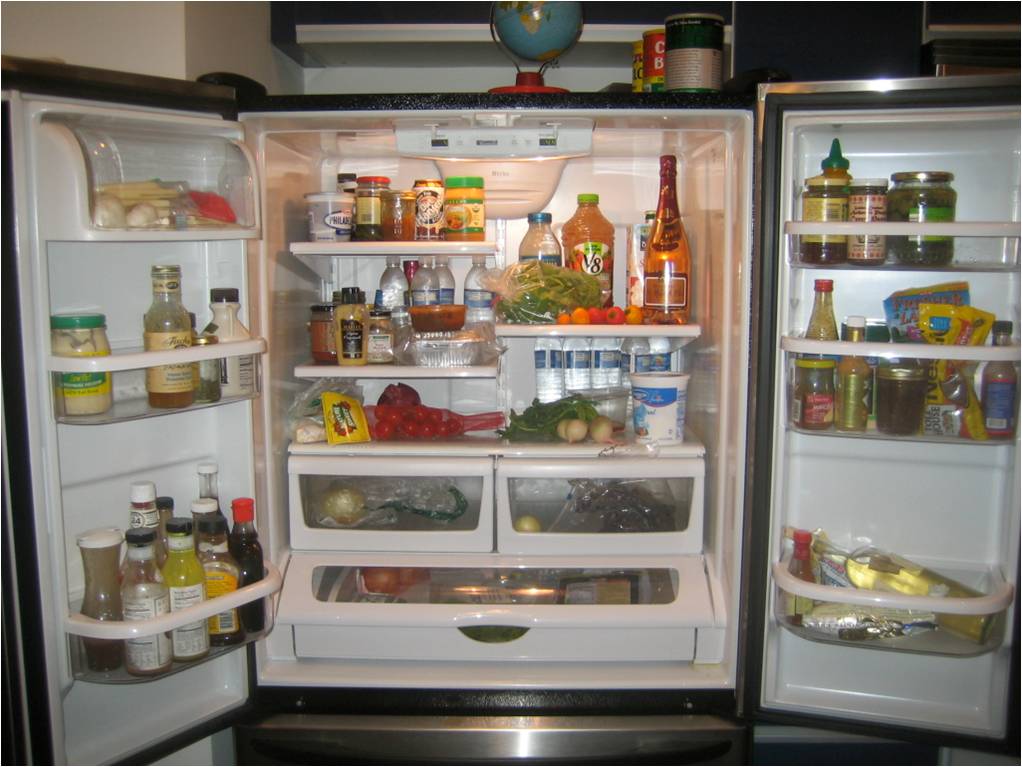
fridge2Many people are in vacation mode at the moment.  In some organisations it is impossible to hold meetings because of non-overlapping holidays, unless of course you work in countries where everyone goes on holiday at the same time – try getting in or out of Paris on certain weekends in August!  We have been away already and when we got back home one question that was asked is ‘What was the fridge/freezer doing while it was set on vacation mode?’  Fridge and freezers are one of the largest consumers of power in most households so saving energy while we are away on vacation makes sense and there are a number of strategies adopted by different manufacturers.  The most common one is to raise the temperature of the fridge compartment to around 39°F or 4°C which is just cold enough to prevent bacterial growth. Energy movement due to heat transfer is proportional to the temperature difference. Hence, if the temperature difference between the fridge and its surroundings is reduced then there will be less heat transfer into the fridge and less energy will be expended to remove it and keep the contents cold.  Of course the door being shut thoroughout the vacation helps.

In normal use, when we open the door there is heat transfer into the fridge from the warmer room which raises the energy level inside the fridge.  This energy is stored as internal energy in the air and fridge contents and temperature is a measure of this internal energy level, i.e. the temperature goes up.  The fridge has to perform work to remove the internal energy and reduce the temperature.  The situation is exacerbated by the light inside the fridge which comes on when the door is opened because the light bulb generates heat, this is the basis of Everyday Engineering Example about the extra cost of running of a fridge when the light stays on permanently because the switch is broken.

Back to vacation mode for a moment, most fridge/freezers also de-activate the automatic defrost function in vacation mode as well, to save energy.

Sources:

Alison for asking the question – thank you.

Information on safe food storage – Food Safety and Inspection Service