Let’s try a thought experiment, following on from my previous post (Beyond Zero on 20th February, 2013). Imagine two equal amounts of matter, A and B at -350 Kelvin and 350 Kelvin respectively. We would expect heat to flow from the hot one, that’s B to A, the cold one. This would cause the internal energy of B to decrease with a corresponding rise in the internal energy of A so that B gets colder while A gets hotter, i.e. they both move closer to absolute zero with corresponding decreases in entropy. The Second Law of Thermodynamics does not allow this to happen and in fact the reverse would occur, i.e. heat would flow from the cold one A to B, lowering the temperature of A and raising the temperature of B so that they both move away from absolute zero with corresponding increases in entropy.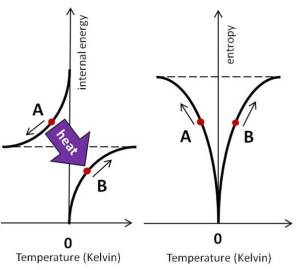
IF we could actually make this happen then we would able to design engines with efficiencies higher that 100%. One corollary of the Second Law of Thermodynamics is that heat cannot be converted into work without some of the heat being wasted or lost as entropy. In a power station, heat is taken from a hot source (e.g. a nuclear reactor, solar concentrator or gas furnace) and some of it converted into shaft work, which turns a generator to produce electricity, while the remainder is dumped into a cold sink usually the environment via cooling towers. However, if our cold sink was at a negative temperature on the Kelvin scale then we could take heat from the cold sink and the hot source at the same time! Why aren’t we doing this? Well, we don’t have any naturally occurring cold sinks at below zero Kelvin and to create one uses more energy than we would gain in our super-efficient power station – that’s the Second Law kicking in again. So you can’t have something for nothing.
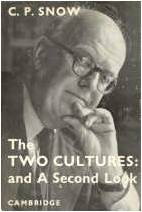 The term ‘Two Cultures’ was coined by Sir Charles Snow more than fifty years ago in his 1959 Rede Lecture to describe the gulf that existed then and persists today between scientists and non-scientists. He equated not knowing the second law of thermodynamics to never having read anything by Shakespeare. A number of my posts have referred to the Second Law of Thermodynamics because it explains why engines run and chemical reactions occur but to quote Peter Atkins, it is also ‘the foundation for understanding those most exquisite consequences of chemical reactions – acts of literary, artistic and musical creativity that enhance our culture‘.

 Realize Engineering