Category Archives: Learning & Teaching

Tessellating bikes

pelaton

Photo credit: Isobel

Whoosh!  The unexpectedly exhilarating experience of standing on the kerb as more than a hundred cyclists raced past less than an arm’s length away during Stage 1 of the Tour of Britain on a beautifully hot sunny day.  We had walked from our house down to the finish line adjacent to Liverpool’s waterfront and watched from behind crowd-control barriers as the riders raced past on a couple of the eight laps of the course around the city.  The crowds, big screens and team buses at the finish line created a party atmosphere; however it was much more exciting being close enough to feel the riders’ slipstream when we watched in the quieter street next to Cain’s Brewery where there were no barriers and fewer spectators. It was thrilling on the last lap when the pelaton caught up with break away leaders and they all sped downhill in a single charge.

Of course the bikes are marvels of light-weight engineering and make excellent everyday engineering examples for students but we were more fascinated by how the teams tessellated eight or more spare bikes onto the roof of their support cars that cruised along behind them!tesselated

For Everyday Engineering Examples in Dynamics see lesson plans D6, D7 and D11; and in Mechanics of Solids see S2, S3, S7 and S8 for a unicyclist!

Vacation mode

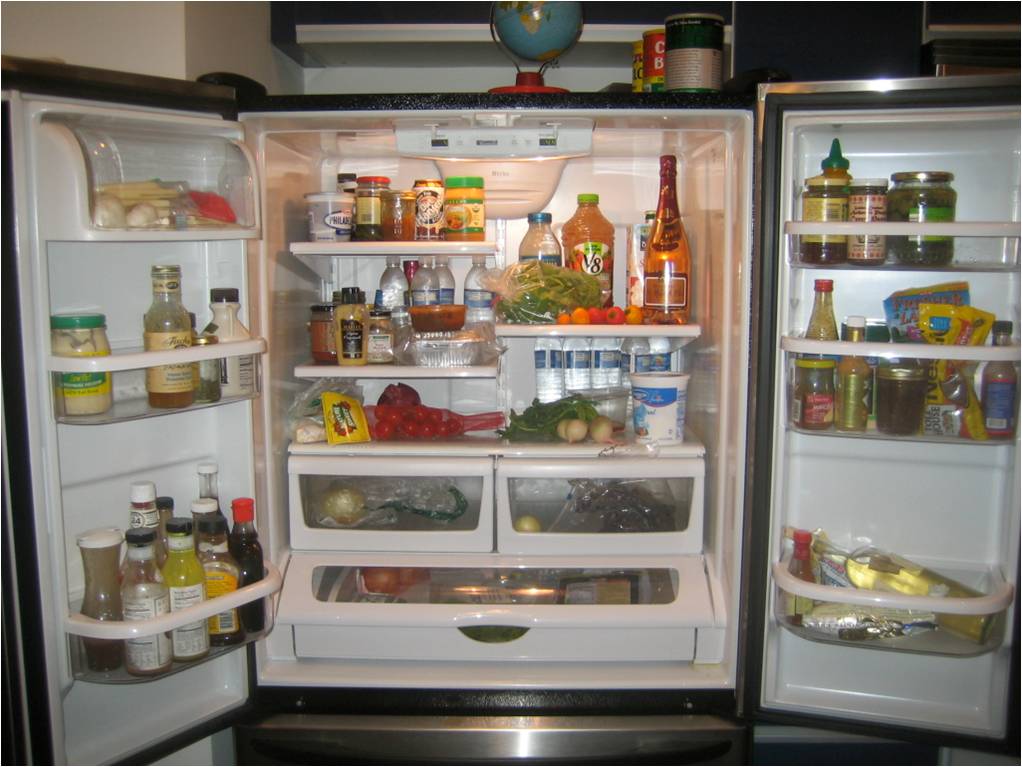
fridge2Many people are in vacation mode at the moment.  In some organisations it is impossible to hold meetings because of non-overlapping holidays, unless of course you work in countries where everyone goes on holiday at the same time – try getting in or out of Paris on certain weekends in August!  We have been away already and when we got back home one question that was asked is ‘What was the fridge/freezer doing while it was set on vacation mode?’  Fridge and freezers are one of the largest consumers of power in most households so saving energy while we are away on vacation makes sense and there are a number of strategies adopted by different manufacturers.  The most common one is to raise the temperature of the fridge compartment to around 39°F or 4°C which is just cold enough to prevent bacterial growth. Energy movement due to heat transfer is proportional to the temperature difference. Hence, if the temperature difference between the fridge and its surroundings is reduced then there will be less heat transfer into the fridge and less energy will be expended to remove it and keep the contents cold.  Of course the door being shut thoroughout the vacation helps.

In normal use, when we open the door there is heat transfer into the fridge from the warmer room which raises the energy level inside the fridge.  This energy is stored as internal energy in the air and fridge contents and temperature is a measure of this internal energy level, i.e. the temperature goes up.  The fridge has to perform work to remove the internal energy and reduce the temperature.  The situation is exacerbated by the light inside the fridge which comes on when the door is opened because the light bulb generates heat, this is the basis of Everyday Engineering Example about the extra cost of running of a fridge when the light stays on permanently because the switch is broken.

Back to vacation mode for a moment, most fridge/freezers also de-activate the automatic defrost function in vacation mode as well, to save energy.

Sources:

Alison for asking the question – thank you.

Information on safe food storage – Food Safety and Inspection Service

Engineering archaeology

Last week I spent a relaxing day painting the old railings in front of our house. Since I am not a painter and decorator by trade the end result is not perfect but they look much better in shiny black than two-tone rust and matt black.   One of the fleurs de lis on our railings had been knocked off when either we moved in or the previous occupiers moved out.  It’s a way of life being an engineer, so the shape of the failure surface on the broken railing was bugging me while I was painting the rest.  You would expect wrought iron railings to be ductile, i.e. to deform significantly prior to fracture, and to have a high tensile strength.  Wrought iron’s properties are derived from its very low carbon content (less than 0.25%) and the presence of fibrous slag impurities (typically about 2%), which almost make it a composite material.  It was historically used for railings and gates.  However, my broken railing had exhibited almost no deformation prior to fracture, i.e. it was a brittle failure, and the fleur de lis had broken in half on impact with the stone flags.  So on one of the rainy days last week, when I couldn’t paint outside, I did a little bit of historical research and discovered that in the late 1790s and early 1800s, which is when our house was built, cast iron started to be used for railings.  Cast iron has a high carbon content, typically 2 to 4%, and also contains silicon at between 1 and 3% by weight.  Cast iron is brittle, i.e. it shows almost no deformation prior to fracture, so the failure surface tends be to flat and smooth just like in my fleur de lis.

This seems like a nice interdisciplinary, if not everyday, engineering example.  It would be vandalism to go around breaking iron railings in front of old buildings.  So, if you want Everyday Engineering Examples of ductile and brittle behaviour, then visit a junk shop and buy an old china dinner plate and a set of cutlery.  The ceramic of the china plate is brittle and will fracture without deformation – have some fun and break one!  The stainless steel of the fork and spoon is ductile and can be easily bent, i.e. it is easy to introduce large deformation, in this case permanent or plastic deformation, prior to failure.  In fact you will probably have to bend the fork back and forth repeatedly before it will snap with each bending action introducing additional damage.

The more curious will be wondering why some materials are ductile and others brittle.  The answer is associated with their microstructures, which in turn is dependent on their constituents, as hinted above.  However, I am not going to venture into material science to explain the details.  I have probably already given materials scientists enough to complain about because my Everyday Engineering Examples are not directly analogous at the microstructural level to wrought iron and cast iron but they are more fun.

Sources: http://www3.westminster.gov.uk/spgs/publications/Railings.pdf

Thunderous applause

2d543f31-6f09-43ba-875c-c2d5d3bd0cebI have had cause to applause enthusiastically on two recent occasions. We went to see ‘Dead Dog in a Suitcase’ at the Everyman Theatre in Liverpool. It was fantastic and we joined in a standing ovation at the end. It’s a beggar’s opera that throughly deserved the rave reviews that it has received. It is full of energy, music, wit and spectacular performances.

The second occasion was my son’s graduation in Durham Cathedral. The programme asked us not to applaud as each graduand’s name was read out and they walked onto to the podium to shake the hand of the Chancellor, Sir Thomas Allen, but to hold our applause until the end. So, the last graduand walked off the podium to thunderous applause. Sir Thomas is an opera singer with a sonorous speaking voice and he gave a theatrical entertaining speech that we applauded enthusiastically and appreciatively. It is the tradition at Durham to applaud the new graduates as they walk down the aisle to leave the Cathedral. It’s a long aisle, there were a lot of graduates and we clapped energetically so that by the time the end of the line reached the door our hands were smarting.

You are right. There has been no mention of engineering, yet. However, here it comes. The heat and stinging sensation in the palms of my hands as the last graduate left the cathedral reminded me briefly of an example from my first year thermodynamics lectures in which I estimated the temperature rise in the skin of the hand from vigorous clapping ten times. This was more an exercise in estimating and problem definition than thermodynamics as you will see from the attached worksheet (clapping_example.pdf), but those skills are as important to an engineer as a knowledge of the laws of thermodynamics. Its also another Everyday Example and the experimental part can be performed at home.