I am worried that engineering has become a mechanism for financial returns in an economic system that values profit above everything with the result that many engineers are unwittingly, or perhaps in a few cases wittingly, supporting the concentration of wealth into the hands of a few capitalists. At the start of the industrial revolution, when engineering innovation started to make a difference to the way we live and work, very few engineers foresaw the impact on the planet of the large scale provision to society of products and services. Nowadays most engineers understand the consequences for the environment of their work; however, many feel powerless to make substantial changes often because they are constrained by the profit-orientated goals of their employer or feel that they play a tiny role in a complex system. Complex systems are often characterised by self-organisation in which order appears without any centralised control or planning and by adaptation to change and experience. Such systems are familiar to many engineers and perhaps they do not, but should, think of the engineering profession as complex system capable of adaptation and self-organisation in which the actions and decisions of individual engineers will cause the emergence of a new order. Our individual impact might be tiny but by acting we influence others to act and the cumulative effect will emerge in ways that no one can predict – that’s emergence for you.
Author Archives: Eann Patterson
Collaboration and competition
Competition has become a characteristic of many activities in life, whether it is teams vying to win a trophy, universities attempting to be top of a league table, retailers trying to persuade you to buy from them, or politicians seeking power. Natural selection is often cited to demonstrate that competition is ubiquitous in nature and therefore something to be embraced and celebrated as a route to success. However, Suzanne Simard has highlighted that competition is only part of Darwin’s theory of natural selection. It was popularised following the publication of his book ‘The Origin of Species’ in 1859; however, Darwin also wrote about the ways in which plants co-operate and collaborate and Simard believes that collaboration is ‘as important, if not more important’ than competition in the development of ecosystems. Trees may have a better chance of adapting to climate change because they are adapting faster than us. A number of mass movements of plants are in progress – the fastest appears to be the northwards migration of white spruce trees in the eastern US which have moved 100 km every decade for the last thirty years. Perhaps it is time to apply some more comprehensive biomimetics to the organisation of society at all levels and consider how greater levels of collaboration rather than competition would help us tackle the challenges facing civilisation.
Sources:
Henry Mance, Lunch with the FT: Suzanne Simard ‘I say to the trees, “I hope I’m helping”‘, FT Weekend, 26 March / 27 March 2022.
James Bridle, The speed of a dandelion, FT Weekend, 2 April / 3 April 2022.
A sign of normality returning
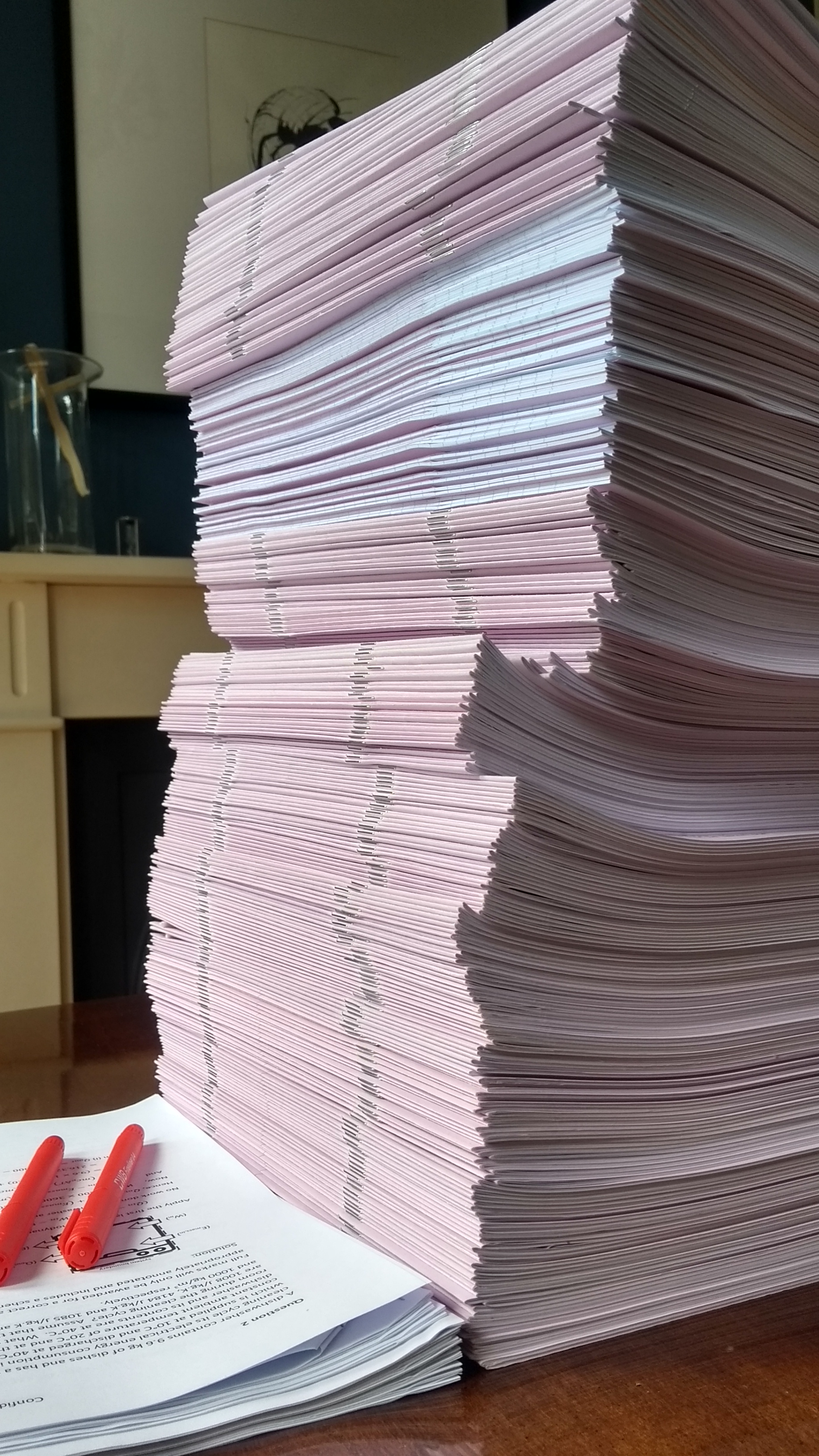
I am in the midst of marking examination scripts. I have about two weeks to award a maximum of about 26,000 marks which is a huge number of decisions to make in a relatively short time [see ‘Depressed by exams‘ on January 31st 2018]. Although the pile of examination scripts is tall and the task can feel overwhelming, it represents a return to normality following the pandemic when we conducted on-line, open-book examinations [see ‘Limited bandwidth’ on June 2nd, 2021]. We have been teaching 100% on-campus for the whole semester and all of our examinations have returned to their pre-pandemic format, i.e., the majority have been in-person, closed-book and invigilated. I have enjoyed teaching thermodynamics in a huge lecture-theatre filled with students and it is relief that I do not have to set examination questions whose answers cannot be found using a search engine or solved using a programme. Anyway I need to pick up my red pen and return to my marking so only a brief post this week.
Delaying cataclysmic events might hasten their advent
In thermodynamics, students are taught to draw a boundary around the system they want to analyse and to decide whether the boundary is open or closed to transfers of mass and energy based on the scenario they want to model. The next step is to balance the energy flows across the boundary with the change in the energy content of the system. This is an application of the first law of thermodynamics which is that energy can neither be created nor destroyed. Rudolf Clausius is credited with discovering entropy when he realised that when energy flowed as heat across a system boundary it became entropy or disordered energy. For instance, when a steam engine does work and discharges heat to the environment. The second law of thermodynamics states that entropy of the universe increases in all real processes. Thermodynamicists are not the only people who draw boundaries and decide whether they are open or closed. Politicians and generals draw national boundaries occasionally and more frequently decide whether they are open or closed to people, goods and capital. After the first world war economists, such as Friedrich Hayek and Ludwig von Mises, proposed that conflict would be less likely if people, goods and capital could flow freely across national boundaries. These ideas became the principles on which the IMF and World Bank were formed at Bretton Woods in July 1944 in the closing stages of the second world war. Presidents of the USA, since Ronald Reagan, have taken these ideas a step further by unleashing capitalism through deregulation of markets in the belief that markets know best. However, ever-growing capital generates an ever-increasing rate of creation of entropy and disorder in the world [see ‘Existential connection between capitalism and entropy‘ on May 4th 2022] and perhaps attempting to reduce conflict by unfettering capital actually accelerates the descent into chaos and disorder because entropy increases in every transaction.
Sources:
Rana Foroohar, When the market fails us, FT Weekend, 23 April/24 April 2022.
Gary Gerstle, The Rise and Fall of the Neoliberal Order: America and the World in Free Market Era, Oxford: OUP, 2022.
The cataclysmic events referred to in the title are those identified by Thomas Piketty as being the only means by which economic inequality is reduced, i.e., wars and revolutions [see ‘Existential connection between capitalism and entropy‘ on May 4th 2022]. The title was inspired by correspondence from Bob Handscombe with whom I wrote a book entitled ‘The Entropy Vector: Connecting Science and Business‘.