Tag Archives: Thermodynamics

Closed system on BBQ

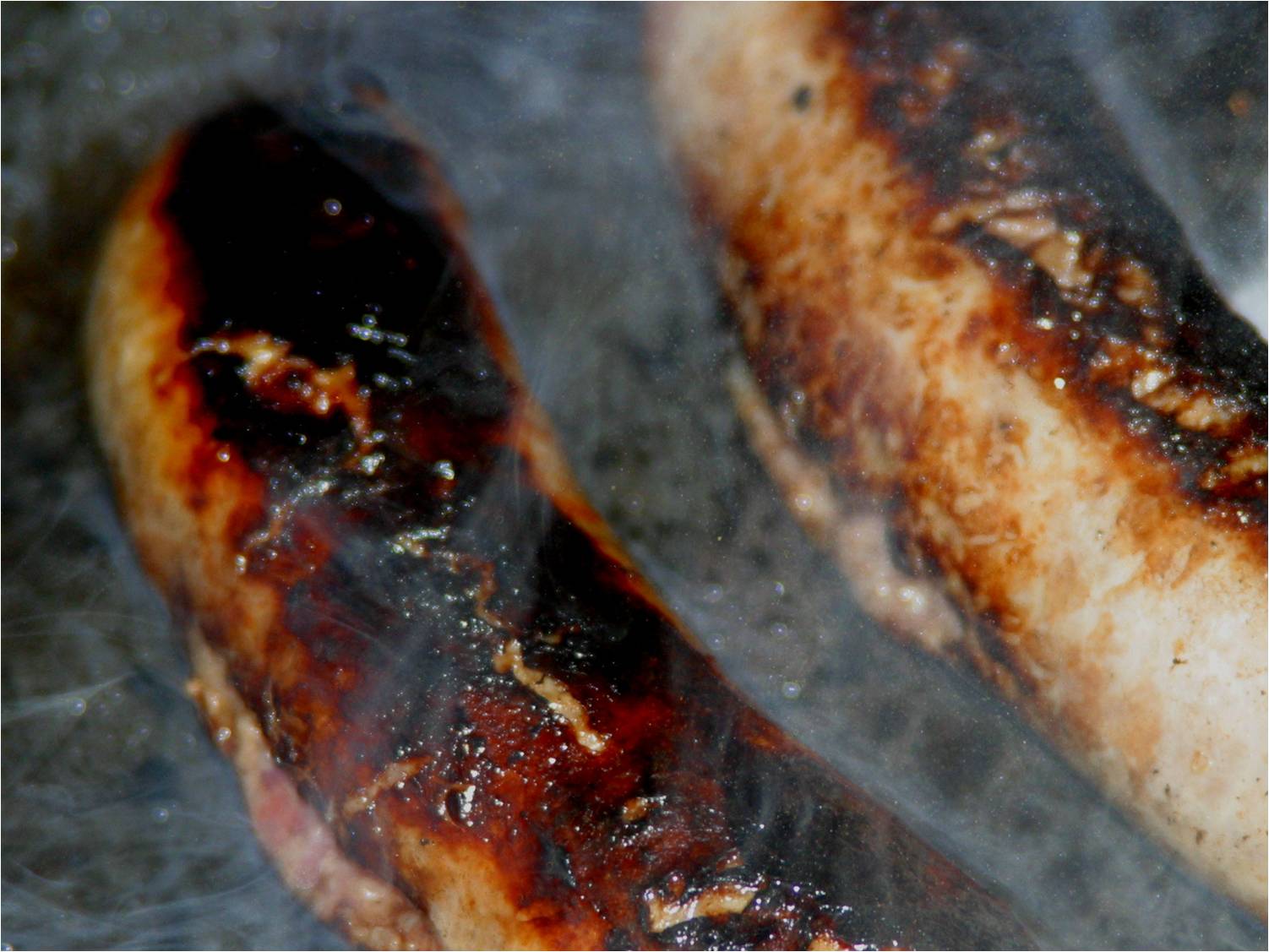
sausagecloseupMy post of December 21st, 2012 on ‘Closed systems in nature?’ is my most popular  based on the statistics from WordPress.  These statistics led me to go back and read it again, which set me thinking along the same lines while tending the barbeque in our backyard.  A sausage is a nice example of a closed system with a boundary, or skin, that is impervious to mass or material moving across the boundary but which allows energy transfer in the form of heat.

Heat transfers into the system [sausage] through the boundary [skin] adjacent to the hot charcoal in my barbeque and heat transfers out on the opposite side.  Heat is simply energy transfer that occurs along a temperature gradient or across a temperature difference, from a higher to a lower temperature.

The temperature difference between the hot charcoal at about 375 degrees Centigrade and a sausage starting to cook at about 70 degrees is larger than the difference between the sausage and the air above it at say 35 degrees Centigrade, so more heat [energy] is transferred into than out of the sausage.  The difference between the energy in and out is used to heat and cook the sausage including starting to boil the water-content and trigger chemical reactions associated with cooking.  This is a manifestation of the first law of thermodynamics for the closed system, i.e. heat transfer in minus heat transfer out equals the change in the energy content of the system.  The net flux of heat into the sausage causes it to get hot and be cooked.

You can’t avoid thermodynamics, it gets involved in everything!
Impossible perfection

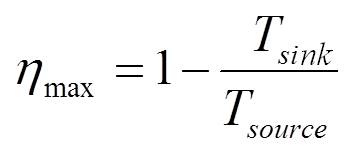
Carnot's equation for ideal efficiency of a cyclic device converting heat to work and operating between two temperatures specified on the Kelvin scale

Carnot’s equation for ideal efficiency of a cyclic device converting heat to work and operating between two temperatures specified on the Kelvin scale

In my last post [National efficiency on 29th May, 2013] I calculated the efficiency of the nationwide process of electricity generation in the UK [35.8%] and made no comment on the relatively low value.  It will be similarly in all industrialised countries as a consequence of the second law of thermodynamics and the requirement for all real processes to increase entropy.  A French engineer / scientist, Sadi Carnot [1796-1832] demonstrated from the second law, that the maximum efficiency achievable in ideal conditions by a process operating in a cycle to convert heat into work is a ratio of the temperatures of the heat source and cold sink to which excess heat is dumped.  In a power station the heat source might be a fossil-fuelled furnace, a nuclear reactor or a solar concentrator.  The cold sink is usually the environment, perhaps in the form of river or sea water.  So both source and sink temperatures are limited.  The sink by the local climate and the source by the temperatures that modern materials can withstand.

The very best efficiency based on Carnot’s expression for a maximum material temperature of 350 degrees Centigrade [=623 Kelvin] and environment temperature of 5 degrees Centigrade [278 Kelvin] is 55%.  Of course a real power station will never operate at this level because ideal conditions are not achievable – perfection is impossible.

The ideal efficiency improves as the operating temperatures of the heat source and sink are moved further apart and this quest to raise this temperature difference drives a substantial proportion of materials research.  However, even operating with a heat source at 800 degrees Centigrade, using expensive, high temperature alloys, such as Hastelloy N  [a nickel-chromium alloy], on a winter day in the Canadian capital, Ottawa where the average January daytime temperature is -7 degrees Centigrade, the Carnot efficiency of a power station would be only 75%  [=1-(266/1073)].

National efficiency

Thermodynamics, especially the first and second laws, are usually perceived as boring and perhaps mysterious by most people, including many engineers, as well as irrelevant by many non-engineers.  However, thermodynamics is fundamental to how engineers deliver products and services to society.  The name ‘thermodynamics’ does not help much, perhaps it would be better to call it ‘energy science’, since it is about energy transfers, conversions and flows.

The national energy flow charts mentioned in my post about ‘Energy Blending’ on 22 May 2013 illustrate nicely the first and second laws of thermodynamics (or energy science).  The underlying basis of the flowcharts is to treat the nation as a system and to account for the energy flows in and out across the system boundaries.  The first law, which is about conservation of energy, demands that the inflow and outflow balance one another, so for the UK and USA the annual inflows were 12.5 and 92 quintrillion joules respectively.  A quadtillion is a million million million or 1 with 18 zeros.

The second law demands that any real process involves an increase in entropy, which is a measure of energy dispersion, essentially lost or wasted energy, and this is also present in the flow charts.  In the centre of the UK chart is electricity generation or conversion with an input totally 82.4 Mtoe [millions tons oil equivalent], an output of 29.5 Mtoe and losses of 48.2 Mtoe, which are demanded by the second law of thermodynamics.  So the overall efficiency of electricity generation in the UK is 35.8% [=desired output/required input].

Footnote: the raw data for the UK and USA energy inflows were 299.2 Mtoe [millions tons oil equivalent] and 97 quadrillion Btu [British Thermal units] respectively which I converted into the SI unit for energy, the joule.  The links for the energy flow charts are:

UK Energy flow chart: http://www.gov.uk/government/uploads/system/uploads/attachment_data/file/65897/5939-energy-flow-chart-2011.pdf

USA Energy flow chart: http://www.eia.gov/totalenergy/data/annual/pdf/aer.pdf

Sonic screwdrivers

138-3816_IMG

No relevance except for the tranquility or absence of noise.

In a recent post on Noise Transfer [27th March, 2013] I highlighted the parallels between energy transfer by heat and noise.  In many cases, the heat and, or noise transfer is by-product of a process through which energy is dispersed to satisfy the requirements of the second law of thermodynamics, that entropy must increase as a product of all real processes.  Entropy, can be interpreted as a measure of dispersion, or the lack of availability to do anything useful and this applies to most heat and noise that we encounter in everyday life.

We can use concentrated sources of heat to produce useful work such as the furnace in a power station, but the second law of thermodynamics demands that we waste a substantial proportion of it through the creation of entropy.  It is also possible to use concentrated sources of noise, such as ultrasonic transducer to perform useful work for us, such as in surgery and the manufacture of composite materials [see Professional Engineering, http://profeng.com/features/good-vibrations ]; although an all-purpose sonic screw-driver of the kind used by Dr Who is not possible, yet.