Tag Archives: Thermodynamics

Beyond zero

Recently a study has been published in Science [http://www.sciencemag.org/content/339/6115/52] about creating temperatures below absolute zero (see previous post on Arbitrary Zero, 13 February 2013), i.e. negative temperatures on the Kelvin and Rankine scales.  Temperature is a measure or indicator of the internal energy of matter which in turn is related to the spin state of electrons.  Electrons have two available spin states that are known as ‘up’ and ‘down’.  At room temperature more electrons have ‘down’ spin than ‘up’, and as absolute zero is approached all electrons align to have ‘down’ spin which is a configuration that corresponds to zero entropy.  When the temperature rises from room temperature, electrons tend to switch from ‘down’ to ‘up’ spin so that at an infinite temperature there are equal numbers of electrons in the two spin states.

The current theory is that at -300 Kelvin more electrons have ‘up’ than ‘down’ spin, i.e. a mirror image of the situation at +300 Kelvin.  If the temperature is lowered still further then the ‘up’ spin electrons tend to switch to ‘down’ spin so that at a negative infinite temperature there are equal numbers of electrons with ‘up’ and ‘down’ spin.  This state is equivalent to an infinite positive temperature, i.e. the absolute temperature scale can be considered to be circular or to have the negative and positive components joined at zero and infinity.

If you have made it this far then well done!  But if you didn’t quite follow everything then try the explanation at Newsy [http://www.newsy.com/videos/scientists-create-negative-kelvin-temperature-gas/ ].
Arbitrary zero

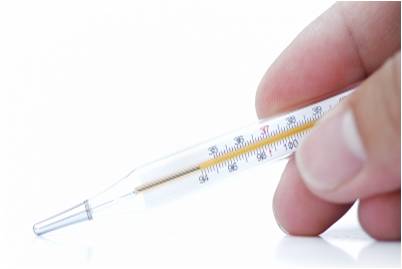
thermometerAs mentioned in my previous post (Lincoln On Equality, 6th February, 2013), the Zeroth Law of Thermodynamics enables the concept of temperature and temperature scales to be established.  The Swedish astronomer, Anders Celsius (1701-44) devised a temperature scale on which water froze at 100 degrees and boiled at zero, i.e. the opposite way around to the scale that bears his name today.  Daniel Fahrenheit (1686-1736), a German instrument maker, was probably the first to use a mercury thermometer and he assigned zero to the lowest temperature he could achieve, which was for a mixture of salt and water.  He chose his body temperature as 100 degrees because it was an easily portable standard, but not ideal because it is not totally reproducible.  Fahrenheit’s scale had a temporary advantage because negative numbers were rarely needed given the technology of the day and that water freezes at 32 degrees Fahrenheit.

Somewhat later it was decided that it might be more appropriate to set zero as the lowest attainable temperature, known as absolute zero, which is defined by the Third Law of Thermodynamics as the temperature at which the entropy of all perfectly crystalline pure substances is zero.  This lead to definition of two temperature scales: the Kelvin scale with degrees the same size as on the Celsius scale so that water freezes and boils at 273K and 373K respectively; and the Rankine scale with degrees the same size as the Fahrenheit scale.

Actually, absolute zero is not attainable.  The world record stands at 810 trillionths of a degree Rankine (see http://www.smithsonianmag.com/science-nature/phenom-200801.html).

Image credit: arztsamui / FreeDigitalPhotos.net

Lincoln on equality

I watched Steven Spielberg’s movie ‘Lincoln’ recently.  Lincoln is portrayed as quoting Euclid on equality: ‘Things that are equal to the same things are equal to each other’.  This is from Euclid’s book ‘Elements’ which was in common use until modern times as a mathematics textbook and is believed to have sold more copies than any other book besides the Bible.  In the movie Lincoln extends the meaning of this first of Euclid’s ten axioms from mathematics to embrace the equality of men.  Since I am teaching thermodynamics at the moment, I was struck by its similarity to the zeroth law of thermodynamics, which states that ‘two systems in thermal equilibrium with a third system  are also in thermal equilibrium with each other’.  The concept of the zeroth law is sometimes accredited to Rankine who lived in the middle of the 19th century, or more than two thousand years after Euclid (380BC – 260BC).  It is reputed to be called the zeroth law because it was only recognised as being of fundamental importance to thermodynamics after the first and second laws were well-established and to rename them would have caused confusion.  The zeroth law allows temperature and temperature scales to be defined.  It seems to me to be a special case of Euclid’s first axiom ‘Things that are equal to the same things are equal to each other’, and that it is remarkable that it took the fathers of thermodynamics so long to recognise it, especially when they were probably brought up on Euclid’s ‘Elements’ as their mathematics textbook at school.

Life-time battle

163-6306_IMGLife is a constant battle against entropy.  All living things are well-ordered structures with low entropy (degree of disorder) and the second law of thermodynamics demands that entropy levels are always trying to increase.  Animals fight this tendency by eating low entropy plants (or other animals), breaking them down to release entropy, thus satisfying the second law, and retaining low entropy components, i.e. highly-ordered and high energy molecules such as glucose.  If we stop eating, our bodies start to disintegrate and we die – entropy wins as the molecules of bodies are dispersed.

Plants use sunlight to fight the entropic battle.  In photosynthesis, low entropy solar energy converts carbon dioxide and water  to oxygen and glucose with the creation of entropy in the form of dispersed heat.