Tag Archives: nuclear energy

Energy efficiency

We were sent a summary of our annual gas and electricity consumption recently by our local utility company. The utility quantified our consumption of both gas and electricity in units of kilowatt-hours (kWh). It is usual to be sold electricity in kilowatt-hours but most people are confused by this unit. Perhaps because they learnt at school that the units of energy are Joules in the SI system and the power rating of appliances is usually given in Watts. They might know that a Watt is a Joule of energy per second, so what is a kilowatt-hour? Well it is about 3.6 x 10⁶ Joules or 3.6 MJ, because it is 1000 Joules per second (= Watt) for one hour. So, I think the utility company should be telling me how many MegaJoules (MJ) we have consumed. After all we are used to seeing the energy content of our food quoted in kiloJoules (kJ), as well as calories.

The situation with our gas consumption is rather different because the utility does not supply energy but gas. The amount of energy that I get from it depends on what I do with it. If I burn it under conditions of constant volume, e.g. in a closed rigid container with exactly the correct concentration of oxygen then it will generate more energy in terms of heat than when it is burnt in constant pressure conditions, such as at atmospheric pressure in air. This is because in constant pressure conditions some of the energy released by combustion is used to expand the exhaust gases against the constant pressure, i.e. to do work, and only what is left is released as heat. So the utility should sell the gas by weight. If they sold it by volume then I would be paying more for the same amount of gas (i.e. number of hydrocarbon molecules) when the supply pressure was reduced.

Oil companies don’t sell gasoline or diesel in Joules for the same reason but they can sell by volume because it is always supplied to our cars at atmospheric pressure and the volume of a liquid is essentially constant.

We like to compare the efficiency of cars in terms of miles per gallon, or kilometres per litres. Efficiency can be loosely defined as what you want divided what you have to put in [See my post entitled ‘National Efficiency‘ on May 29th, 2013]. So for a car, what you want is kilometres travelled and what you put in is litres of fuel. However, when we are all driving plug-in electric cars then we will probably talk about how many kilometres per megajoule our car achieves [see my post entitled ‘Are electric car back?‘ on May 28th, 2014] . Unfortunately, while we are in transition with plug-in hybrids, car manufacturers like to quote very attractive kilometres per litre and ignore the electricity supplied via the plug – as if it were free!

Image courtesy KKN Liebstadt NPP from http://www.nucleartourist.com/systems/ct.htm
Watched kettle never boils

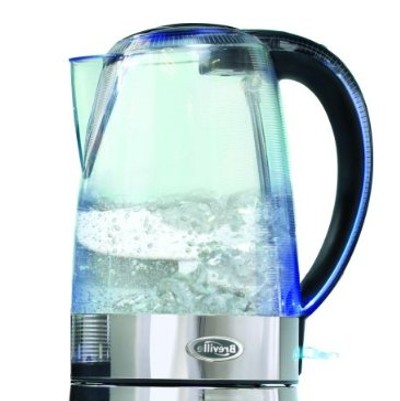
boiling kettleThe phrase ‘a watched kettle never boils’, or a watched pot as Americans might prefer say, is a familiar phrase.  We have probably all stood waiting for water boil thinking it is taking a long time.  This might be in part because the rate of boiling does indeed slow down during the heating process and then speed up towards the end.

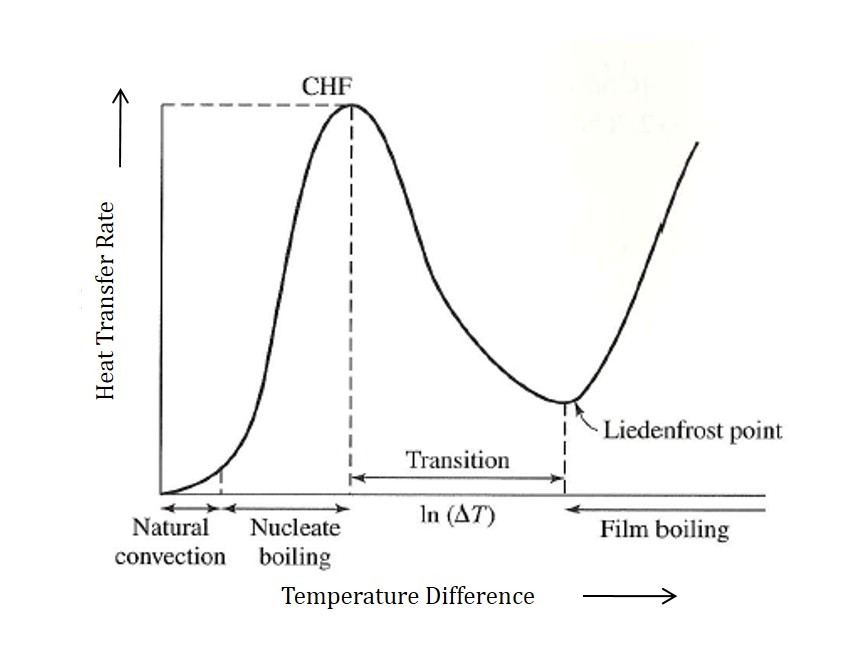
When an electric kettle is first switched on the element in the bottom of the kettle heats up causing heat to be transferred by conduction to the water.  The water adjacent to the element rises in temperature becomes less dense, moves towards the surface and transfers heat by natural convection to the contents of the kettle.  As the temperature of the water rises, tiny bubbles form on the element due to local boiling.  Bubbles are dislodged by new ones forming and float up to the surface giving the appearance that complete boiling is imminent.  However, as the temperature rises further the element becomes completely covered by a film of vapour that insulates the element from the water and slows down heat transfer to the water.  This delays boiling until the element has pumped enough energy (heat) into this film for heat transfer to occur across it from the element to the water. Sections of the film tend to break away and belch onto the surface of the water.  This process of large bubble formation and belching on the surface usually establishes itself fairly quickly once the first one has broken free and we see the familiar violent boiling of the kettle.

So the watched kettle has boiled but only after what might have seem like an interminable delay.  If you have a transparent electric kettle then you can watch this happen, otherwise you could watch a YouTube video – possible the most boring video on YouTube?

The process described above is known as the Liedenfrost effect and is illustrated graphically in the chart below, which is based on Figure 6.16 in ‘The Design and Simulation of Thermal Systems‘ by NV Suryanarayana and Oner Arici published by McGraw-Hill.  There are a number of more comprehensive explanations available, for example by Jearl Walker.  The Leidenfrost effect is also responsible for the way water disperses in liquid droplets across a very hot surface instead of evaporating as steam, see this Youtube clip for more explanation.

boiling graph


Hot particles

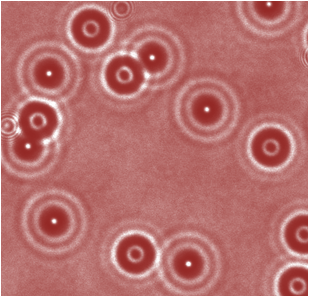
diffraction pattern from nanoparticlesHave you ever wondered why people visiting the site of the Fukushima nuclear accident are only dressed up in coveralls and masks?  In my post on December 18th entitled ‘Hiding in the Basement’, I explained that gamma radiation requires a sheet of lead to stop it so the coveralls are clearly not protecting Fukushima visitors against radiation.

Our bodies cope with low levels of radiation everyday because we absorb about 0.024 Sieverts per year from the natural environment and the same amount is absorbed during a full-body scan in hospital.  One Sievert is equivalent to 1 Joule absorbed per kilogram of body mass. If you hold a tennis ball as high above your head as you can reach and let it fall to the ground, then the ball hits the ground with about 1 Joule of kinetic energy.  Your heart uses about 1 Joule of energy per beat.

The estimated maximum dose received by residents living close to Fukushima was 0.068 Sieverts or about three annual doses.  The visitors’ coveralls and mask are protecting them from ‘hot’ particles that are often produced during a nuclear accident. ‘Hot’ particles can be inhaled or ingested and continue to emit radiation when inside the body thus delivering a large concentrated dose to a relatively small number of surrounding cells, which are disrupted and destroyed by the high-levels of energy.  ‘Hot’ particles are small pieces of radioactive material and vary in size from tens of nanometres to a few millimetres, so that they don’t have high penetrating power and can be detected using a Geiger counter.

Hiding in the basement

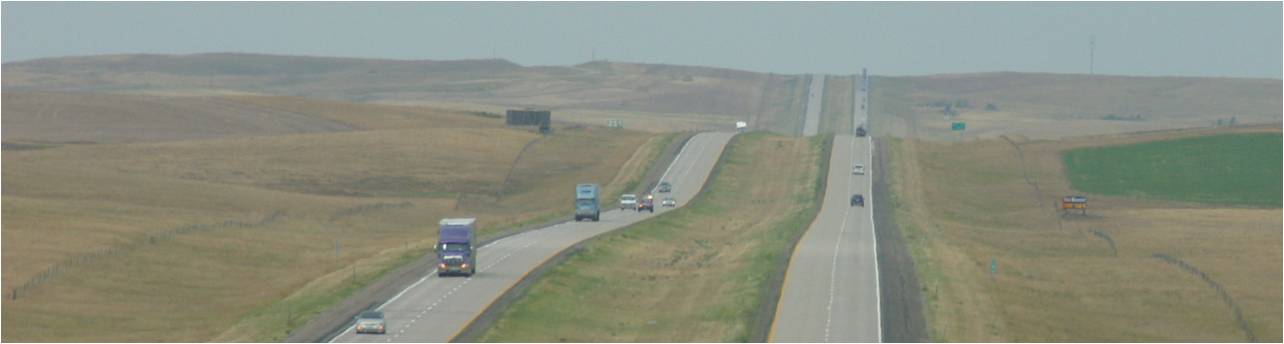
us highwayWhen we lived in the USA, I remember seeing billboards along the Interstate with messages from FEMA telling us ‘Be Ready’, to prepare, to plan, and to stay informed.  I was never quite sure what we were meant to be ready for since we lived in rural Michigan where we were fortunate not to experience violent weather and to be far from industrial plants that might explode and shower us with chemicals or radiation.  The billboard advertised the FEMA website [www.ready.gov] which contains very little factual information about radiation but does imply you should seek shelter in the basement of tall buildings in the event of a nuclear accident. Some commentators have suggested that the psychological effects arising from fear of nuclear radiation can cause more health issues than the dosage received especially for those not in the immediate vicinity of an incident.  So, knowing more about radiation in advance of an incident would be helpful and might also dispel many of the fears that cause opposition to nuclear energy.

So, does sheltering in a basement offer reasonable protection?  Well, radiation is produced when radioactive materials decay and their atoms release protons and neutrons from their nucleus plus some of the electrons that orbit the nucleus.  The protons and neutrons cluster together to form alpha particles (actually Helium nucleii) that are relatively massive and can stopped by a sheet of paper.  The electrons, known as beta radiation, whizz out at high-speed but can be stopped by a thin sheet of Aluminium.  High-energy photons are also released with the electrons and are known as Gamma radiation, which requires a sheet of lead or a considerable thickness of concrete to stop them.

So sheltering in the basement is a good idea especially if the building above contains a substantial amount of concrete.

Sources:

http://www.ready.gov/nuclear-power-plants

David Ropeik, Fear vs. radiation: The mismatch, in the International New York Times, Tuesday October 22, 2013. http://www.nytimes.com/2013/10/22/opinion/fear-vs-radiation-the-mismatch.html?_r=0