Category Archives: sustainability

Water, water, everywhere

Wood engraving illustration of the Ancient Mariner by Gustave Dore

Wood engraving illustration of the Ancient Mariner by Gustave Dore

Water, water, every where,
And all the boards did shrink;
Water, water, every where,
Nor any drop to drink.

These lines are from the Rime of the Ancient Mariner by Samuel Taylor Coleridge published in 1798.  They were brought to my mind when I was looking at the data in the GIO report on ‘Water’ that I mentioned in my post entitled ‘Closed system: water’ [17th July, 2013].

The quantity of water used to produce some everyday familiar items is staggering, for instance 140 liters to make one cup of coffee [growing the beans, harvesting, transporting and processing them], or 1,300 litres for a kilogram of wheat resulting in 40 litres per slice of bread but that is tiny compared to 1800 litres for a 4oz beef burger.  You might be reading this in a part of the world that is constantly, or at least frequently, deluged with rain and so be thinking that none of this matters, except that much of what you consumes probably comes from a part of the world where water is less readily available and massive civil engineering projects are required to ensure an adequate supply, which have enormous ecological consequences.

And that pair of jeans you are probably wearing, well, they required 10,855 litres of water!
Click to access ibm_gio_water_report.pdf

Closed system: water

gio_waterSometime ago I wrote about the need to consider the planet as a closed system, i.e. a system to which no new mass is being added, other than the occasional meteor from space [see my posts ‘Closed systems in nature?’ and ‘Open-world mind-set’ on December 21st, 2012 and January 4th, 2013, respectively].  This closed system approach applies to water.  The total amount of water on the planet does not change and it has been moving around the hydrologic cycle for thousands of years.  Mankind interacts with this cycle changing the chemistry, usefulness and availability of water.  All of us contribute to these changes in a small way but 6.5 billion of us make a big impact.

Most of us are aware of pollution to rivers and groundwater caused by use of fertilizers and pesticides.  We are perhaps less aware that removing groundwater for irrigation, industrial processes and domestic consumption can reduce water pressure underground in coastal regions causing saltwater to percolate and mix with freshwater reserves.  Or that discharges from desalination plants increases the local salinity of seawater while carbon emissions in the atmosphere is sequestered by the oceans raising water acidity levels.  All of these effects can damage ecosystems.

80% of available freshwater resources in the world are used to grow food.  Yet, we also need it in huge quantities for industrial processes, for instance it requires 10 litres of water to make a sheet of paper and 200 litres to make one kilogram of plastic.  Just as in energy consumption, there are huge global variations in daily domestic consumption per capita from 778 litres in Canada, 139 litres in the UK and India to 95 litres in China.

So, in addition to thinking about energy consumption when designing products and services, engineers need to think about water requirements since although there is a renewable supply it is not  infinite or even constant.

The data above was taken from ‘Water: A Global Innovation Outlook Report’ available at http://www.ibm.com/ibm/gio/media/pdf/ibm_gio_water_report.pdf

Impossible perfection

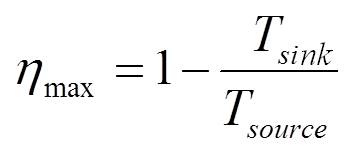
Carnot's equation for ideal efficiency of a cyclic device converting heat to work and operating between two temperatures specified on the Kelvin scale

Carnot’s equation for ideal efficiency of a cyclic device converting heat to work and operating between two temperatures specified on the Kelvin scale

In my last post [National efficiency on 29th May, 2013] I calculated the efficiency of the nationwide process of electricity generation in the UK [35.8%] and made no comment on the relatively low value.  It will be similarly in all industrialised countries as a consequence of the second law of thermodynamics and the requirement for all real processes to increase entropy.  A French engineer / scientist, Sadi Carnot [1796-1832] demonstrated from the second law, that the maximum efficiency achievable in ideal conditions by a process operating in a cycle to convert heat into work is a ratio of the temperatures of the heat source and cold sink to which excess heat is dumped.  In a power station the heat source might be a fossil-fuelled furnace, a nuclear reactor or a solar concentrator.  The cold sink is usually the environment, perhaps in the form of river or sea water.  So both source and sink temperatures are limited.  The sink by the local climate and the source by the temperatures that modern materials can withstand.

The very best efficiency based on Carnot’s expression for a maximum material temperature of 350 degrees Centigrade [=623 Kelvin] and environment temperature of 5 degrees Centigrade [278 Kelvin] is 55%.  Of course a real power station will never operate at this level because ideal conditions are not achievable – perfection is impossible.

The ideal efficiency improves as the operating temperatures of the heat source and sink are moved further apart and this quest to raise this temperature difference drives a substantial proportion of materials research.  However, even operating with a heat source at 800 degrees Centigrade, using expensive, high temperature alloys, such as Hastelloy N  [a nickel-chromium alloy], on a winter day in the Canadian capital, Ottawa where the average January daytime temperature is -7 degrees Centigrade, the Carnot efficiency of a power station would be only 75%  [=1-(266/1073)].

Energy blending

As I write this post, the electricity demand in the UK is 37.5 GW [=37,500,000,000 Watts].  The industry claims that wind turbines typically supply about 30 to 40% of their capacity, while the National Wind Watch in the US claims 15 to 30%.  In other words, a large wind turbine rated at 3MW [3,000,000 Watts] would will typically generate 1MW from its 50m blades that give it a total height of about 130m [about 30% higher than St Paul’s Cathedral in London].  So 37,500 such wind turbines would be required to meet current electricity demand in the UK, or one for every 1.6 miles on a square grid covering the country, which is why blending of energy sources is essential [see posting on May 15th, 2013 on Energy diversity].

We can do similar calculations for solar panels, which typically produce 250 Watts /square metre but for only perhaps 4 hours per day in the UK, so that 150 square kilometres of solar panels would be needed to meet current demand, if the sun was shining which it is not – another reason for blending energy sources.

Fossil fuel fired power stations make up 70% of the blend in the UK and are responsible for about 25% of the UK carbon emissions.  The UK government aims to reduce carbon emissions by 80% by 2050 (based on 1990 levels), so about 65% of the UK powerstations have to be changed in the next 35 years to provide a more sustainable blend of energy sources.  This is not long given the scale of the infrastructure projects required and the situation is the same in many countries around the world.  So there is plenty for engineers to do once the decisions have been made on the blend.

[ http://www.gov.uk/government/uploads/system/uploads/attachment_data/file/65897/5939-energy-flow-chart-2011.pdf ]

[ http://www.gov.uk/government/policies/reducing-the-uk-s-greenhouse-gas-emissions-by-80-by-2050 ]