Tag Archives: heat transfer

Zen and entropy

Picture1Last weekend I went to a performance of Handel’s Messiah in our local cathedral.  The atmosphere in the vast cathedral was wonderful and for part of the performance I was transformed into a zen-like state by the music.

However, there were quite of lot of disturbances during the performance including some that went beyond the usual coughing and sneezing.  It is interesting that a sneeze in the quiet environment of a cathedral or library causes a large disturbance while the same sneeze in a busy street goes unnoticed.  Of course, it is about the change in the noise level, and as a percentage, the added noise of a sneeze is much greater in the quiet library than the busy street.  Noise is a form of energy that becomes dispersed and dissipated as it propagates and so it is easy to equate it to heat which exhibits the same behaviour.  Heat transfers from hot to cold places while noise propagates from loud to quiet places, and neither does the reverse, which was Clausius’ observation that lead to the Second Law of Thermodynamics.  Clausius also defined change in entropy as the heat transfered divided by the temperature at which it occurs.  So the same heat transfer creates more entropy at low than at high temperatures, just as a sneeze causes more disorder/disruption in a quiet than a loud environment.  We can equate entropy to the level of disorder present in any system or environment.

And the second law of thermodynamics states that the entropy of an isolated system will always increase until it reaches a maximum at equilibrium.

On the beach

beachMaybe you are lying on the beach reading this, or if not dreaming about lying on the beach.  We enjoy lying on the beach, or next to a swimming pool, in part because it involves doing nothing and in part because of the heat transfer.  Heat transfer is transfer of energy from a high to a lower temperature zone.  It can occur in four ways: conduction, free convection, forced convection and radiation; and all of them occur on the beach on a hot day.

Conduction occurs as a flow of kinetic energy from one molecule to the next by direct contact.  When you are lying on the beach it occurs between you and the surface that you are lying on.  When you first lie down on hot sand, then the energy flows from the hot sand to your cooler body by conduction.

Free or natural convection is heat transfer carried by a rising current of fluid due to buoyancy effects created by the hotter fluid being less dense.  This tends to happen above your warm body after you have been lying in the sun for a while.  It also happens above the hot sand and you can sometimes see a heat haze caused by the rising hot air that has a lower density and thus different refractive index compared to the surrounding air.

Forced convection also involves heat transfer by a moving current of fluid but in this case the flow is caused by an external source.  So if there is breeze across the beach then you will be cooled by forced convection as you lie on the beach.

Radiation consists of electromagnetic waves in the infrared spectrum travelling away from a source in all directions.  This is the heat from the sun that makes it so pleasant to lie on the beach on a sunny day.

Ok, shut your eyes and go back to sleep.  The heat transfer lesson is over – though some of you might want to think about whether that breeze is really forced convection since it is probably caused by natural convection on a climatic scale.

Closed system on BBQ

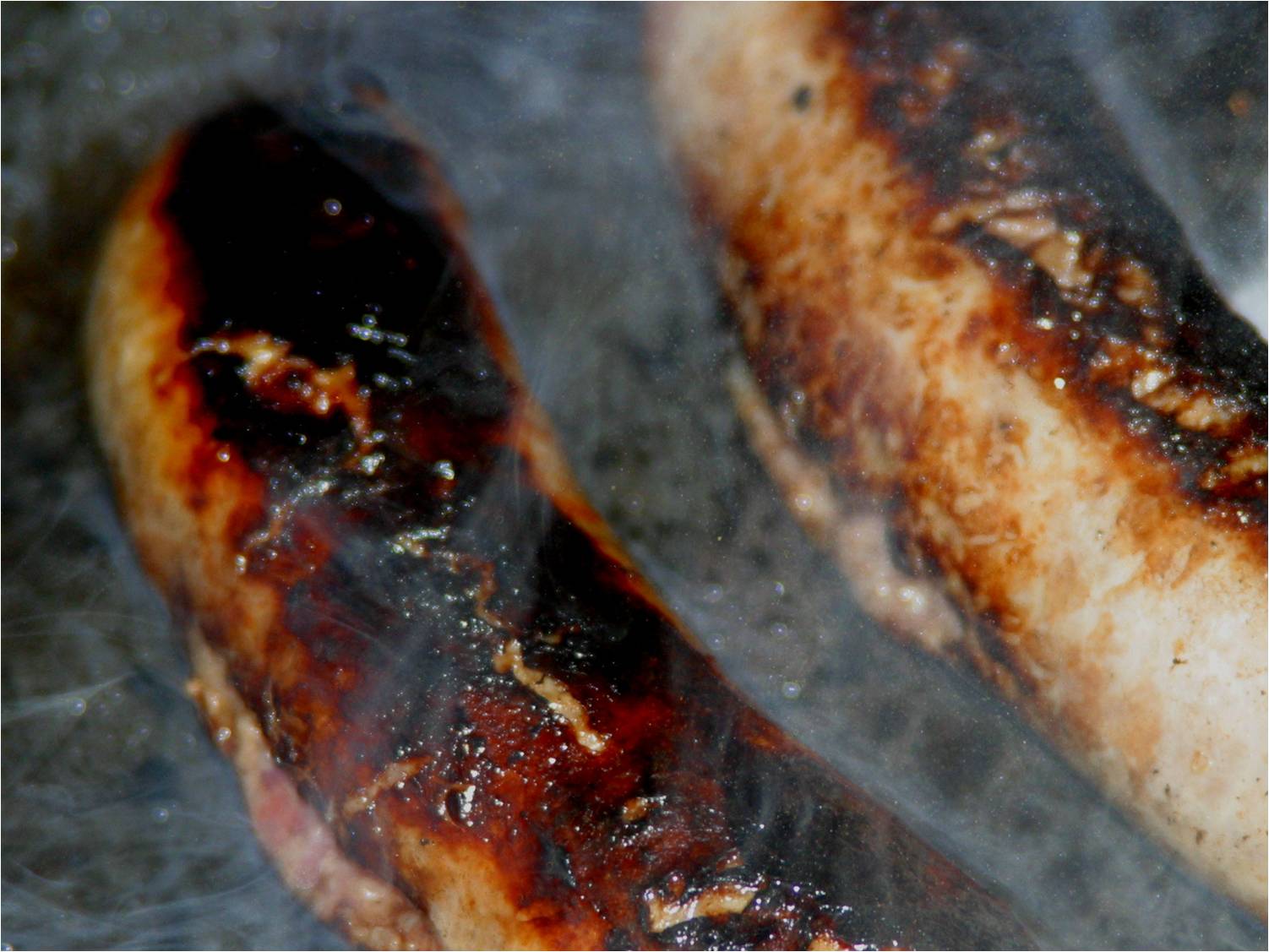
sausagecloseupMy post of December 21st, 2012 on ‘Closed systems in nature?’ is my most popular  based on the statistics from WordPress.  These statistics led me to go back and read it again, which set me thinking along the same lines while tending the barbeque in our backyard.  A sausage is a nice example of a closed system with a boundary, or skin, that is impervious to mass or material moving across the boundary but which allows energy transfer in the form of heat.

Heat transfers into the system [sausage] through the boundary [skin] adjacent to the hot charcoal in my barbeque and heat transfers out on the opposite side.  Heat is simply energy transfer that occurs along a temperature gradient or across a temperature difference, from a higher to a lower temperature.

The temperature difference between the hot charcoal at about 375 degrees Centigrade and a sausage starting to cook at about 70 degrees is larger than the difference between the sausage and the air above it at say 35 degrees Centigrade, so more heat [energy] is transferred into than out of the sausage.  The difference between the energy in and out is used to heat and cook the sausage including starting to boil the water-content and trigger chemical reactions associated with cooking.  This is a manifestation of the first law of thermodynamics for the closed system, i.e. heat transfer in minus heat transfer out equals the change in the energy content of the system.  The net flux of heat into the sausage causes it to get hot and be cooked.

You can’t avoid thermodynamics, it gets involved in everything!

Sonic screwdrivers

138-3816_IMG

No relevance except for the tranquility or absence of noise.

In a recent post on Noise Transfer [27th March, 2013] I highlighted the parallels between energy transfer by heat and noise.  In many cases, the heat and, or noise transfer is by-product of a process through which energy is dispersed to satisfy the requirements of the second law of thermodynamics, that entropy must increase as a product of all real processes.  Entropy, can be interpreted as a measure of dispersion, or the lack of availability to do anything useful and this applies to most heat and noise that we encounter in everyday life.

We can use concentrated sources of heat to produce useful work such as the furnace in a power station, but the second law of thermodynamics demands that we waste a substantial proportion of it through the creation of entropy.  It is also possible to use concentrated sources of noise, such as ultrasonic transducer to perform useful work for us, such as in surgery and the manufacture of composite materials [see Professional Engineering, http://profeng.com/features/good-vibrations ]; although an all-purpose sonic screw-driver of the kind used by Dr Who is not possible, yet.