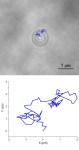
 Most of us have a sub-conscious understanding of the forces that control the interaction of objects in the size scale in which we exist, i.e. from millimetres through to metres. In this size scale gravitational and inertial forces dominate the interactions of bodies. However, at the size scale that we cannot see, even when we use an optical microscope, the forces that the dominate the behaviour of objects interacting with one another are different. There was a hint of this change in behaviour observed in our studies of the diffusion of nanoparticles [see ‘Slow moving nanoparticles‘ on December 13th, 2017], when we found that the movement of nanoparticles less than 100 nanometres in diameter was independent of their size. Last month we published another article in one of the Nature journals, Scientific Reports, on ‘The influence of inter-particle forces on diffusion at the nanoscale‘, in which we have demonstrated by experiment that Van der Waals forces and electrostatic forces are the dominant forces at the nanoscale. These forces control the diffusion of nanoparticles as well as surface adhesion, friction and colloid stability. This finding is significant because the ionic strength of the medium in which the particles are moving will influence the strength of these forces and hence the behaviour of the nanopartices. Since biological fluids contain ions, this will be important in understanding and predicting the behaviour of nanoparticles in biological applications where they might be used for drug delivery, or have a toxicological impact, depending on their composition.
Van der Waals forces are weak attractive forces between uncharged molecules that are distance dependent. They are named after a Dutch physicist, Johannes Diderik van der Waals (1837-1923). Electrostatic forces occur between charged particles or molecules and are usually repulsive with the result that van der Waals and electrostatic forces can balance each other, or not depending on the circumstances.
Sources:
Giorgi F, Coglitore D, Curran JM, Gilliland D, Macko P, Whelan M, Worth A & Patterson EA, The influence of inter-particle forces on diffusion at the nanoscale, Scientific Reports, 9:12689, 2019.
Coglitore D, Edwardson SP, Macko P, Patterson EA, Whelan MP, Transition from fractional to classical Stokes-Einstein behaviour in simple fluids, Royal Society Open Science, 4:170507, 2017. doi: 10.1098/rsos.170507.
Patterson EA & Whelan MP, Tracking nanoparticles in an optical microscope using caustics. Nanotechnology, 19 (10): 105502, 2009.
Image: from Giorgi et al 2019, figure 1 showing a photograph of a caustic (top) generated by a 50 nm gold nanoparticle in water taken with the optical microscope adjusted for Kohler illumination and closing the condenser field aperture to its minimum following method of Patterson and Whelan with its 2d random walk over a period of 3 seconds superimposed and a plot of the same walk (bottom).
 Four years ago I wrote a post asking whether there were any fundamental laws of biology that are sufficiently general to apply beyond the context of life on Earth [‘Laws of biology?‘ on January 16th, 2016]. I suggested Dollo’s law that diversity and complexity increases in evolutionary systems; the Hardy-Weinberg law about allele and genotype frequencies remaining constant from generation to generation; and the Michaelis-Menten law governing enzymatic reactions. Recently, I came across a simpler statement of the laws of biology proposed by Edward O.Wilson. He states that the first law of biology is all entities and processes of life are obedient to the laws of physics and chemistry; and the second law is all evolution, beyond minor random perturbations due to high mutation rates and random fluctuations in the number of competing genes, is due to natural selection. It seems likely that these simpler laws will be universally applicable; however, until we find evidence of extra-terrestrial life, they will remain untestable in a universal context unlike the laws of physics.


 Realize Engineering